John ESTRIDGE [11146]
- Born: 18 Jul 1732, St Thomas Basseterre St Kitts.
- Baptised: 30 Jul 1732, St Thomas Basseterre St Kitts.
- Marriage (1): Mary SEATON [11149]
- Marriage (2): Susanna [11369]
- Died: Sep 1778 aged 46

 General Notes: General Notes:
John was a beneficiary under the Will of his Grandfather Francis Phipps of St Kitts dated 12 April 1740 also his uncle Robert Phipps 19 May 1747
Ref: Caribbeana Page 358/59 Vol 2
A John Estridge's Will was proved PCC 1778 309 Hay
Also a John Estridge died England Jul or Aug 1794 proved PCC 412 Holman
Research Notes:
Many details of this family are revealed by this action resulting from the insolvency of John's estate. It has been brought, to determine the right to a cargo of sugar, but the backgound to the parties and sums of money involved is revealing.
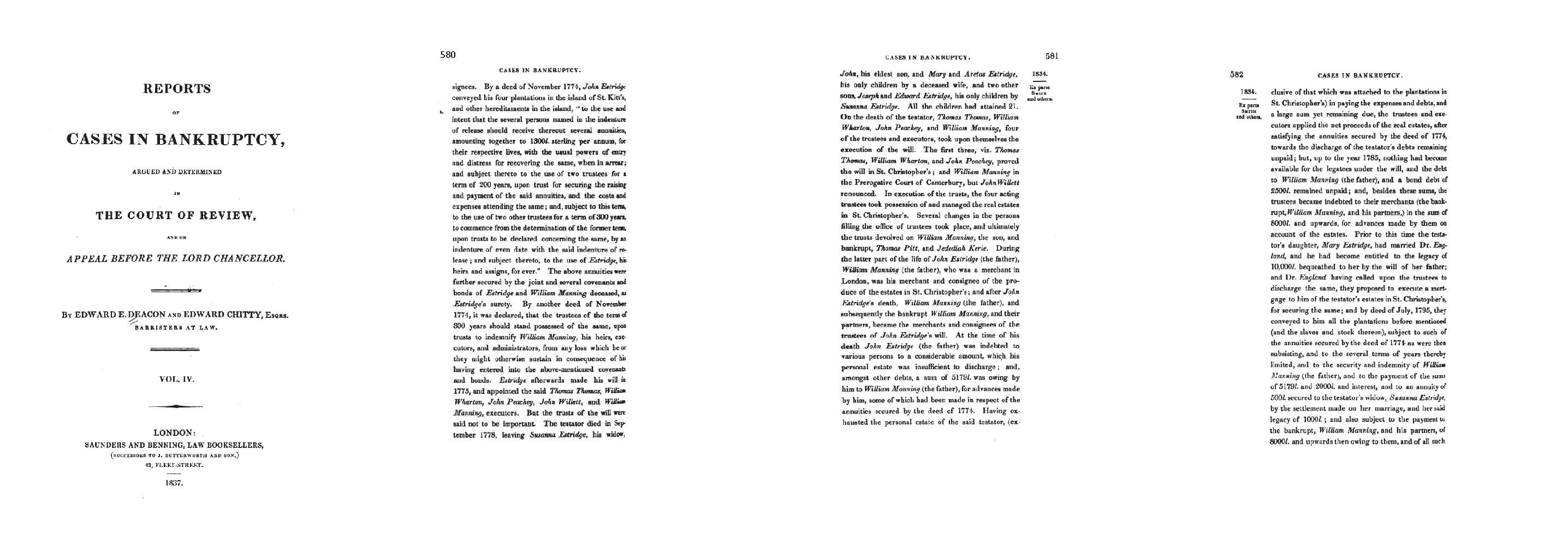
Reports of Cases in Bankruptcy
Argued and Determined in
The Court of Review and on
Appeal before the Lord Chancellor
by Edward E Deacon and Edward Chitty Esq.
Barristers at Law
Vol. IV.
Page 579
Ex parte Messrs Smith, Payne and Smith. In the matter of William Manning, Frederick Manning, and John Levicount Anderdon.On 1 September 1831, the commission issued, and Reid, Dixon, and Wrangham were chosen
Page 580
assignees. By a deed of November 1774, John Estridge conveyed his four plantations in the island of St Kitts and other Hereditments in the island, "to the use and intent that the several persons named in the indenture of release should receive theirout several annuities, amounting together to L.1300 sterling per annum for their respective lives, with the usual powers of entry and distress for recovering the same, when in arrear; and subject thereto to the use of two trustees for a term of 200 years upon trust for securing the raising and payment of the said annuities, and the costs and expenses attending the same; and, subject to this term to the use of two other trustees for a term of 300 years, to commence from the determination of the former term, upon trusts to be declared concerning the same, by an indenture of even date with the said indenture of release; and subject thereto, to the use of Estridge, his heirs and assigns, forever." The above annuities were further secured by the joint and several covenants and bonds of Estridge and William Manning deceased, as Estridge's surety. By another deed of November 1774, it was declared, that the trustees of the term of 300 years should stand possessed of the same, upon trusts to indemnify William Manning, his heirs executors, and administrators, from any loss which he or they might otherwise sustain in consequence of his having entered into the above mentioned covenants and bonds, Estridge afterwards made his will in 1775, and appointed the said Thomas Thomas, William Wharton, John Peachey, John Willett, and William Manning, executors. But the trusts of the will were said not to be important. The testator died in September 1778 leaving Susannah Estridge, his widow,
Page 581
John, his eldest son, and Mary and Aretas Estridge, his only children by a deceased wife, and two other sons Joseph and Edward Estridge, his only children by Susannah Estridge. All the children had attained 21.
On the death of the testator, Thomas Thomas, William Wharton, John Peachey, and William Manning for of the trustees and executors, took upon themselves the execution of the will. The first three, viz. Thomas Thomas, William Wharton, and John Peachey, proved the will in St Christophers; and William Manning in the Prerogative Court of Canterbury, but John Willett renounced. In execution of the trusts, before acting trustees took possession of and managed the real estate's in St Christophers. Several changes in the persons filling the office of trustees took place, and ultimately the trusts devolved on William Manning, the son, and bankrupt, Thomas Pitt, and Jedediah Kerry. During the latter part of the life of John Estridge (the father), William Manning (the father), who was a merchant in London, was his merchant and consignee of the produce of the Estates in St Christophers; and after John Estridge's death, William Manning (the father), and subsequently the bankrupt William Manning, and their partners, became the merchants and consignees of the trustees of John Estridge's will. At the time of his death John Estridge (the father) was indebted to various persons to a considerable amount, which his personal estate was insufficient to discharge; and, amongst other debts, a sum of L.5179 was owing by him to William Manning (the father), for advances made by him, some of which had been made in respect of the annuities secured by the deed of 1774. Having exhausted the personal estate of the said testator,
Page 582
(exclusive of that which was attached to the plantations in St Christophers) in paying the expenses and debts, and a large sum yet remaining due, the trustees and executors applied the net proceeds of the real estates, after satisfying the annuities secured by the deed of 1774, towards the discharge of the testator's debts remaining unpaid; but, up to the year 1785, nothing had been available for the legatees under the will, and the debt to William Manning (the father), and a bond debt of L.2500 remained unpaid; and, besides these sums, the trustees became indebted to their merchants (the bankrupt, William Manning, and his partners,) in the sum of L.8000 and upwards, for advances made by them on account of the estates. Prior to this time the testator's daughter, Mary Estridge, had married Dr England, and he had become entitled to the legacy of L.10,000 bequeathed to her by the will of her father: and Dr England having called upon the trustees to discharge the same, they proposed to execute a mortgage to him of the testator's estates in St Christophers, for securing the same; and by deed of July, 1795, they conveyed to him all the plantations before mentioned (and the slaves and stock thereon), subject to such of the annuities secured by the deed of 1774 as were then subsisting, and to the several terms of years thereby limited, and to the security and indemnity of William Manning (the father), and to the payment of the sums of L.5179 and L.2000 and interest and to an annuity of L.500 secured to the testator's widow, Susannah Estridge, by the settlement made on her marriage, and her said legacy of L.1000; and also subject to the payment William Manning, and his partners, of L.8000 and upwards then owing to them, and of all such
Page 583
other sums of money as should thereafter become due to them from the trust estates for monies advanced or to be advanced by them over and above the clear yearly produce of such trust estates in order to keep up the estates and the several yearly payments necessarily to be made under the deed of 1774 and the will with interest for such advances advances and subject to redemption on payment of the legacy of L.10,000 and interest. . . . . . continues to page 603.
http://books.google.co.nz/books?id=NwU0AAAAIAAJ&pg=PA1028&lpg=PA1028&dq=Reports+of+Cases+in+Bankruptcy+Argued+and+Determined+in+The+Court+of+Review+and+on+Appeal+before+the+Lord+Chancellor+by+Edward+E+Deacon+and+Edward+Chitty+Esq.&source=bl&ots=HiQdif7ZjB&sig=HB9SY3xTlHZ0wDWs5bSdmnb2IJ8&hl=en&sa=X&ei=H8cXU7uZFInXkAWFnYHIAg&ved=0CCUQ6AEwAA#v=onepage&q=Reports%20of%20Cases%20in%20Bankruptcy%20Argued%20and%20Determined%20in%20The%20Court%20of%20Review%20and%20on%20Appeal%20before%20the%20Lord%20Chancellor%20by%20Edward%20E%20Deacon%20and%20Edward%20Chitty%20Esq.&f=false
John married Mary SEATON [11149] [MRIN: 3721], daughter of SEATON [18773] and Unknown.
John next married Susanna [11369] [MRIN: 3804]. (Susanna [11369] died after Sep 1778.)
|