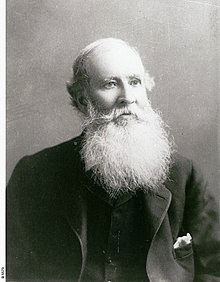
James Collins HAWKER [14743]
- Born: 8 Apr 1821, Titchfield HAM
- Marriage (1): Louisa LIPSON [14744] on 25 Oct 1850 in Holy Trinity Adelaide SA
- Died: 15 May 1901, Ashford North Adelaide SA aged 80

 General Notes: General Notes:
James was Comptroller of Customs Adelaide SA
Genealogy SA website
Groom Surname: HAWKER
Groom Given Names: James Collins
Bride Surname: LIPSON
Bride Given Names: Louisa
Marriage Date: 25-Oct-1850
Marriage Place: Holy Trinity Church Adelaide
Groom Age: 29
Groom Marital Status: S
Groom Father:
Bride Age: 21
Bride Marital Status: S
Bride Father:
District: Adelaide
Book/Page: 4/171
Mr. James Collins Hawker, whose Masonic jubilee was lately celebrated, is the third son of the late Admiral Edward Hawker, of Ashford Lodge, near Petersfield, Hampshire, and Cavendish-square, London, and, was born at Catsfield, Hampshire, April 10, 1821. In his youth he was for some, years under private tuition in France, Switzerland, and Italy, afterwards at a school in Walthamstow, Essex, and finally at the High School, Tavistock square,. London. In 1838 he came put to ,the colony with His Excellency Lieutenant Colonel Gawler, K.H., and acted for some time as extra A.D.C. and assistant in the Private Secretary's office, and was subsequently appointed junior officer to a Government survey party, of which Sir. J. McLaren was senior, afterwards Deputy Surveyor-General. Mr. Darke was second, murdered by the natives near the Gawler Ranges several years later, and Mr. Counsel third officer. John MacDouall Stuart, the famous explorer, was draftsman to the party. Mr. Hawker was engaged on sectional surveying under Captains Sturt and Frome, R.E., Surveyor-Generals, from near St. Mary's to Maclaren Vale, and then laying off a road via Willunga to Encounter Bay. In March 1840, he resigned his appointment on the survey, and in April left by the Katherihe Stewart Forbes, Captain Fell, for Englaud, Captain Grey (afterwards' Governor of South Australia) and Mrs.Grey being also passengers; The passage was a very " prolonged one, owing first to a leak, obliging the vessel to be taken to Mauritius for repair, and afterwards a shortness of provisions necessitating their putting into St. Helena and Corvo, one of the Western Islands, for supplies. These circumstances caused the passage to occupy 163 days. On arrival in England Mr. Hawker found that his brothers George and Charles had left some two months before for South Australia, with tbe intention of settling there if sufficient inducement; offered. Mr. Hawker therefore decided to return to the colony, and on December 4, 1840, he left by the Siam, Captain A. Smith. The passage occupied 135 days, owing to calling at Rio do Janeiro for provisions. The vessel arrived at Holdfast Bay on April 25, 1841. Ten days after his arrival Mr. Hawker volunteered as one, in a party of ten, under command of Lieutenant Field, R.N., to try and recover a large number of sheep taken by the natives of the Ruins, River Murray, from messrs Inman and H. Field on their overland journey from New South Wales. The expedition unsuccessful, owing to the smallness of the party and the large number of natives opposed to them, estimated by Lieutenant Field at between 200 and 300 men. In the encounter Lieutenant Field was wounded in the head, his horso badly speared as was one of the other horses, and one horse was killed. On return to Adelaide an expedition was organized under command of Major O'Halloran, aud Mr. Hawker was appointed commissary to the party, which was successful to a certain extant by protecting the survivors of Mr. Langhornes cattle overland party and recovering the bulk of the cattle the party having been attacked some days previous near Lake Victoria, on which oocasion four men were, killed and two badly wounded. Mr. Hawlter and his brothers purchased sheep, and located, themselves near where the township of Nuriootpa now stands, but shortly afterwards they had to move along owing to the purchase by the late Captain Bagot on behalf of Sir M Featherstonhaugh, of a special survey which included the run they were occupying. They therefore moved to the North about ten miles down the Hutt River from Clare, and the temporary station was formed at a native well, in which water was good, that in the river being very brackish. Messrs. George and Charles Hawker went out prospecting.for a better locality to move to. During their absence the water in the well suddenly ran out, and on December 22, 1811, Mr. James Hawker having discovered a fairly good supply, where the Bungaree Station now stands, transferred the sheep to that locality, where a good supply of permanent water was obtained by sinking. In 1842 the murders of settlers by the Port Lincoln natives at several outstations caused the Government to send over a detachment of the 96th Regiment to proclaim martial law and endeavour to capture and make an example of the murderers, but in this they were unsuccessful, as with exception of a few natives shot the rest took to the scrub. The farthest outstation from Port Lincoln was Mr. C. Dutton's formerly Sheriff of the Colony, and he finding his station quite untenable owing to the.great number of natives in the vicinity and their, hostile actions determined to start with his people and stock to make his way round the head of Spencers Guif and for this purpose he left his station in July 1842. When twelve weeks had elapsed, and no tidings had been heard of him, it was determined to start a light party to try and ascertain his whereabouts, and on September 14, a party started from Bungaree then the farthest station north of Adelaide the members being Messrs. James Baker, William Peter, James and Charles Hawker, and Billy, a New South Wales aboriginal. The party suffered great hardships from want of food and water and intense heat. A full description of the journey appears in Mr. J. W. Bull's work Early Experiences of Colonial Life, No. 45. The search party reached Port Lincoln on October 12, having passed on their way in the station of Messrs. Biddell and Brown, who, with all their people, had been murdered in the most cold-bloodod manner by the natives. No trace of Mr. Dutton was discovered by the search party, but at a later period it was ascertained through some natives that Mr. Dutton and all his part had been murdered. In 1813 Mr. Hawker sold his share in the Bungaree Station to his brother George, and went to Moorunde, on the River Murray, Mr. E. J. Eyre the explorer and late Governor of Jamaica, Mr. E. B. Scott, late Superintendentof Yatala Labour Prison, and Mr. Hawker being the first three settlers on the Murray. In 1844 Mr. Hawker took his boat up with Captain Sturts Expedition as far as Lake Bonney, and by request of Captain Sturt surveyed the creek supplying the lake with water from the Murray, and which Captain Sturt named Hawker's Creek, but Mr. J. Chambers forming a station there some years afterwards it was then called after him. The speculation on the Murray proving unsuccessful, Mr. Hawker was in 1817, appointed to H.M. Customs, Port Adelaide us a landing waiter, later on as Tide Surveyor, and then Measuring Surveyor of Shipping to the Board of Trade, A revenue station was erected at Hawker's Creek Glanville, for the use of himself and boats crews. In 1863 he was appointed Comptroller of H. M. Customs. Mr. Hawker initiated in 1860 the first rowing club at Port Adelaide, called the "Pelican," of which he was captain and an oarsman for many years. Mr. Hawker was married on October 24. 1850, to Louisa, youngest daughter of Captain Lipson, R.N., who with his family, arrived in the colony prior to the proclimation in 1836, Captain Lipson having been appointed Naval Officer and Harbormaster by the Admiralty, subsequently, by the Local Governments, Collector of Customs, and head of the Trinity Board. In 1853 Mr. Hawker was offered the Assisting Commissionership of Crown Lands and Special Magistracy at Port Lincoln, which he declined, preparing to remain in the Customs Department. In August 1872, he took his retirement, after having served nearly twenty five years in the Customs and entered into business as land and station agent, which he still carries on. Mr. Hawkser has been a Freemason for half a century, having been initiated in the Lodge of Friendship, No.423, E.C., now No. 1.
S.A.C., in 1817. He was incalled as W. M. in 1863. and the same year was appointed Grand Registrar of South Australia, and was installed as W. M. of the Mark Lodge, 41, E.C., also elected P.Z. of the Royal Area Chapter, 423, E.C. He is one of the founders of the Lodge of St. Albans, 38. S.A.C., and in April last was elected an honorary member of the Lodge of Friendship, No. 1 SAC. Mr. Hawker has been noted for very many years past as a keen sportsman with gun and rod and in conjunction with the late Mr. John Newman, organized in 1868 the first gun club in the colony, called after His Excellency Colonel Hamley, the "Hamley Gun Club." Of this His Royal Highness the Duke of Edinburgh was patron, and on the oocasion of his visit to the colony attended and shot at a meeting of the club, and won a match.
Ref: Evening Journal (Adelaide, SA : 1869 - 1912) Sat 24 Apr 1897 Page 5
Obituary
THE LATE MR. J. C. HAWKER. AN INTERESTING CAREER.
Mr. James Collins Hawker, one of the oldest colonists in the State, died at his residence, Strangways terrace, North Adelaide, at 8 o'clock on Wednesday morning. The deceased, who attained his eightieth birthday on April 10, 1901, was the third son of the late Admiral Edward Hawker, of Petersfield, Hampshire, and was born at Catsfield, in the same English county. After an educational career in French, Swiss, and Italian academies his scholastic studies were completed at the High School in Tavistock square, London. He came to South Australia in 1838, the year following its proclamation, with His Excellency Lieut.-Col. Gawler, whom he served as extra aide-de- camp and assistant in the private secre- tary's office. Subsequently he received ap- pointment on a Government survey party, led by Mr. J. McLaren (afterwards Deputy Surveyor-General), acting under that gen- tleman as junior officer. Mr. Hawker was engaged on sectional surveying on the South road, from near "Old St. Mary's" to Willunga, and also laid off a road between the latter place and Encounter Bay. The Surveyor-Generals at that time were Capts. Sturt and Frome. The famous explorer, in whose memory the erection of a monument is at the present time being discussed, John MacDouall Stuart, was draftsman to the party; the second officer was Mr. Darke (subsequently murdered by natives near the Gawler Ranges), and the third officer Mr. Counsell. In March, 1840, Mr. Hawker resigned the position on the sur- vey, and in the following month left for England in the ship Katherine Stewart Forbes, Captain Fell, with Captain Grey (afterwards Governor of South Australia) and Mrs. Grey as fellow-passengers. A leak being discovered in the vessel she had to put in at Mauritius for repairs, and short- ness in the commissariat also necessitated calls at Mauritius and Coroo (one of the western islands) for provisions; so that pas- sage occupied 168 days. Finding on arrival in England that his brothers George (after wards the Hon. G. C. Hawker) and Charles had left two months before for South Aus- tralia, with the intention of settling in the colony, Mr. Hawker returned in December of the same year by the Siam, Captain A. Smith, and after a voyage of 136 days, which included a call at Rio Janeiro for supplies, Holdfast Bay was reached on April 25, 1841. Ten days after his arrival Mr. Hawker volunteered to act under command ot Lieut. Field, R.N., as one of a party of 10 to endeavour to recover a large number of sheep which had been taken, by natives of the Rufus, on the River Murray, from Messrs. Inman and H. Field, on their overland journey from New South Wales. The party found themselves opposed by between 200 and 300 natives, and were compelled to return unsuccessful, with their commander wounded in the head, and his horse badly speared. Another horse was similarly wounded, and one was killed outright. Mr. Hawker afterwards went out as commissary under command of Major O'Halloran, and their force succeed- ed in protecting the survivors of Mr. Lang- horne's cattle overland party, which had been attacked a few days before, and four of its members killed, and two badly wounded. The bulk of the cattle were also recovered. Mr. Hawker then settled down with his brothers, and the trio engaged in sheepfarming at Nuriootpa, but the purchase of the special survey, which included their run, by the late Captain Bagot, on behalf of Sir M. Featherstonhaugh, com- pelled their removal. Ten miles down the Hutt River from Clare, in the north, they founded a temporary station at a native well, where the water was good, that in the river being brackish. During the ab- sence of the brothers George and Charles on a prospecting tour the water in the well suddenly gave out, and on December 22, 1841, Mr. Jas. Hawker discovered a fair permanent supply at Bungaree, which was improved by sinking, and transferred his stock to that locality. In 1842 the murders of settlers by the Port Lincoln natives at several outstations caused the Government to send over a de- tachment of the 96th Regiment, proclaim martial law, and endeavour to capture and make an example of the murderers, but in this they were unsuccessful, as with the exception of a few natives shot the rest took to the scrub. The farthest outstation from Port Lincoln was Mr. C. Dutton's (former- ly Sheriff of the colony), and he, finding his station quite untenable owing to the great number of natives in the vicinity, and their hostile action, determined to start with his people and stock to make his way around the head of Spencer's Gulf, and for this purpose left his station in July, 1842. When 12 weeks had elapsed, and no tid- ings had been heard of him, a light party, to try and ascertain his whereabouts, started from Bungaree then the furthest station north of Adelaide on September 14, the members being Messrs. James Baker, William Peter, James and Charles Hawker, and Billy, a New South Wales aboriginal. The party suffered great hard- ships from want of food and water and in- tense heat. The search party reached Port Lincoln on October 12, having passed on their way the stations of Messrs. Biddell and Brown, who, with all their people, had been murdered in the most cold-blooded manner by the natives. No trace of Mr. Dutton was discovered by the search party, but at a later period it was ascertained through some natives that Mr. Dutton and all his party had been murdered. In 1843 Mr. Hawker sold his share in the Bungaree Station to his brother George, and went to Moorundie, on the River Murray. Mr. E. J. Eyre, the explorer, and formerly Governor of Jamaica, Mr. E. B. Scott, late Superintendent of Yatala Labour Prison, and Mr. Hawker, being the first three settlers on the Murray. In 1844 Mr. Hawker took his boat up with Captain Sturt's Expedition as far as Lake Bonney, and by request of that officer surveyed the creek supplying the lake with water from the Murray, and which Captain Sturt named Hawker's Creek, but Mr. J. Chambers forming a station there some years afterwards it was then called after him. The speculation on the Murray proved unsuccessful, and Mr. Hawker was, in 1847, appointed to H.M. Customs, Port Adelaide, as a landing waiter, later on as Tide Survevor, and then Measuring Surveyor of Shipping to the Board of Trade. A revenue station was erected at Hawker's Creek, Glanville, for the use of himself and boats' crews. In 1863 he was appointed Comp- troller of H.M. Customs. Mr. Hawker initiated in 1860 the first rowing club at Port Adelaide, called the "Pelican," of which he was captain and an oarsman for many years. Mr. Hawker wus married on October 24, 1850, to Louisa, youngest daughter of Captain Lipson, R.N., who, with his family, arrived in the colony prior to the proclamation in 1836, Captain Lipson having been appointed Naval Officer and Harbourmaster by the Admiralty, subsequently by the local Governments Collector of Customs and head of the Trinity Board. In 1853 Mr. Hawker was offered the post of Assistant Commissioner of Crown Lands, and also that of Special Magistrate at Port Lincoln, but declined to take either office, preferring to remain in the Customs Department. In August, 1872, Mr. Hawker retired from the service after nearly a quarter of a century in the Customs branch, and entered into private commercial life, establishing the business of land and stationary agency and surveyor, which is still carried on under the style of James C. Hawker & Son. Mr. Hawker was one of the oldest mem- bers of the Masonic craft in this State. He was initiated in the Lodge of Friendship, the first lodge that was formed in South Australia, on January 27, 1847; a year later he was appointed its secretary, and in 1863 received elevation to the worshipful master's chair. Here his distinctive abili- ties made themselves manifest in an es- pecial degree; in the same year he was ap- pointed senior grand deacon in the Pro- vincial Grand Lodge, and succeeded in 1864 to the responsible office of Provincial Grand Registrar of South Australia. Mr. Hawker at various times held many other high positions in the order, including the chief chair of the Mark Lodge, No. 41, E.C., and the First Principalship of the Royal Arch Chapter, No. 423, E.C. Lodge St. Alban, No. 38, S.A.C., also owns him as one of its founders. On March 4, 1897, the Lodge of Friendship, No. 423, E.C. (now No. 1, S.A.C.) presented Mr. Hawker with the portrait in oils of himself, which now hangs in the Masonic Hall, Flinders street, in commemoration of his masonic jubilee. It was remarked at the celebration that, although the lodge charter had been granted 63 years before, Mr. Hawker was the first member whose jubilee had been celebrated. His devotion to the interests of the order had largely helped to ensure its continuance in South Aus- tralia, when, at the end of the sixties es- pecially, little enthusiasm was shown by the brethren in the work of the lodge. At the time of his jubilee Mr. Hawker was elected an honorary member of the Lodge of Friendship. Mr. Hawker was noted as a keen sports- man with gun and rod, and in conjunction with the late Mr. John Newman organized in 1868 the first gun club in the colony, called after His Excellency Colonel Hamley the "Hamley Gun Club." Of this His Royal Highness the Duke of Edinburgh was patron, and on the occasion of his visit to the colony attended and shot at a meeting of the club, and won a match. On October 24, 1900, Mr. and Mrs. Haw- ker celebrated their golden wedding. Mrs. Hawker is the youngest daughter (Louisa) of Captain Lipson, R.N., who at the time of the marriage, which took place in Tri- nity Church, Adelaide, was harbourmaster and port officer at Port Adelaide. The pa- pers of the day contained interesting refer- ences to the celebration of the nuptials, and, among other things, stated that the ships in the harbour hoisted their colours, and that every house on shore was decorated with flags. "In fact, all the bunting that could be mustered was exhibited on the oc- casion, the road from the custom-house to Venn's being a row of flags, sus- pended from side to side, and un- der which the carriages had to pass." Among the guests at the wedding breakfast were His Excellency the Gover- nor, Sir Henry Young, Lady Young, and the Chief Justice. Some amusement was caused at the time by the publication of the following lines in a local paper: -
AN HYMENEAL DILEMMA. "Marry by banns?" the fair Louisa-cried, "I'll ne'er to such vulgarity consent; Pray understand I've too much proper pride To have it said we through that ordeal went." "Then," quoth the.bridegroom, "we shan't wed- that's plain, None here a Hawker's licence can obtain." "Well, said the beauty with a pretty pout, While love from each bright twinkler sparkles out. "Sooner than lose you, dearest James, I think they may call out our names." The career of few old colonists was better known than that of Mr. J. C. Hawker, sen., and his series of interesting reminiscences of colonial episodes which he has lately contributed to "The Register" have been read with keen appreciation. Mr. Hawker has left a widow: three sons, Messrs. E. Lipson Hawker, of Brisbane; Major J. C. Hawker, of the Permanent Ar- tillery (who was major and adjutant in the first Imperial contingent, under Colonel Rowell) ; and Mr. Thomas Lipson Hawker, of Sydney; and five daughters. Mrs. J. N. Blyth, of Melbourne; Miss Edith L. M. Hawker, of Adelaide; Miss Florence Ade- laide Hawker, of Melbourne; Mrs. Clark- son, wife of the chief engineer of H.M.S. Protector; and Mrs. J. McKenzie Henry, of Melbourne. The funeral will take place on Friday morning at North road cemetery.
Ref: The Register (Adelaide, SA : 1901 - 1929) Thu 16 May 1901 Page 6
Obituary
DEATH OF MR. J. C. HAWKER,
Mr. James Collins Hawker, of 'Ashford,' North Adelaide, has passed away at the age of 80 years. He was a son of the late Admiral Edward Hawker, R.N., who, in 1786 served in the Pegasus, under H.R.H. Prince William Henry, afterwards King William IV., and a son-in-law of the late Captain Thomas Lipson, R.N., who served under Lord Nelson. and was in many important engagements. For years Mr. Hawker had lived a quiet life at Strangways-terrace, North, Adelaide. He was a remarkably, vigorous man, full of activity; until over taken by the illness which ended his long career in South Australia. Mr. Hawker came to South Australia in 1838 with Governor Gawler, who was an old friend of his father, and who succeeded Captain Hindmarsh, R.N., the first viceregal representative in the colony. Colonel Gawler offered Mr. Hawker's father to take one of his sons to South Australia with him, and the offer being accepted, the deceased gentleman was the one chosen. He arrived in Adelaide with Governor
Gawler in October, accompanied the Governor on his official entry into the city, and witnessed the swearing-in at the Vice-regal residence. He remembered Port Adelaide in the days when it was a wretched mudhole, and it was there he met his father-in-law the late Captain Lipson, R.N. Captain Lipson was appointed in England harbormaster at Port Adelaide, and subsequently, in addition to his other offices, he was, in 1873, made first Collector of Customs in South Australia, which office was held some years afterwards by his son-in-law. In December, 1838, Mr. Hawker joined the party whiph conducted a survey on the Sturt River, led by Mr. J. W. McLaren, who was associated with the Ordnance Trignometrical Survey of Ireland and afterwards became
Deputy Surveyor General of South Australia. Mr. Hawker was fourth officer in that party, and in the following year was leader of a survey; party on the Oinkaparinga. Amongst the officers was Mr. James McDouall Stuart, the famous explorer, who was a draughtsman, and became a close friend of the deceased gentleman in after years. Mr. Hawker executed surveys in other parts of the colony, and having resigned from that department returned to Government House to assist in the Private Secretary's office. He was present at the public dinner given to Colonel Gawler in 1840, and in tho same year left for England in the ship Katherine Stewart Forbes. He returned again in the barque Siam. In 1841 the blacks had committed several outrages which necessitated the authorities taking prompt, measures to punish them. A company of volunteers, under Major O'Halloran Commissioner of Police, went out as a punitive expedition to deal with the natives, and amongst the party was Mr. Hawker. He was also measuring board surveyor for the Board of Trade in 1873, and Comptroller of Customs and landing surveyor in 1872. Mr. Hawker had to. relinquish the Customs Collectorship owing to the failure of his sight, and he then carried on an agency business in the city for some years. Mr. Hawker, unlike his brother, the late Hon. G. C. Hawker, took no part whatever in public life. He leaves three sons Major Hawker, of the Permanent Force, and Messrs. Edward Hawker, who is in Queensland, and Thomas Hawker, who is in New South Wales and five daughters, three of whom are married. Mr. Hawker was the author of Early Experiences in South Australia.
Ref: Chronicle (Adelaide, SA : 1895 - 1954) Sat 18 May 1901 Page 34
James married Louisa LIPSON [14744] [MRIN: 5223] on 25 Oct 1850 in Holy Trinity Adelaide SA. (Louisa LIPSON [14744] was born on 9 Sep 1829 in England. and died on 5 Aug 1918 in England..)
|