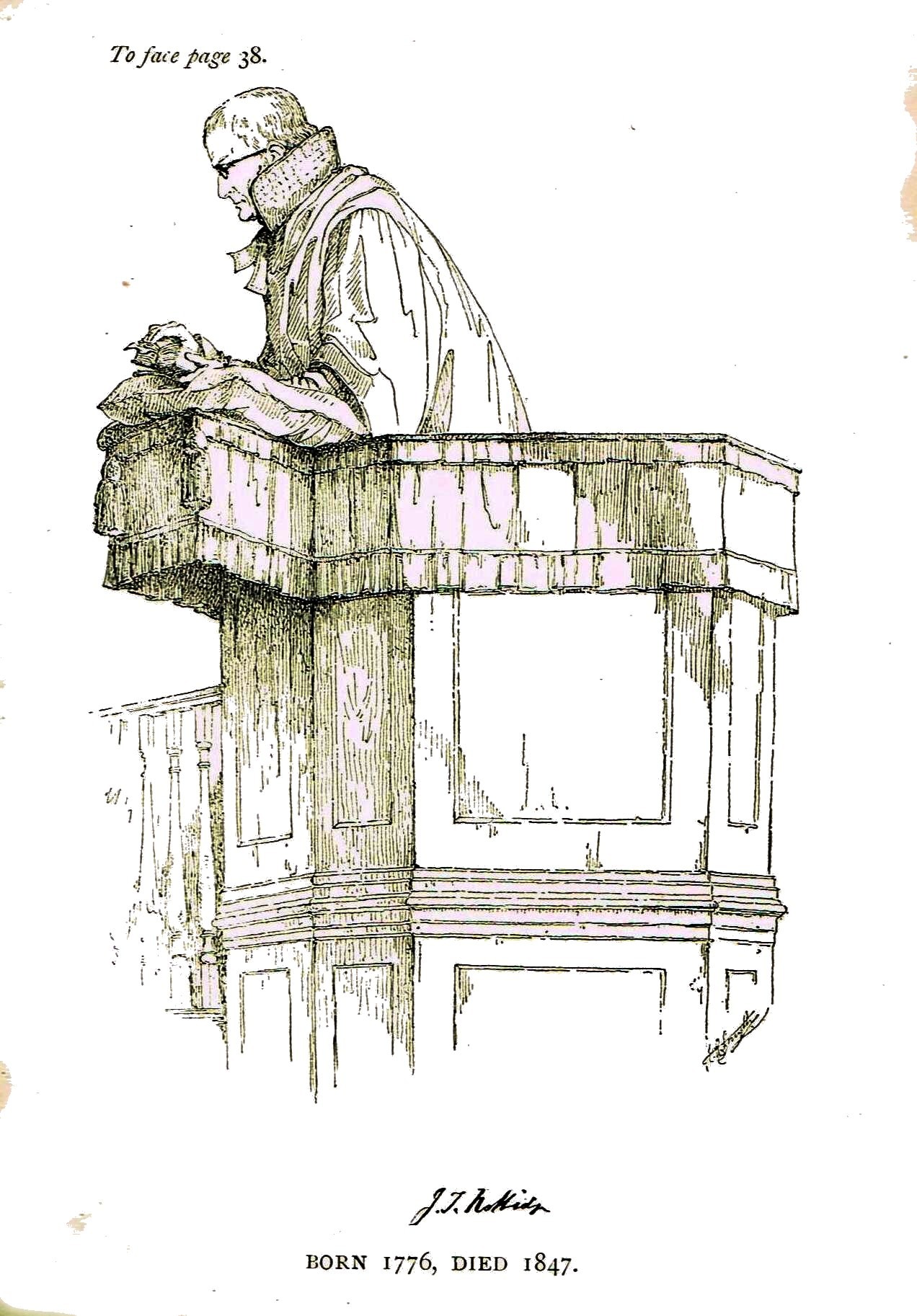
Rev John Thomas NOTTIDGE of St Helens Ipswich [1982]
- Born: 23 Feb 1776, Bocking ESS
- Baptised: 24 Feb 1776, St Mary Bocking ESS
- Marriage (1): Louisa ROBINSON [1971] on 7 Aug 1810 in St Luke Chelsea LND
- Died: 21 Jan 1847, The Grove Ipswich SFK aged 70

 General Notes: General Notes:
D-P 268-1-3 img117 son of Mr Thomas ... Privately Baptized. Publickly received April 25 (with Apr 1776 entries)
Ref: Freereg.
John Thomas. Nottidge
Adm. Fell.-Com. (age 17) at TRINITY, Jan. 26, 1793. [Only] s. of Thomas, of Bocking, Essex. [B. Feb. 23, 1776.] School, Charterhouse, London. Matric. Michs. 1796; B.A. 1797; M.A. 1800. Adm. at Lincoln's Inn, Oct. 28, 1794. Ord. deacon (London) May 19, 1811; priest, Feb. 23, 1812; C. of Halstead, Essex, 1811-21. V. of Old Newton, Suffolk, 1823. R. of St Helen's and St Clement's, Ipswich, 1821-47. Married Louisa. 'He was deservedly called "The father of the Clergy" at Ipswich.' Died Jan. 21, 1847, at The Grove, Ipswich. (Inns of Court; Clergy List; G. Mag., 1847, I. 447.)
John Thomas Nottidge Esq
Record Type: Marriage
Marriage Date: 7 Aug 1810
Marriage Place: St Luke, Chelsea, Kensington and Chelsea, England
Spouse: Louisa Robinson
Register Type: Parish Register
Deaths
John Thomas Nottidge
Registration Year: 1847
Registration Quarter: Jan-Feb-Mar
Registration district: Ipswich
Volume: 12
Page: 322
The Late Rev J T Nottidge.
Sorrowing multitudes assembled together on the 28th ult, to witness the obsequies of this lamented gentlemen, and to pay their last tribute of affectionate sympathy for the faithful pastor. The solemn ceremony of the internment was appointed to take place at St Helens Church at 1 o'clock, and accordingly, long before that hour, St Helens St on both sides, leading to the road which communicates with "The Grove" where the late residence of the deceased is situated, and where he breathed his last, was crowded with people, most of whom were in mourning attire. The houses and shops throughout the parishes of St Clement and St Helen had closed shutters, and during the funeral ceremony all business was suspended. Indeed all the classes offered the homage of the heart to one whose practical piety and unostentatious benevolence had for so many years cheered the hearts of the widow and fatherless, and raised the sorrowful from despondency to lively hope beyond the grave. Soon after 1 o'clock, the bell of St Helens Church having resumed its solemn peeling, the funeral cortege moved from the deceased's residence, in the following order: R W Porter, Esq and Mr Sawyer, churchwardens of St Clement; Mr T B Ross and Mr I Baker, churchwardens of Trinity district church; Mr J M Clark and Mr Long, churchwardens of St Helen, all wearing black silk hat bands, and having their wands of office covered with grape; 33 clergyman in full canonical's, with silk hat bands. These were succeeded by G G Sampson Esq Mayor of Ipswich, G Bullen Esq W C Fonnereau, Esq J Head, Esq. S Ray, Esq W May, Esq Capt Paget, Lt Bolton, R.N. W Cooper, Esq the Rev T Davidson. The coffin was covered with a black silk velvet pall, supported by 12 bearers. The chief mourner was Ralph Nottige, Esq, nephew to the deceased, with two other of his relatives, accompanied by the Rev C Bridges, the Rev C M Torlesse, and the Rev T B West, 4 dissenting ministers also joined the cortege, where the domestics, and about 100 of the parishioners of St Clement and St Helen, all in mourning attire, closed the procession. The body was met at the southern porch, by the Rev T Davidson, the officiating minister, who read the funeral service. The remains were deposited in a plain brick vault on the north side of the church, and the brass plate on the lid of the coffin exhibiting merely the name and age of the deceased. A more impressive scene we have not often witnessed, the body descending to its last resting place amid the sighs and tears of the hundreds who crowded the burial ground.
Ipswich Journal and Chelmsford Chronicle 5 February 1847.
On Sunday 31 January 1847 the Rev W W Woodhouse curate of St Clements Ipswich preached a sermon on the occasion of John Nottidge's death - "Barnabas a Good Man and full of the Holy Ghost and of Faith"
See the "Books" section on this website.
Ref: Courtesy of N. Brand Historian.
"John Thomas Nottidge's Correspondence" see "Books" section on this website.
Other Records
1. Rev John Thomas Nottidge: Letter to Charles Martin Torlesse, 3 Apr xvi (1816), Bocking ESS.
Ref Bygone Days Pages 187 - 189 see Books Section.
MY DEAR CHARLES,
" I have been much interrupted since I received your letter, and am seldom capable of being a very punctual correspondent. The impression I entertained of your being candidate for an University Scholarship arose solely from my being informed that you did not expect to succeed. For if you have to contend only with the men of your own college, even though some of them should be of a higher year, I did not think (all things considered) that you ought to have entertained any very appalling apprehensions. If the materials you possessed on leaving Dr. Butler, and the public and private lectures you have since received had been carefully attended to and regularly digested in an orderly manner in your own mind and memory, referring to such helps as were necessary to understand whatever difficulty occurred, I think you ought to be able to enter the lists with most men that even Trinity can furnish. There may be men of more talent and genius, but that does very little indeed at Examination, plain persevering labour is the only means of success. You say you have totally neglected your Classics since you have been at Cambridge. Here you see is more than half your time gone, and one most important subject of examination on which you are to depend for your future credit and for a fellowship, and for accomplishing that general success in your Academic pursuits which will reward your mother's anxiety and expence, as yet wholly neglected. I have no idea that this need have been the case with any young man of common industry, common talents, and common health. If indeed you have not yet habituated yourself to resolute application for a considerable part of every day, and if you do not regularly master every difficulty that can be mastered as it occurs in the course of your reading, then every other advantage will amount to nothing, the more you read the more you will be confused. And if you lay by any part of your studies for so long a time as you have the Classics, you will find that if you recollect anything of what has been so long neglected, what remains will be without any order or consistency, like the recollection of a dream, and when you come to Examination you will not be able to bring it forwards. Whatever subject you wish to retain and produce in an intelligible and creditable form, you must read a little of, if ever so little, constantly. 'The men of our year (you say) are very superior Classics.' How came they to be so Charles ? By labour, and persevering labour. This, with common advantages, will make anybody a good Classic, and you have had much more than common advantages and I hope the result of them will yet appear. As to getting up things for Examination I have
Page 188
no great opinion of any such process. But perhaps something of the following plan it might be worth your while to try. First keep fast hold on your Mathematics, and don't fall into the error of withdrawing your attention from them, but secure the means of doing yourself credit in the Department you have cultivated. Then give the rest of your time to reading Translations of the ancient Historians. And from the Translations as often as you come to any interesting period turn to the originals, and thereby make yourself master of the general style and all the grammatical peculiarities referring to the best grammatical works, and writing them down, and constantly examining yourself in them by memory. In the same manner exercise yourself in Chronology and I suppose Geography also, having dates and places always before you, and recollecting dates and drawing maps of particular places from memory. I don't know whether you ever tried Gray's Memoria Technica, a great deal may be so remembered if you take any fancy to the plan. This sort of exercise is the only road to the recollection of dates and grammatical peculiarities, they cannot be got up by any compendious method. The Translations will be a shorter way of getting at the matter of the Historians, as of course you will not have time to read the originals at length. Meanwhile you must translate and compose, and remember it is not how much but how well. Do a little constantly till the Examination and endeavour to catch the manner and spirit of the authors into whose language you translate. Write again as soon as you can and let me know when the Exam. takes place, and what books you resolve to undertake, and I will pick up any hints I can from Dr. Adams and other friends. Be determined and persevering and do your best, and if you do I am sure you will do yourself credit though you should not succeed, and you will feel your own strength for another struggle.
" Kind remembrances, "
Yours J. T. N.
"What have been the subjects of the Classical Lects. for this and the last year ?"
2. Rev John Thomas Nottidge: Letter to Catherine Gurney Torlesse nee Wakefield, 26 Mar 1827.
Ref Bygone Days Pages 190 - 191 see Books Section.
MY DEAR CATHERINE,
" How much I feel having by my foolish blunder missed seeing you the other day, I cannot easily tell, nor how gladly we would put the horses to and indemnify ourselves this very day from disappointment. But the tremendous calls of daily engagement are such, and during the Confirmation even rather more pressing than usual, that I feel compelled once for all to say that I fear my reduced strength does not encourage the hope of my being able for the future to do anything beyond barely creeping through the most obvious of ministerial duties, even so as to keep off the very strongest and most unanswerable convictions of gross neglect. Added to this, almost every other concern in which I am engaged has, by gradually accumulating neglect and arrear, got into such a state of perplexity that if I had no ministerial engagements at all, it might not improbably take all my disposeable time, and attention, to get my house in order before I die. "To have a little conversation and prayer with you at this particular juncture would be inexpressibly pleasing to me. But I can no more appoint a day for it than a man who is escaping out of a house on fire, or a commander exposed to the perpetual attacks of a vigilant and restless enemy. All I can say is that so long as I keep myself from hurry, and the indulgence of that tendency to complain, which great weakness is frequently occasioning, I neither droop nor despond, but see hope all along my road, and brighter at the end of it, persuaded that with all my sense of weakness and weariness I shall yet be made more than Conqueror thro' Him that loved us. While I insert our united love, I cast up my heart to Him Who can and will do more for us than we can ask or think.
" I remain your faithful and affect. friend, "
JOHN THO. NOTTIDGE.
" I cannot spare the sermon at present but will send it as soon as I can. I am very glad you intend visiting the parish throughout, you will find that all that is effectually done will be through the instrumentality of personal conversation. Give
Page 191
them texts of Scripture (not to learn by heart but to think of) on Xts Ministrations, on covenanting with Him, and a regular lecture at your schoolroom on the three parts of the Bapt. Coy. would afford the scheme for distributing the materials of personal conference. God be with your spirits."
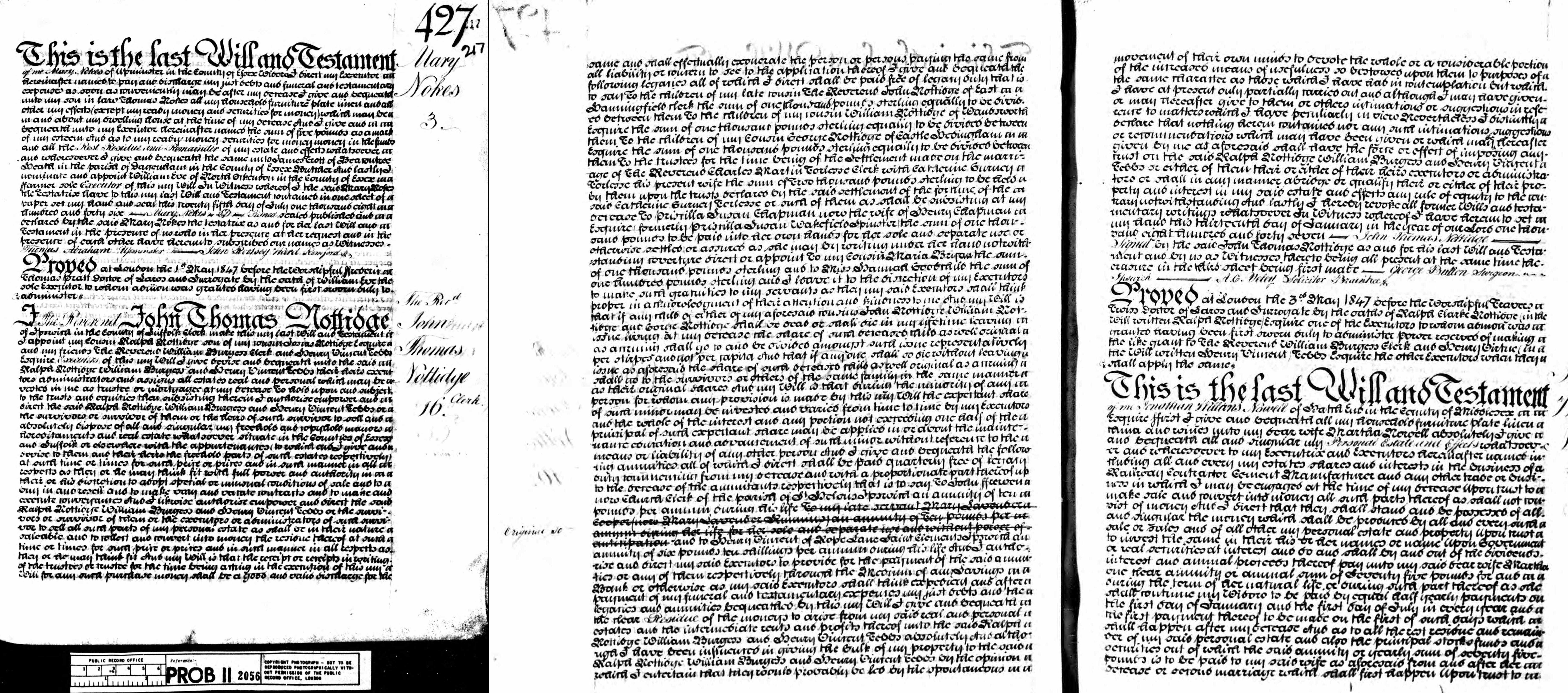
3. Rev John Thomas Nottidge: Will, 1847, Ipswich, SFK.
To be transcribed
John married Louisa ROBINSON [1971] [MRIN: 636], daughter of Martin ROBINSON [1964] and Mary ELLITHORNE [1963], on 7 Aug 1810 in St Luke Chelsea LND. (Louisa ROBINSON [1971] was born on 24 Jun 1783 in Red Lion St Camden and was baptised on 13 Jul 1783 in St George Queen Sq Camden.)
|