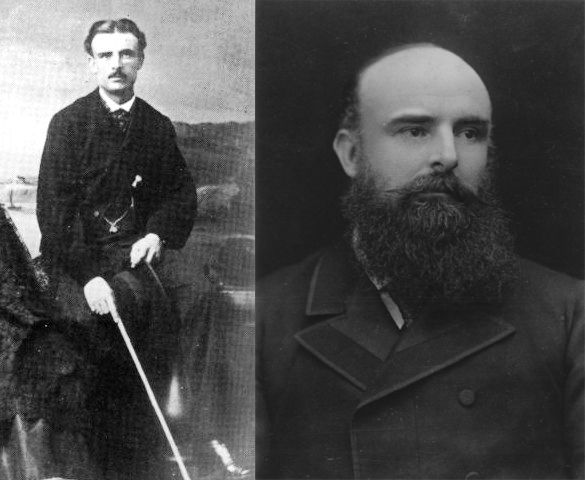
Sir Frederick Napier BROOME [35793]
- Born: 1842, Canada
- Marriage (1): Lady Mary Anne STEWART [35794] on 21 Jun 1865 in Prees SAL
- Died: 1896 aged 54

 General Notes: General Notes:
Sir Frederick Napier Broome KCMG (18 November 1842 \endash 26 November 1896) was a colonial administrator in the British Empire, serving in Natal, Mauritius, Western Australia, Barbados and Trinidad and Tobago. The Western Australian towns of Broome and Broomehill are named after him. He has signed his name as F. Napier Broome.
Early life
The eldest son of Rev. Frederick Broome, rector of Kenley, Shropshire, by his wife Catherine Eleanor (eldest daughter of Lieut.-Colonel Napier, formerly Superintendent, Indian Department, Canada) Broome was born in Canada and educated at Whitchurch Grammar School, Shropshire. When visiting England in 1865, he married Mary Anne Barker on 21 June. The couple moved to New Zealand where Broome had a sheep station, in the Malvern Hills, province of Canterbury.
Career
Journalist and poet
Broome returned to London in 1869, and for the following six years was a regular contributor to The Times, being the newspaper's correspondent at the Duke of Edinburgh's marriage at St. Petersburg, and on many other occasions. He also wrote literary reviews, art critiques, and miscellaneous articles. He published two volumes of verse, Poems from New Zealand (1868) and The Stranger of Seriphos (1869), and contributed verse to the Cornhill, Macmillan's Magazine, and other periodicals.
Administrator
In 1870 he was appointed secretary to the St. Paul's Cathedral Completion Fund, and, in 1873, secretary to the Royal Commission on Unseaworthy Ships, and held for some time a commission in the Essex yeomanry. He was selected by the Earl of Carnarvon, in 1875, to proceed with Lord Garnet Wolseley on a special mission to Natal, as colonial secretary of that colony. He held that post until 1878, when he was promoted to the colonial secretaryship of Mauritius, where he administered the government in 1879, and was lieutenant-governor of the island from 1880 to 1888. He was the 14th governor of Mauritius from 9 Dec 1880 to 5 May 1883. He was created CMG in 1877, and KCMG in 1884
On receiving the news of Britain's military disaster at Isandlwana (1879), he despatched at once to the assistance of Lord Chelmsford nearly the whole of the garrison of the colony, including a half battery of artillery, For which he was warmly thanked by the governor and high commissioner of the Cape Colony, Sir Bartle Frere, and by the colony of Natal through its lieutenant governor, Sir Henry Bulwer.
Governor of Western Australia
On 14 December 1882 he was appointed governor of Western Australia, and assumed office in June 1883. He visited England in 1885, when, with the "view of extending knowledge of the resources of what was at that time a little known colony", he read a paper on "Western Australia" before the Colonial Institute, H.R.H. the Prince of Wales taking the chair. That year he donated a small but important collection of Aboriginal artefacts from Western Australia to the British Museum.
His term as governor of Western Australia was marked by great extension of railways and telegraphs, and general progress. When the colony was preparing for responsible government, Broome acted as intermediary between the Legislative Council and the British secretary of state. After considerable correspondence, the details of the new constitution were settled, and a bill, approved by Her Majesty's Government, finally passed the local legislature in 1889. Since complementary legislation was needed from Westminster to transfer Crown lands to the colonial legislature, the necessary bill was at once introduced by Lord Knutsford, and passed the House of Lords; but, owing to strong opposition to handing over an immense tract of Crown lands to the colonists, which suddenly showed itself in the home press and in the House of Commons, the bill could not be proceeded with in the House in 1889, and had to be deferred to the following year.
Sir Frederick and two leading members of the Western Australian legislature travelled to England in December 1889 to give evidence before a select committee of the House of Commons, to which, early in the session of 1890, the Constitution Bill was referred. Much to the surprise of the London press, the committee reported in favour of the bill and of the transfer of all lands to the colony.
Consequently, the British Parliament passed a bill for the whole of the lands of the vast territory\emdash 1,060,000 square miles\emdash to be freely handed over to the legislature of Western Australia, which thus obtained its new constitution on the same basis as the other colonies of the continent, there being no opposition to the bill in the House of Lords. Broome finally left Western Australia in December 1889, on a mission to England in connection with the Constitution Bill, and his tenure as governor ended in September 1890. One source states "Disputes with his senior officials tarnished Broome's reputation in the Colonial Office. p.10
Broome was transferred to serve as acting governor of Barbados in the West Indies and, in July 1891, was appointed governor of Trinidad.
He died in London in 1896 and was buried on the eastern side of Highgate Cemetery.
Wikipedia 2023
Research Notes:
Sir Frederick Napier Broome (1842-1896), farmer, journalist and governor, was born on 18 November 1842 in Canada, the eldest son of Frederick Broome, rector of Kenley, Shropshire, England, and Catherine Eleanor, daughter of Lieutenant-Colonel Napier. He was educated at Whitchurch Grammar School, Shropshire. In 1857 he migrated to Canterbury, New Zealand, where he engaged in farming. In 1864 he returned to England and on 21 June 1865 married Lady Mary Anne, the eldest daughter of Walter George Stewart and widow of Sir George Barker. Broome was eleven years younger than his wife, who had two sons from her first marriage.
The Broomes settled on a sheep station in the South Island of New Zealand, leaving the two children to be educated in England. In the next three years they lived comfortably, managing their property, hunting, visiting neighbours and exploring the countryside. However, their first son died in 1866, aged two months, and in 1868 a disastrous snowstorm and catastrophic floods ended their farming. They returned to London disillusioned, and both turned to writing as a career. Broome published in London two volumes of verse, Poems from New Zealand (1868) and The Stranger of Seriphos (1869), and began to write regularly for The Times. He also contributed poetry to the Cornhill and Macmillan's magazines.
Broome was a special correspondent in St Petersburg at the Duke of Edinburgh's wedding, and wrote numerous literary reviews and art criticisms for London newspapers. He served as the secretary of the St Paul's Cathedral Completion Committee and the royal commission on unseaworthy ships in 1873, and held a commission in the Essex Yeomanry. His wife had two sons, Guy in 1870 and Louis in 1874, and was appointed the first lady superintendent of the National Training School of Cookery, South Kensington. The activities of the Broomes introduced them to a wide circle of acquaintances, but their friends were greatly surprised when Broome was nominated for the post of colonial secretary in Natal. He accepted the appointment and arrived in Natal in 1875. His wife joined him later but spent little time there. In 1877 he was appointed C.M.G. In 1878 he became colonial secretary of Mauritius and often acted as administrator when the governor was absent. In 1880 he was promoted lieutenant-governor of Mauritius, and his prompt action in the Isandula affair, by dispatching almost the whole of his garrison to aid Lord Chelmsford, helped to avert a disaster at a critical time in the Zulu war. However, the climate of Mauritius did not suit his wife, and Broome was especially pleased when offered the governorship of Western Australia, a colony renowned amongst officers on leave from India for its salubrious climate. He took office in June 1883 and for the next six years was happily united with his wife and younger son.
Broome arrived in Western Australia at an auspicious time. The colony had recovered from the economic stagnation which followed the closing of the imperial convict establishment, and within a few years it experienced the first of several spectacular gold discoveries which profoundly changed its economy and prospects. Broome's first and most urgent task was to obtain the approval of the British government to raise a loan for public works, especially railways. For this purpose he went to England in November 1884, and the success of his mission enhanced his standing with the leading colonists; so also did the knighthood conferred on him by the Queen. However, after his return in June 1885 the changing character of the colony made the maintenance of the existing form of government exceedingly difficult. The governor had large executive and administrative power, but the representative Legislative Council had no autonomy in determining such matters as the crown land regulations and the raising of government loans, and was more like a debating club than a legislature. None of the governors before Broome had seriously encouraged the movement for self-government; nor had the Colonial Office, influenced by the small size of government revenue and population compared with the large extent of territory in Western Australia. The British government's only concession to colonial opinion had been to expand the Legislative Council and increase the proportion of its elected members. The last change had been made in 1882, when the council was enlarged to twenty-four members, sixteen of them elected on a property franchise.
In August 1884 Broome suggested to the Colonial Office that a parliamentary system of government be established as soon as possible; he was convinced that responsible cabinet government would be successful and that the population was increasing rapidly enough to enable the colony to pay its own way, an opinion soon to be confirmed by the discovery of the Kimberley, Yilgarn and Pilbara goldfields in 1885-88.
In July 1887 the Legislative Council asked Broome to take the necessary steps to introduce responsible government. He supported the proposal, provided that suitable protection was given to the Aboriginals and that the British government might at any time create a separate colony in the north of Western Australia; he also suggested a bicameral legislature with a 'People's Chamber' and an upper house of nominees. The secretary of state approved in principle the council's request, supported Broome's proposal for a possible division of Western Australia into two colonies, and insisted that permanent protection be given to Aboriginals by the creation of a board responsible to the British government and not to the local legislature.
The draft of a constitution bill was sent to London, and in December 1888 general elections were held so that colonists could express their views on it. Thereafter events moved quickly. The newly-elected council approved the bill because the informed public, though hesitant about a nominated upper house, fully supported the principle of local independence. To expedite the passage of the bill through the imperial parliament, the council appointed Governor Broome, (Sir) Stephen Parker and Sir Thomas Cockburn-Campbell as their delegates to London. On arrival the delegates found much opposition to an unqualified grant of responsible government to Western Australia. The Times protested strongly against the proposed transfer of a large slice of territory to a handful of settlers whose principal claim, it believed, was mere contiguity to the other self-governing colonies in Australia. In parliament several members claimed that colonial lands were a heritage held in trust for the empire and future generations, and suggested that Western Australia be divided immediately at 26°S into two colonies, with self-government only for the southern portion. This proposal was firmly opposed by the Western Australian delegates. In a strongly worded letter to The Times in May 1889 Broome had declared that the constitution bill might not improperly be styled 'a bill to promote the bona fide utilisation and settlement of the Imperial patrimony in Western Australia'. A select committee interviewed the delegates and recommended that the constitution bill be adopted without major alteration; the British government was to retain the right to subdivide the colony at any future time. The constitution bill received royal assent on 15 August 1890, and the representatives of the other Australian colonies in London congratulated Broome and his colleagues on their good fortune.
Broome's success in leading colonial opinion towards the attainment of responsible government was in marked contrast to his inability to work with his chief colonial advisers. He became unpopular with his senior officials and their petty quarrels developed into public storms. He was almost continuously in disagreement about administrative matters with his surveyor-general, (Sir) John Forrest, and his attorney-general, Alfred Hensman, who had a severe personal clash with Broome, was suspended from office and resigned from the Executive Council. The root cause of these disputes was the nature of the colonial civil service: senior appointments were made by the secretary of state in London while the governor could suspend an official but not dismiss him, and although the officials administering departments were members of the Legislative Council they were not responsible to it for their actions. The most sensational dispute was between the governor and Chief Justice (Sir) Alexander Onslow. It began over the advice which the judge might give the governor about appeals for remissions of sentences. Mutual recrimination was followed by public disputation, and as the combatants became heated they lost all sense of proportion. Unwise actions by Onslow brought the matter into the press and Broome suspended him from office. The subjects in dispute, partly legal, partly personal, were referred to the Colonial Office and thence to the Privy Council. In due course both parties were admonished and Onslow was reinstated, but the bitterness which had spilled into the press, clubs and gatherings at street corners, took much longer to dissolve. One sequel to the 'Onslow Affair' was an attempt in the House of Commons to have Broome recalled for his uncontrollable temper, administrative incompetence and despotism. The government refused to support the motion, which was defeated by 124 votes to 36, but Broome's reputation in the Colonial Office suffered and prevented fulfilment of his hopes for an extension of his term in Western Australia.
Contemporary opinion about Broome and his competence as an administrator was never neutral, mainly because neither he nor his senior officials would compromise or temper their statements. While most thoughtful colonists appreciated his initiative and leadership on general issues, few would agree that he had done much to advance the colony's material progress. Broome, on the other hand, wanted more credit than he was entitled to. However, these temperamental disagreements should not be overemphasized. When Broome left Perth in December 1889 the colony had crossed a significant watershed in its economic and political progress: the northern pastoral industry was flourishing; three major railways to the north, east and south of the capital were under construction; and the colony was well able to cope with the gold boom which had already begun before Broome's successor arrived.
Both Broome and his wife took a great interest in colonial affairs, constantly touring the rural districts and promoting charitable and philanthropic movements. Government House in Perth was not only the Mecca of local 'society' but a haven for citizens in need of help and advice. In September 1890 Broome was appointed acting-governor of Barbados. While governor of Trinidad in 1891-96 he visited England each year for health reasons and appears to have been a successful administrator. He died on 26 November 1896, before he could make substantial provision for his family's maintenance. He left only a small annuity for one son. His wife petitioned the government of Western Australia for an allowance, but some parliamentarians had strong memories and may have recalled the burning of Broome's effigy; the annuity granted to Lady Broome and her children was a mere £150. The pearling town of Broome had been proclaimed in1883, on a site surveyed by the explorer and later premier John Forrest just east of Dampier Creek, on Roebuck Bay in the Kimberley district.
Ref: https://adb.anu.edu.au/biography/broome-sir-frederick-napier-3068
Frederick married Lady Mary Anne STEWART [35794] [MRIN: 12977], daughter of Walter George STEWART [35809] and Unknown, on 21 Jun 1865 in Prees SAL. (Lady Mary Anne STEWART [35794] was born in 1831 in Spanish Town Jamaica and died on 6 Mar 1911 in St George Hanover Sq London.)
|