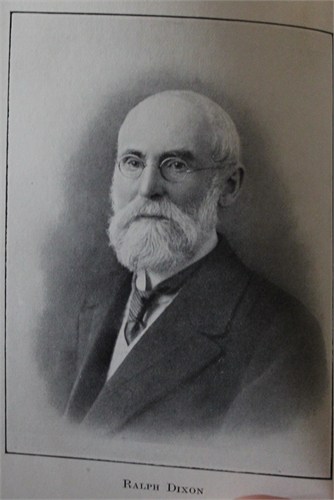
Ralph DIXON [21295]
- Born: 14 Jan 1836, Bishop Auckland DUR
- Marriage (1): Elizabeth FOX [21296] on 6 May 1858 in Dewsbury YKS
- Died: 1 Jul 1916, Highfield Gt Ayton YKS aged 80

 General Notes: General Notes:
The Annual Monitor for 1917 - Being an Obituary of the Members of the Society of Friends. Pages 49 - 54
Ralph Dixon 80 years 6 months.
Died 1 July 1916 of Gt. Ayton Yorkshire a Minister.
Ralph Dixon was born 4th of January 1836 at Bishop Auckland and at the age of 5, came with his parents to settle at Gt. Ayton, when his father was appointed the 1st superintendent of the newly founded the North of England Agricultural School there.
His father, George Dixon, was the son of Ralph Dixon, a convinced Friend, sprung from an old Quaker family of Staindrop; his mother was Alice Swinburn, not originally a Friend, daughter of a Sunderland shipowner. For five years R.D. was a scholar at Ackworth School, having previously been at Ayton School under his father; he was later a student at the Flounders Institute, having for his contemporaries William S Lean, William Kitching, Walter Morrice, and others. Returning to Ayton as a teacher, for some years he filled the post of head-teacher in the school, and, on his father retiring in order to go to America, to take up work among the freed slaves, Ralph Dixon was appointed, in 1865, as Superintendent, at the age of 29, which position he held until the Christmas of 1895.
Shortly after leaving the school he built Highfield his residence at Gt Ayton, and the remaining years of his life and that of his wife were spent, very largely, in planting and tending the beautiful garden surrounding the house - a never failing source of interest to both - and here, seated in the rock garden, R.D. was photographed only the week preceding his death.
In 1858 he married Elizabeth, daughter of David and Rebecca Payne Fox, of Dewsbury, who, after a union of 56 years, died at Highfield on the anniversary of their marriage, they had 9 children who survived infancy, of whom 7 were daughters; of these, 2 in India and a son in Africa spent the best part of their years in foreign mission work, the family all meeting at their father's funeral, the first time for 20 years.
Ralph Dixon was recorded a Minister in early life, and faithfully exercised his gift; he had a deep concern for the children who formed so large a part of Ayrton Meeting, the majority of whom were strangers to Friends mode of worship before coming to the school; and it was only three weeks before his death that he last spoke powerfully and lovingly to them, although for once, owing to feebleness, he remained seated to do so. He was a diligent attender at Monthly and Quarterly Meetings, taking his right share in the exercise and deliberations of these. Guisboro Monthly Meeting comprises the two very small Meetings of Castleton and Guisboro, besides the larger one of Ayrton. Ralph and Elizabeth Dixon took a loving interest in the support of these gatherings, which, in former days, had been attended by many yeomen farmers and their families.
They were particularly faithful in visiting the Meeting held once a month at Bilsdale, about 16 miles from Ayrton, and, although hardly any members of the Society remained in the Dale, the local farmers would come on these occasions for miles around, not infrequently numbering 50 or more. Many times R and E Dixon have made the long drive in their phaeton through snow and sleet and the most inclement weather, even when well over 70 years of age, and sometimes have been bound to turn back for the snowdrifts and storms. Wensleydale also was frequently visited by them in Gospel love, also Kirby Moorside and Osmotherley, on the edge of the Cleveland Moors, often holding lantern Gospel and Temperance meetings and giving Peace addresses.
For 15 years Ralph Dixon was honorary secretary to the British Schools at Gt Ayrton, and for the same length of time to the local branch of the British and Foreign Bible Society, retiring from this in 1915. The British and Foreign Bible Society presented him with a very handsome Bible with illuminated frontispiece. He had a fair knowledge of French, Latin and Hebrew, and was specially interested in the Hebrew race, through his lifelong friendship with his cousin, Dr John Dixon, of the Mildmay Mission to the Jews, in London. He also studied the Norwegian language, and was able to read the Bible in Norse, and in the latter part of the 1860s made a tour in Norway, having a rough and adventurous time visiting the Friends in Stavangar and elsewhere.
During part of the time he was the guest of Asbjorn Kloster, the founder of the Total Abstinence Movement in Norway, who had visited Ayrton School for several months in 1850, in order to study English methods of teaching and to learn the language, and here he first heard of Total Abstinence. A.K's sons were later educated at Ayrton School, and his statue is to be seen at Stavangar. In 1885, R.D. visited the friends residing in Minden and Piermont, and in the Spring of 1902 paid a second visit to Norway, accompanied by his eldest daughter, and was much interested in noting the changes which had taken place during the 30 years which had intervened.
Ralph Dixon was extremely fond of children, and enjoyed telling them stories and anecdotes of his earlier days. He was a keen naturalist - wrote a book on shells - and expert botanist, interested in natural history, astronomy, and kindred subjects; had a vast mine of information to draw upon, which he freely shared with others, making him a very interesting person to converse with.
After the death of his wife in 1914, he had a serious illness which left him frail in body, though vigourous in mind, but he kept up his interest in Meeting affairs and seldom missed morning Meeting; his last day out, 3 days before his death, was to post the notices for Bilsdale Meeting.
He often visited those whose age or infirmities prevented attending Meeting, and in these visits of loving sympathy his mellowing character and ripe Christian experience were very evident, and his ministrations will be long remembered and sorely missed. What was said of Mary Slessor, of Calabar, was also true of Ralph Dixon:- "It was not difficult to see the last touches of the Master's hand to the life he had been moulding for so many years"
"God calls our loved ones, but we lose not wholly what he hath given; they live on earth in thought and deed as truly as in his heaven"
Ref: http://www.mocavo.com/The-Annual-Monitor-for-1917-Being-an-Obituary-of-the-Members-of-the-Society-of-Friends-in-Great-Britain-and-Ireland-From-October-1-1915-to-September-30-1916/411065/78
Other Records
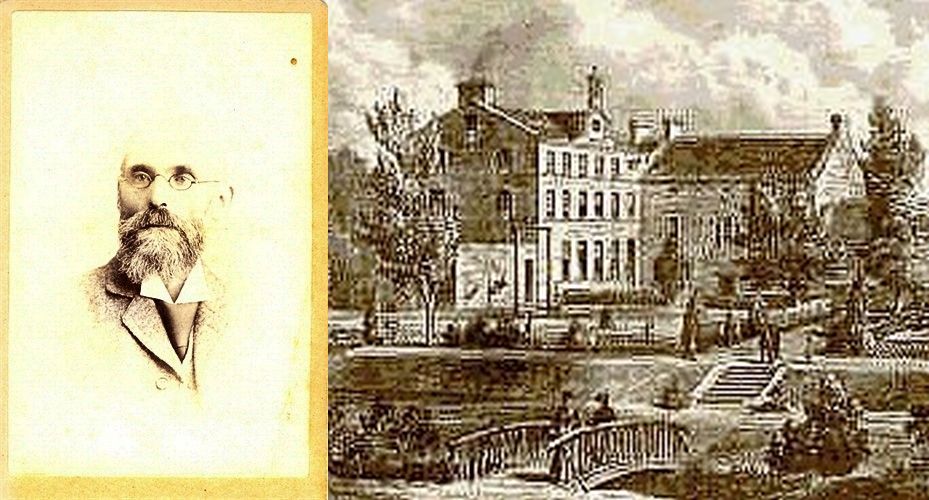
1. Ralph Dixon: Gt Ayton Agricultural School: Gt Ayton YKS.
A Biographical sketch of
Ralph Dixon,
of Great Ayton - 1836-1916
Ralph Dixon, of Highfield, Great Ayton, died on the first of July, 1916, after only a few days' illness, aged eighty years and a half. He was born 4th January, 1836, at Bishop Auckland, and came with his parents to settle at Great Ayton in 1841, when his father was appointed the first superintendent of the newly-founded North of England Agricultural School there. The mother of Ralph Dixon was Alice Swinburn, who was not originally a Friend; her father was a shipowner of Sunderland, and her great-great-uncle was the Reverend Thomas Stackhouse, M.A., author of the well-known Commentary of the Bible.
Ralph Dixon was educated at Ackworth School, and later went to the Flounders Institute. After being for some years the head teacher and virtual superintendent of Ayton Friends' School, he was appointed superintendent in 1865, on his father retiring in order to go to America. He retired from this post in 1896, but carried on as a gentleman farmer at the School Farm until his death, renting it and employing a hand to live in the premises He continued to live at Chestnut House, which had been built for him adjoining the School premises, until 1898, when the house became the School Sanatorium. He then moved to Raby Cottage, a house built by and belonging to his uncle, Robert Dixon of Meynell Hall, Ingleby.
In the year 1907 he built Highfield, his residence at Great Ayton, and the remaining years of his life and that of his wife were very largely spent in planting and tending the beautiful garden surrounding the house. Like his father, who lived to be ninety-two, he was in full possession of his mental and physical powers until the time of his death, with only the loss of activity due to a short illness.
Ralph Dixon was always a very keen naturalist and wrote a book on shells. As a practical farmer all his life and an instructor of agriculture to his pupils at the School, he made a study of agriculture on scientific lines and was well known as a good and up to date farmer in the district. Like his father he was an expert botanist, and from his "seed room" for many years the village people obtained their vegetable and flower seeds. In his phaeton and pony trap he and his family and friends visited the countryside for many miles round Ayton, the dales and villages of this part of Cleveland, and a great number of their inhabitants being well known to him personally. He held by examination a lecturer's diploma, 19th in honours in the United Kingdom in scientific agriculture, and organized classes for the local farmers whom he instructed for a number of years. He was also associated with Lord de Lisle in farmers' classes at Ingleby, three miles away.
In addition to his scientific interests, the study of language and dialect was a great pleasure to Ralph Dixon. Local dialects interested him as being closer to the Anglo-Saxon than the current English of to day. He had a fair knowledge of French, Latin, and Hebrew, and was especially interested in the Hebrew race through his life-long friendship with his cousin Dr. John Dixon, of the Mildmay Mission to the Jews in London. Furthermore he learnt the Norwegian language, and made a tour in Norway in the latter part of the 60's, having a very rough and adventurous time there visiting the Norwegian Friends then in Stavanger and elsewhere. During part of the time he spent in Norway he was the guest of Asbjorn Kloster, of Stavanger, the founder of the total abstinence movement in Norway who had visited Ayton School for several months in 1850 in order to study English teaching methods and the English language, and had there first heard of total abstinence.
Asbjorn Kloster's sons were later educated at Ayton School, and his public statue is to be seen in Stavanger. One of his sons called on Ralph Dixon at Great Ayton a few years before his death.
In 1885 Ralph Dixon visited Hamburg, Hanover and the Rhine, and the Friends in Minden and Piermont ; and in the spring of 1901 he made a second visit to Norway with his eldest daughter and was much interested in remarking the changes which had taken place in more than thirty years.
He was appointed a Minister of the Society of Friends in early life, this being an honorary recognition accorded to those members of the Society who speak frequently and acceptably in their meetings. He frequently exercised his gift in this respect within the boundaries of Guisborough Monthly Meeting, but he was of a retiring disposition, and never felt called upon to seek a wider field, except at Hawes and in Wensleydale.
Ralph Dixon's faith was simple and evangelical, but of the quiet old-fashioned type. His natural trend was more practical and scientific than literary or critical, and while he was among the first in the district to take up and practise successfully photography, the magic-lantern, acetylene gas, and new farm instruments and methods, the application of scientific theories to religious questions did not trouble him as it has troubled so many Friends during the last generation. To him an intelligent acceptance of the Bible, read in accordance with the quiet doctrines of evangelical Quakerism, sufficed; but he was very liberal minded with regard to others and laid most stress on the virtue of their lives and the genuineness of. their convictions. He abhorred hypocrisy and sanctimoniousness and pride, but freely recognised opinions different from, his own.
His sermons were usually expositions of biblical passages with the object of showing the infinity of God's love for us, of pointing out the simplicity of the way of salvation, and of exhorting us all to live honourably before men and God. They were not so personally Striking or dramatic, nor were they so embellished with literary references or historical examples as are the addresses of some Quaker ministers, nor did they enter the realms of Mysticism or Higher Criticism; but they were simple, straightforward and humble, and revealed an extremely intimate acquaintance with the Bible, a broad appreciation of Nature and of Humanity, familiarity with the experiences of the early Quakers and of missionaries and philanthropists, and the general information at the disposal of a well-informed mind.
Although possessing much of the vigour and enthusiasm and progressiveness of his father, he had not his self-assertion. He was reserved, reticent, and shy, and did not seek new friends, or accept public positions. He was not a ready conversationalist, but had the courage to speak where he felt it necessary. He was nevertheless always very ready to organise meetings or entertainments for those whom he felt he could help in Ayton and the neighbouring villages, and many much appreciated magic lantern shows, temperance meetings, bible-meetings, pleasant Sunday afternoon meetings, social teas, excursions, farmers' classes, mothers' meetings, &c., owed their conception and management to him and his wife. At these times he could be thoroughly comfortable, and enjoyed himself as much as anyone. He was so essentially humble that no one could ever feel "patronised," and this was no doubt the reason why he was so much respected by the country people although he was not rich and gave away little of a material nature.
The heavy responsibilities which he took on becoming superintendent of a large boarding-school when only twenty-nine years of age no doubt produced a certain sternness in the interest of discipline, but those who knew him at all well in later life knew how extraordinarily warm-hearted, generous, affectionate and forgiving he really was, although always in the most secret and quiet way possible. He valued his honour and good name very considerably, but he seemed to have no worldly pride whatever and would show no increased respect or deference to people of wealth or social position, in fact, his manner was probably less gracious to peer, baronet, or wealthy Quaker than to a farmer or tradesman. He enjoyed telling stories and anecdotes of his earlier days and experiences to his children and grandchildren and was often humorous and always most matter of fact in his conversation.
In politics he was a Liberal of the old school and not at all in agreement with socialistic tendencies, but he was never a keen politician. He hated all war and preparations for war and did all he could for the cause of peace. While deeply lamenting the present war he took no extreme pacifist view and thought that young men ought to help their country in non-combatant ways. It is interesting; to remember that his grandfather and namesake was fighting. a hundred years ago in Spain against the French, and that now one of his grandsons is fighting in this war on the same side as our former hereditary enemy.
When it is recollected that Ralph Dixon was superintendent of Ayton School for over thirty years, and that his father and he together were consecutively in charge for considerably over half-a-century, it is more easy to realise how his name and memory are inseparably connected with it in the minds of hundreds of his old scholars. His father presumably sat in the ministers' gallery of Ayton Meeting on becoming superintendent in 1841, and either father or son sat there without any break for exactly seventy-five years.
The life of a head master of a Quaker boarding school is not usually filled with incident sufficiently important to warrant narration in a biographical sketch. The careful guardianship of the youth of both sexes and the judicious supervision of their education require a man of honour and wisdom, of discretion and energy, and of intelligence and adapt ability. These qualities were displayed in no small degree by Ralph Dixon during the thirty years of his Superintendence. The work which he thus accomplished is of great importance to the nation, and the recognition accorded to men who hold such positions seems hardly proportionate. But Ralph Dixon certainly did not seek public recognition; he merely sought to do his duty.
One or two incidents with regard to his school life may be mentioned. The school swimming bath was originally a linseed vat in what is now the Station Road; when this had to be given up the scholars bathed in the open river for a time, but Ralph Dixon was anxious to convert some old tan pits in the School garden into a proper bath. Some difficulty was experienced, so he and the older boys made the present swimming bath and laid the cement with their own hands. Contrary to the expectation of the School Committee he was able to collect sufficient money to erect the gymnasium and lecture hall to commemorate the school jubilee. His father, George Dixon, had started the school museum with curios obtained by his friend Isaac Sharp in Greenland, Labrador, and other parts of the world, and Ralph Dixon was much interested in adding to it. Besides his keen interest in botany, he interested the scholars in astronomy, and persuaded Joseph Pease, M.P. for Darlington, to present the School with a valuable telescope.
The principal patrons of the School with whom he came into contact were Thomas Richardson of Cleveland Lodge, Great Ayton, and of Richardson, Overend and Gurney, bankers of London, the founder of the School; John and Henry Richardson of Langbaurgh Hall, Great Ayton; Edward Pease of Darlington, founder of the first railway, John Pease of Cleveland Lodge and of Darlington ; his son Joseph Pease, his grandson Sir Joseph Whitwell Pease, Bart, of Hutton Hall, and his great-grandson Sir Alfred E. Pease, Bart., of Pinchingthorpe House; and Jonathan Backhouse Hodgkin of Cleveland Lodge and of Darlington. The scholars have filled many useful positions in all parts of the world and space does not permit of naming any here. Further information may be obtained from the History of Ayton School published in the year 1891 and written by Ralph Dixon and his father.
From Ayton Old Scholars website archives, retrieved 6/3/2012 - <http://www.aytonoldscholars.org/archives/archives_staff/archives_staff_ralph_dixon.htm>; unreferenced; Appears to have been written shortly after his death, possibly by his grandson Bernard Thistlethwaite who was keen on family history.
Ralph married Elizabeth FOX [21296] [MRIN: 7654], daughter of David FOX [35146] and Rebecca PAYNE [35147], on 6 May 1858 in Dewsbury YKS. (Elizabeth FOX [21296] was born on 10 Jul 1834 in Dewsbury YKS and died on 6 May 1914 in Highfield Gt Ayton YKS.)
|