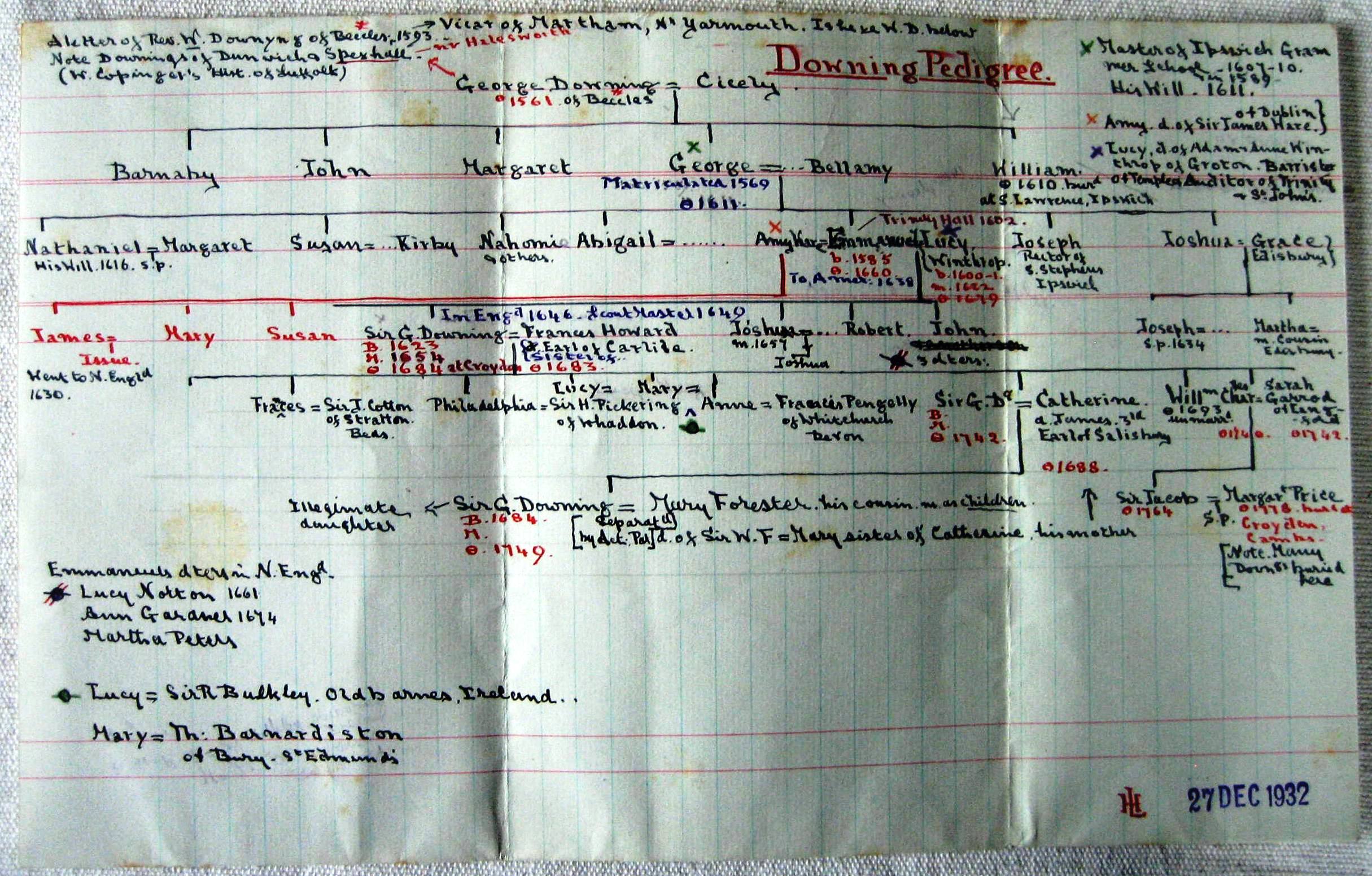
George DOWNING of Beccles SFK [21785]
- Born: Abt 1525, Ipswich, SFK
- Marriage (1): Cicely [21786] in 1561 in Beccles SFK
- Died: Abt 1564 aged about 39

 General Notes: General Notes:
Will dated 20 Dec 1561 at Beccles Proved 20 Jun 1564
Research Notes:
This family is based on a Tree done in 1932 by Henry G Downing Liveing supplemented by Robert Stedall, 2017.
However no link with the Downing/Liveing family of London, nor the Downing family of Norfolk, has been found - 2017.
The Suffolk Family of Downing
By Robert Stedall
The earliest known ancestor of the Suffolk family was George Downing of Beccles, whose will is dated 15 December 1561. By his wife, Cicely, he had a large family, of whom George, the third son entered Queen's College, Cambridge in 1569, and later became headmaster of the grammar school in Ipswich. According to a family tree for Downing of Gamlingay (the Baronetcy family - see below), he married a Miss Bellamy. (Although there is no other evidence to confirm that this was her maiden name, she was buried at St Lawrence, Ipswich in 1610.) George made a will on 17 January 1611, proved in Ipswich on 3 October 1611, mentioning his unmarried daughters, but he also had a son, Nathaniel Downing, whose will, dated 7 May 1616, refers to his brothers, Joseph, Joshua, and Emanuel (sic) in addition to other family members.
Emmanuel Downing, born on 12 August 1588 at Edwardstone near Ipswich, was an exceptional personality. He graduated from Cambridge University, qualified as a barrister at the Inner Temple in London and became a non-conformist preacher. He married twice, firstly in 1614 to Anne, daughter of Sir James Ware, the Secretary for Ireland, with whom he moved to live in Dublin. Following her death in 1620, he returned to England temporarily, where, in 1622, he remarried Lucy, the sister of John Winthrop, the founder of the Massachusetts Bay Colony, and its first Governor. He then returned with her to Ireland until 1625. There is a biography written by Frederick Johnson Simmons in 1958 based on Emmanuel's and Lucy's correspondence. In 1629, he was invited by his brother-in-law to join the Massachusetts Bay Colony, but deferred travelling to America until the education of his younger children was completed. Yet some of his elder children joined John Winthrop in America. It was not until October 1638 that Emmanuel and Lucy set out with the remainder of their voluminous family. He became a key member of the colony, advocating slavery as a means of resolving the shortage of labour, and suggesting that native Indians should be traded for black African slaves. He was one of the founders of Harvard University, and George Downing, his eldest son by Lucy, was the second student to graduate from there. In 1652, Emmanuel and Lucy returned with some of their family to England, where he was appointed Clerk to the Council of State of Scotland, but died in Edinburgh on 26 September 1660.
George Downing also returned to England, where he became a strong supporter of the Commonwealth, preaching to Cromwell's troops during the Civil War and serving as a diplomat at The Hague. Yet, following Cromwell's death, he became a moving force in seeking the restoration of the monarchy, and was well rewarded by Charles II, becoming a baronet on 1 July 1663 and Secretary to the Treasury. He soon became extreme wealthy, building Downing Street in London, and amassing the fortune, which ultimately founded Downing College, Cambridge. His change of allegiance did not improve his relationship with his former Parliamentarian colleagues.
The conflicting family trees
Although the family trees provided by the Heralds in their visitations of Norfolk and Suffolk must have been available well before this, the record of Downing of Gamlingay (the country estate of Sir George Downing) does not appear to have been published in printed form until 1900, when it formed part of a collection of Suffolk Manorial Families edited by Joseph James Muskett of New England. The resultant family tree demonstrates that George Downing of Beccles, who died in 1564 could not have been born much after 1530. It follows that he could not have been descended from Geoffrey Downing, who was born in 1524, notwithstanding numerous records, which provide links at various levels to amalgamate the two families. As this family record is based on the Heralds' visitations, the various wills already mentioned and Emmanuel's and Lucy's correspondence, it can be assumed with some assurance that it is accurate. Muskett makes the following note on the similarity of the armorial bearings and the complexity of linking the two groups:
The precise relationship between the Norfolk and Suffolk families, however, has not yet been ascertained, and has been the subject of much misconception and misstatement.
There were several early genealogical records published, but errors crept in, initially it would seem as a result of a biography of the Rev. Calybute Downing (of the Norfolk family), included in Athenae Oxoniensis Vol. III, pp. 105-108 written by Anthony à Wood in 1649. This avers, incorrectly, that he was the father of Sir George Downing (of the Suffolk family), the first baronet. It would seem that John Burke, in his Extinct Baronetage published in 1838, followed Wood in making the Rev. Calybute the father of Sir George. As he probably knew that Calybute had a son, Henry, he included him as a brother of Sir George. As explained above, this Henry seems to have changed his name to Brett. Burke then went further and claimed that Colonel Adam Downing of Bellaghy, the acknowledged ancestor of the Londonderry Downing family, was a son of this Henry Downing (or Brett). We have established no logical explanation for Burke to make this unlikely connection, but it has confused generations of later genealogists.
In 1891, Alexander George Fullerton, a great-great-grandson of Adam Downing, produced a 'Memoir' of his family emblazoned with quartered coats of arms to demonstrate his connection to the Downing baronetcy and his descent from Geoffrey Downing and Elizabeth Wingfield. He had married Lady Georgiana Leveson-Gower, the daughter of the 1st Earl Granville and grand-daughter of Lady Georgiana Spencer, Duchess of Devonshire. It is apparent that Granville did not altogether approve of his parvenu son-in-law, despite his considerable wealth, and Alexander, who was a mere Captain in the Horseguards needed to demonstrate his credentials. He looked no further than Burke to be able to show these connections and he produced a first version of his memoir which followed Burke. He included a short biography of each of the family members, and he fleshed out Henry Downing, Adam's purported father, as follows:
We now revert to HENRY JOHN DOWNING Esq 2nd Son of the Reverend Calybute Downing and only brother of Sir George the 1st Baronet. He was an Officer in the Guards of Charles 2nd, a body of Troops of about 4000 men, horse and foot, commanded by the Duke of Albermarle, "consisting of Gentlemen of quality and Veteran soldiers excellently well clad and well mounted and ordered", as Evelyn remarks, who saw them reviewed July 4 1663. He married Jane, daughter of [BLANK] and died circa 1698 leaving two sons, Adam and George, the latter had a son Adam who died S.P.
In reality, there is no evidence that Henry Downing (or Brett), the son of the Rev. Calybute Downing, married or had children. There is no record of him visiting Ireland and he is not mentioned in regimental records of the Horseguards. Also, there is no further evidence that Adam had a brother, George, with a son Adam, who died S. P.
Shortly after this, the 1698 will of Nicholas Downing of Drumard near Bellaghy must have come to light. Nicholas had no children of his own but he named a brother William, and a range of nephews and nieces including Adam Downing of Rocktown near Bellaghy. He does not name Adam's father, who had predeceased him, but Adam made a will dated 1716, in which he named his mother as 'Jane', and a number of siblings including a brother Samuel. From the two wills, it is apparent that the Downing family had been well established around Bellaghy for some time. Furthermore, the Rev. Calybute Downing had not included sons Nicholas or William among the meticulous parish records that he maintained. Alexander George Fullerton needed to think again. Yet the seal on Nicholas's will carries the arms of the Rev. Calybute's family, the Downings of Norfolk.
At about the same time, John David Downing, the last member of the Downing family to live at Rowesgift, where the family records were stored, produced, quite independently, his own version of the Downing tree, having seen Nicholas's will. He came up with a theory that Nicholas was the son of Emmanuel Downing and Lucy Winthrop. This made him a brother of Sir George Downing the first baronet. Adam was thus deemed to be a grandson of Emmanuel and Lucy. To complete the link, he named Adam's parents as Major John Downing and Jane Clotworthy. These names appear to be completely spurious. There is no record in Emmanuel's copious correspondence that he had a son Nicholas, and although he had a son John, this John was born at Salem in Massachusetts and probably never visited Britain and Ireland, becoming a merchant in Nevis, WI, before marrying on his return to Boston. As Adam had a grandson, Alexander Clotworthy Downing, it is reasonable to assume that John David Downing borrowed the Clotworthy name as a plausible maiden name for Adam's mother, but it has now been established that Alexander Clotworthy was named after his godfather, Clotworthy Skeffington, and no suitably aged daughter Jane has been found among the records of the Clotworthy family in Ireland.
At some point before 1893, Alexander George and his genealogist produced a second version of their Memoir in the light of seeing Nicholas's will, but they may not have seen (or they ignored) the tree produced by John David Downing. They now claimed that Adam was a descendant of Lt. John Downing, who fought at the battle of Kinsale. Their tree averred that this John was the son of Arthur of Lexham. He is shown with a wife 'Margaret' and a son, George, who assisted the head tenant of the Fishmongers' proportion at Ballykelly and leased 3,000 acres. George, in turn, is shown with two sons, Nicholas (from the will) and George, the Comptroller of Customs for Londonderry, who, so they claimed, married Jane, daughter of 'Hugh Montgomery of Ballygowan', becoming the parents of Adam Downing. As Alexander George Fullerton never lived in Ireland, where he might have been able to research these new connections, his conclusions may have seemed a bit controversial. Yet his genealogist will have had access to the Dublin Public Records Office, which was destroyed in the troubles in 1922.
Our researches suggest that much of the ancestry shown in the second version of the Memoir is plausible. We know that Sir Richard Wingfield was a kinsman of John Downing the son of Arthur, and it is reasonable to assume that he took him under his wing at Kinsale and later in Londonderry. Burke's Royal Pedigrees of England provide a family tree that includes some of Lt. John Downing's children. In a footnote, it states that the Downings claim descent through the Wingfields from Henry III, so they seem to be of the Norfolk family. We have found leases signed by George at Ballykelly between 1618 and 1659, and he was later buried at the Island Church on Lough Beg near Bellaghy as was Nicholas. Although there was no Hugh Montgomery of 'Ballygowan', a Hugh Montgomery of Gransheogh lived near Bellaghy with 'several daughters who he married well'. He also had a grandson William Montgomery who borrowed £800, a substantial sum, from Adam, apparently his uncle by marriage.
Not everything in the second version of the Memoir is correct. It still shows Sir George Downing as a son of the Rev. Calybute Downing, thereby incorrectly claiming the Downing Baronetcy for the Norfolk Downing family. It also shows the Rev. Calybute with a son Henry, but this time without issue. It names the wife of George of Ballykelly as Dorcas Blois, who is a member of a family in Spexhall, Suffolk, married to an unconnected George Downing, who is well documented and had no children. Yet in other respects the genealogy seems realistic, notwithstanding that we have not established its sources.
George married Cicely [21786] [MRIN: 7837] in 1561 in Beccles SFK. (Cicely [21786] died about 1562.)
|