William KEABLE Artist [32991]
- Born: 1715, Cratfield, Suffolk
- Died: 1774, Livorno Italy aged 59

 General Notes: General Notes:
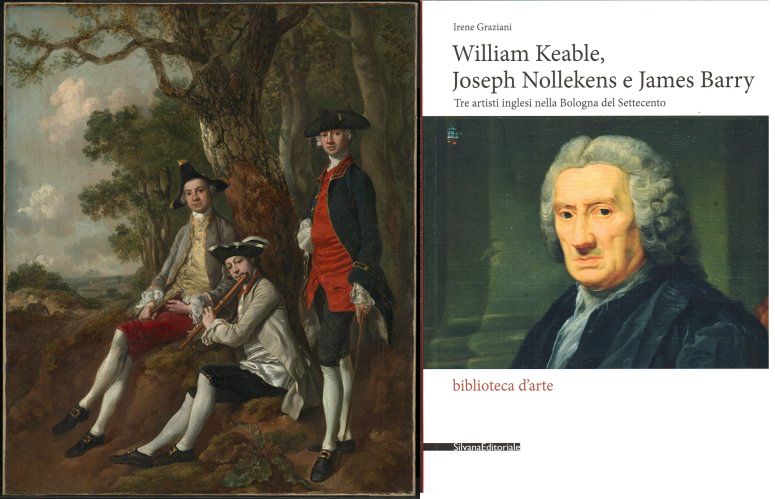
Picture - William Keable with flute painted by Thomas Gainsborough, and as an old man.
See # below
Suffolk Artists
Keable William
1715-1774
William Keable or Keeble, was baptised at Cratfield, Suffolk on 1 October 1715, son of John and Ann Keable. A moderately successful painter of portraits and small conversation-pieces, and a member of St Martin's Lane Academy 1754. He was patronised by a number of American Colonists travelling in London, particularly from Charleston, South Carolina. Two such works, the 1749 portraits of Mrs Benjamin Smith (1722-1760) and her brother-in-law Thomas Smith Jr (1719-1790), were exhibited in the Gibbes Museum of Art 1999 exhibition 'In Pursuit of Refinement - Charlestonians Abroad 1740-1860', and show the important transfer of artistic taste from mid-eighteenth century England to the Americas. William produced a number of charming, small full-lengths in the manner of Francis Hayman (1708-1776) and Arthur Devis (1712-1787), although he also painted large scale pieces. An amateur musician as well as a painter and his role as the flautist implies that he served Crokatt and Muilman as a music master and perhaps also taught them drawing and may have become acquainted with Gainsborough through artistic circles in Suffolk, or musical ones, such as the Ipswich Musical Club, since Gainsborough was himself a talented amateur musician. It was perhaps through a lack of ready patronage that Keable had left to settle in Italy by 1761, where he pained a portrait of Castruccio Bonamici Gandolfini, becoming Accademico della Clementina 1770. Keable was buried at Livorno, Tuscany on 12 January 1774. A label on the back of the stretcher of this conversation piece states that Keable painted the figures and Gainsborough the landscape, although this view has long been disregarded by most Gainsborough scholars.
William Keable
From Wikipedia, the free encyclopedia
He was the son of John and Ann Keable and baptised at Cratfield, Suffolk in October 1715.
His main period of success as an artist was in the 1740s and 1750s; he was a member of the St Martin's Lane Academy in 1754. He specialised in the painting of portraits, especially of American colonists, particularly from Charleston, South Carolina, who were visiting London. Typical of his work were the portraits of Mrs Benjamin Smith (1722-1760) and her brother-in-law Thomas Smith Jr (1719-1790) in 1749. He was also an amateur musician.
By 1761 he had left England to settle in Italy, where he continued to paint portraits, becoming a member of the Accademico della Clementina in 1770. He died in Italy in 1774 and was buried in Livorno.
Works
Self Portrait (1748). Yale Center for British Art
Portrait of a Gentleman
Mrs Benjamin Smith (1749). Gibbes Museum of Art, Charleston, South Carolina
Thomas Smith Jnr (1749)
Castruccio Bonamici Gandolfini (after 1761)
A mezzotint portrait of Sir Crisp Gascoyne, Lord Mayor of London by James McArdell, from a painting by William Keable, was published in the London Magazine for July 1753.
References
"KEABLE, William". Suffolkartists.co.uk. Retrieved 5 March 2019.
In 2020 Irene Graziani of the Department of the Arts, Bologna University Italy, wrote an extensive work published by Silvana Publishing on three English artists working in Italy in the 18thC. William Keable, Joseph Nollekens and James Barry.
Irene Graziana's work on William Keable, translated from Italian (complete with errors!).
William Keable, "a man of merit in the profession of making portraits"
All with origins in Suffolk
Of the three artists gratified in 1770 with the license of the Clementina Academy, William Keable enjoyed the least luck, and it is better to try on this occasion to retrace his activity. A graphite and ink drawing ', accompanied by two inscriptions useful to identify the author and the subject2, the lawyer Jacobus Van der Zee (1688-1745) of Nayland in Suffolk3, is the first known testimony of his commitment in specific area of portrait (table 1). A man of law, therefore: Van der Zee had been appointed in 1740 Master Extraordinary of the Court of the Chancellery by the Lord High Chancellor of Great Britain ". Three years later he is portrayed by Keable: sitting near the frame, the tailcoat narrow to emphasize the weighted build, the buttons put to the test by the abdomen, the neck even fuller than the face, the tip of the big nose with the wide nostrils, the lively look in the informality of a snapshot, certainly due to the technique used, which more than painting translates the freshness of reality on the sheet of paper.
Dated around 1743 - an inscription on the back declares it -, the portrait is surveyed by Edmund Farrer in the early twentieth century at Alston Court, property of the "Dr. Fenn" 5, from whose descendants it is still preserved today, albeit in the southern hemisphere, in New Zealand, in Auckland.
Nayland therefore, a village in Suffolk, near the birthplace of Thomas Gainsborough (Sudbury), with whom Keable will be in contact at the beginning of his career, is therefore the site of his first known commission. In Suffolk the origins of the painter's family seem to take root, traditionally to the profession of barbers and hairdressers, to which the young William would rather prefer the artistic profession.
Self-portrait of an artist.
An artistic identity, that of Keable, documented through a restricted catalogue of portraits, however sufficient to make his talent understood in the investigation of the face, which the painter will follow in his own production, adopting the appropriate adaptations to the figurative codes envisaged for the representation of the individual, and therefore in compliance with the cultural and social models of the time.
Already in the Self-portrait (New Haven, Connecticut, Yale Center for British Art, Paul Mellon Collection; plate 2) 7, signed on the lower left and dated on the lower right along the fake frame that encloses the character within an oval, the young painter, with his hand strung under the elegant unbuttoned submarine, decorated with trimmings, presents himself to the interlocutor in a casual, but upright, pose which will be recurrent in his portraiture production.
Certainly subtle and refined is the chromatic difference between the brown of the parrucca, the brown of the velvet of the coat and the ocher background of the painting, from which the pearly whites of the silk, reflected and decorated with pas-samanerie, of the submarine, seem to bloom the light fabric of the shirt, the flesh of the face. But precisely on these, the powder, which intervened to uniform and smooth the complexion, instead reveals the vital redness in the eyelids around the eyes and the grayish of a beard, although shaved, but thick around the lips and under the chin. Signs of an instinctive vigor difficult to manage to contain, which inexorably tries to resurface under the carefully applied mask of makeup. A vitality not only linked to the young age, but of temperament, and perhaps also determined by a disposition that attaches great value to the empirical experience, to the physical perception of the senses. As if to contradict the artifice of a demeanor that seems to arise from total self-control, the physicality of the face, exposed to clear light, confesses a sensuality that materializes in the volumes that are too full, in the fleshy and red lips that protrude to the point of doing shadow on the chin, in the neck a little tame, pulsating with life, which overflows tightly by the jabot of the shirt. Upon his death, Marcello Oretti will stigmatize Keable's behavior as an unrepentant libertine: "He always lived with excessive scandal because he too loved the females for whom he suffered various unhappy encounters [...]" 8. A temperament that is not very inclined to go along with the conventions: "he despised the Painting Professors, and the most sublime works of the ancient Masters" 9, Oretti continues with disapproval.
To consider the painter's portrait production, his impatience with the schemes delivered by tradition proves to be more presumed than real. However, it makes fun of the disparaging profile that the Bolo-Gnese historiographer intends to assign to Keable, as if to justify his biographical epilogue, necessary and worthy of a free and indomitable life: ''. To the punitive treatment of the burial is added the mockery: ". The assets of the painter, who died< Protestant >(Oretti ), inherit the Fabbriceria di San Petronio, generating a reaction of discontent in the circle of the closest friends and acquaintances of Keable. They account for the papers in the Archivio della Fabbriceria traced by Gui-do Zucchini ", which document the controversy arisen between the Fabbriceria and the spouses Domenico Gandolfi and Anna Laurenti Gandolfi ", intending to retaliate economically to obtain the inheritance promised by the deceased as well as the payment of the expenses incurred for the painter, a guest in their home, where he dies, and insolvent even in against the young sculptor Giovan-ni Battista Manfredini, who at the request of Keable, without receiving compensation or reimbursement, intervened on his "terra cotta portrait of a half-relief figure >, To draw< four jets of scagliola >4. The documents of the trial also reveal the testimonies of Domenico Piò, master of Manfredini, who declares to be in possession of a "cable" of the terracotta portrait in question (March 5, 1774) 15, and of Carlo Bianconi, who confi the assignment given by the Englishman to the young sculptor to "make some of his portrait's revenue" and comments, referring to the payment of the work
lent, never happened, that "the said Mr. Kcabel for certain things was very slow to do his duty" ". In the testimonies of the colleagues of the Clementina (Domenico Piò, secretary of the Clementina, Carlo Bianconi, Academician of the issue, Giovanni Battista Manfredini, two-time winner of the Marsili Aldrovandi Prize '7) therefore reports the news of a "terra cotta portrait of a half-relief figure" depicting Keable himself, of which no trace remains among the assets of the estimate compiled at the painter's death and yet to such an extent that he considered to want to obtain replicas of it, relying on Manfredini. Oretti also refers to a portrait "in terra cotta clay as true as it is" in the painter's biography: it would have been executed by his compatriot Nollekens during his stay in Bologna "and was therefore probably considered by Keable, no longer young and perhaps even in compromised health conditions - Laurenti remembers him" always infirm ", and still ill years earlier, in Ischia, in 1755 he had wanted to make a will '9 -, a work capable of adequately passing on his memory. In the eyes of Keable, the bust modeled by Nollekens. it could count as an emotional reference to the common British origins, it could qualify as a sign of friendship of the English sculptor, together with him appointed Clementine Academician in 1770: it would therefore seem plausible to believe it the model used for the replicas of Manfredini, mentioned in the acts of the Vestry.
If the procedural event proves interesting in making aspects of the painter's lifestyle appear, some elements are particularly eloquent to indicate the interests deemed indispensable by Keable: in addition to the difficulty in coping with the debts reported by his colleagues, his almost indigence it transpires from the "arid inventory" of the goods listed in the estimate, reported by Zucchini20, in which the tools of the trade appear - a sopratodos, that is, a painter's shirt, worn and stained; a tablet to be painted with used colors and brushes - and, among the objects, two violins perfected by Cristoforo Babbi, professor at the Bolognese Philharmonic Academy, attributed by them one to Amati, the other to Perez21. Music is therefore a second art practiced by Keable who, according to Oretti, "played very well with violin", and loved to frequent the environment of musicians and accordions, probably a meeting place with one of his "unhappy" "Loves, the" Virtuoso di Musica, Margherita Zibetti da la Vissoletta "22, identifiable in Margherita Gibetti, born in Naples in 1744, singer in Bologna in 177123, called the Viscioletta probably in allusion to the sweetness of her singing, sweet as sour cherries. Interpreter in melodrama roles, the "beautiful Viscioletta" also appears in Giacomo Ca-sanova's Storia della mia vita, who says she met her in Bologna, falling victim to the point of deciding "to buy her favors"; little serious customs and a licentious and unbecoming moral conduct that had not disappointed Keable himself, even though it was universally known that Zibetti, despite being "virtuous, was a professional courtesan", as the famous Venetian libertine defines it24. Many traces of the world loved by Keable have vanished: in addition to the portraits of Vissoletta and the other "Virtuose di Musica" who posed for him, listed by Oretti in the short note of works by the English painter, it is with regret that the disappearance must also be noted of the terracotta of
Nollekens, dispersed immediately after Oretti's report, and currently untraceable: in all probability conceived "old-fashioned", as Maz-za suggests ", in analogy with the typologies usually favored by the sculptor, the portrait bust would have offered a different image the artist and would certainly have contributed to consolidating his fame over time, if only for the ennobling and celebratory tone customary to the style of Nollekens. Keable's memory, on the other hand, remains linked only to the young self-portrait 26, and to a second painting, useful to shed light on his working relationships still at the beginning, in the English phase of his career.
# Keable and Thomas Gainsborough
A conversation scene by Thomas Gainsborough, which brings together three young people in the open air, also portrays our painter, intent on playing a flute between two gentlemen, Charles Crokatt and his future brother-in-law Peter Darnell Muilman (Sudbury, Trustees of Gainsborough's House, and London, Tate Gallery; 1749; plate 3). It is not clear if the commission put forward by Peter's father, Henry Muilman, or that of Charles, James Crokatt, probably intends to celebrate the bond between the two families and which will culminate in the engagement between the children: by Charles with Anna27, the only daughter of the Muilman28. A well-concerted relationship, appropriate to consider the balanced social conditions of the respective families of origin, both received thanks to the trade with considerable wealth, and willing to conquer the rank of English landed gentry through the purchase of large landed properties "
Originally from Amsterdam, Henry had retired in 1749 with his brother in Essex, where he had bought a property in Dagenhams (Romford). Charles's father, James Crokatt, was the son of a Scotsman who had emigrated to America. In the British colonies, James Crokatt had achieved a prominent position in the commercial relations between London, India and South Carolina. His success in business in Charleston had allowed him to return to the old Continent and to settle in London from 1739, also carried out the role of agent on behalf of other American settlers, who became wealthy merchants and landowners. A prosperity so happy as to allow him to acquire in 1749 the estate of Luxborough Hall, near Chigwell, in Essex, like that of the Muilman. According to Peter Manigault, a young Charlestonian visiting England between the end of 1750 and 17543 °, for this luxury home Crokatt had had to shell out 19,500 pounds at first, and still another 10,000 for restorations and furnishings. But the investment was more necessary than ever, since it was the last essential step along the path of social ascent towards the coveted entry into the world of the English landed aristocracy;]: the last achievement therefore, still to be achieved for the Crokatt , which would have allowed them to finally gain the top of the social affirmation. The considerable economic fortunes must now be accompanied by luxury goods on British soil and ways suited to the behavior of a gentleman. The refinement of tastes within the education process of the two young people, aspiring to the aristocratic rank, seems to belong to our Keable32, who seems to support them in the role of music teacher and, it can be assumed, given his double ability, also in the study theoretical and practical of the figu- art
Text exceeds 3900 character limit
SPAN. An activity, the latter, which also includes his subscription a few years later, in 1754, of the purchase of three copies of the text by Joshua Kirby, topographer and artist, professor of perspective at the Academy of Painting, Sculpture and Architecture of London, the St Martin's Lane Academy ". In the famous treatise '" the author, taking up the theories of Brook Taylor, aims with illustrations to make them accessible also to non-mathematicians. "The mastery of the rules aimed at a coherent and rational representation of the reality and the transmission of their correct knowledge are therefore among the objectives of Keable, who in harmony with the circle of artists frequented by Kirby - Gainsborough makes the portrait, together with that of his wife, today in Beningbrough Hall, 1751- About 1752; William Hogarth instead made for Kirby the engraving illustrating the frontispiece of the treatise with the Satire on the false perspective and on the error induced by deceptive and fallacious illusions that I seek honest adherence to the truth, relying on the good use of perspective projection systems. A sensitivity towards a natural rendering is captured in the triple re-tract, set by Gainsborough perhaps precisely in the Essex family estates. A stop during a walk in the countryside offers the occasion of a recreational moment: sitting on a slope of the ground, Charles, on the left, his mild and friendly gaze, the tricorn brought far back to fully expose his face, approaches the shoulder to the trunk of a sturdy oak to look for a more comfortable point of support; Keable cheers the company by playing a transverse flute "; right Peter Darnell Muilman,
, lazily and self-satisfied, he offers himself to the shot posed in a studied side-by-side. "In the apparent informality of the" conversation scene "in a landscape, Gainsborough intended to capture roles and temperaments, concentrating above all on the two aspiring gentlemen to the aristocratic rank: "a very pretty young Fellow" is briefly defined Mr. Crokatt "by Peter Manigault, who in a letter to his mother Ann of February 1751 also writes," but young Muilman is not quite so agreeable as could be wi- shed "39. The more constructed attitude assumed by Mr. Muilman in the painting therefore seems not so much to derive from the adaptation to the figurative code of the portrait, which prescribes a presentation of the individual responding to the sophisticated and gallant behaviors foreseen in the treaties of good manners, rather than wanting to reflect the nature of the young man and his social ambitions. The subtle awareness of a superiority, certainly strengthened by an enviable economic security, is impressed in his direct gaze, in his erect head, completely perpendicular to the tricorn, in the guise of a precious blue, a dissonant note compared to the red of the submarine and differs -me from the color range worn by the other two characters. Perhaps the result of the intention to differentiate the scion of Casa Muilman, attributing a position of greater prominence within the visual field of the painting, as the son of the supposed client, which Hugh Belsey believes may be Henry ". But it doesn't matter to find out exactly who advanced the request to Keable, whether James Crokatt or Henry Muilman, since it is quite clear the reason that moved the commission of the painting, which has come down to our days through a line of inheritance that goes back to Anna Muilman, Peter's sister and Charles's wife, the two young portraits: a memory, therefore, also affective, of the new kinship relationship that arose to strengthen relationships otherwise only of an economic nature; but also
a celebration of the new social status of the two family groups, made evident by the lifestyle habits of the two gentlemen. The dating around 1750 should coincide, as well as with the stylistic characteristics of Gainsborough, with the biographical events of the portraits, since Manigualt, a guest of the Crokatt in Luxborough Hall during his English stay, does not fail to mention in his family correspondence, in particular in the aforementioned letter to his mother of 20 February 175141, to the news of the wedding between Charles and Miss Muilman (Anna). A piece of news that is already in the air in that last glimpse of the winter of 1751, comforting us in placing a few months earlier, in a more temperate season, William Keable in relationship with the same social society, to enjoy the sweetness of the leisures in the countryside English.
Keable and the Charlestonians
Perhaps the contacts with the families of the Muilman and the Crokatt, documented through the Gainsborough painting, are at the origin of the commissioning in Keable of some portraits sailed for America and now preserved in museums and collections private individuals. Arriving in Europe in April 1749, Thomas Smith Junior (table 4) and his sister-in-law, Mrs Benjamin Smith (Anne Loughton) of Charleston (table 5), turn to the painter to bring home their own image, a authentic cultural expression of old Europe.
James Crokatt is their agent in London43 and in the years spent in Charleston, before settling permanently in England, he joined the Smith brothers, Thomas and also Benjamin, Anne's husband, in commercial and business operations, offering them the opportunity to increase one's fortune, inherited from the family and accumulated by previous generations, administering extensive agricultural properties. In the service of the Charlestonians, Keable lends himself to portraits of the Smith45, and perhaps also of other settlers from Carolina. In the canvas signed and dated "W KEABLE PINXIT 1749" at the bottom left on the fake frame (Charleston [South Carolina], Carolina Art Association / Gibbes Museum of Art; plate 5) 46, as it also happens in the Self-portrait of the Yale Center, Anne Loughton is caught almost frontally, her shoulders relaxed, her arms stretched along the body, off the pitch, the irises crossed by the light, the transparent skin of the face, which is exposed free of face powder. The brush strokes of color, conducted without detaching the brush and slightly wavy, while sketching the volumes of the fabrics, at the same time return the visual impression, all animated by the streaked play of luminous reflections on the silk; in the shot of the corset and in the cap, making liquid in the muslin or thickening in the turns of the lace, they imitate the effects of natural lightness. The bust of the woman thus emerges against the brown of the background, without the painter having had to resort to any artifice, but limited himself to making the simple and natural beauty of reality appear on the canvas. A similar strategy, perhaps even more accentuated sobriety, is followed in the portrait of the thirty-year-old Thomas Smith Junior (Mr. And Mrs. Robert Goodwyn Rhett Collection; plate 4), painted by Keable in Richmond in June 1749, as they declare two labels on the frame ("WILLIAM KEABLE PINXIT", top; "DONE AT RICHMOND IN SURRY JUNE 1749 IN THE 30TH YR. OF MY AGE THOS SMITH ESQ. " down). chromatic connection between the backdrop and the velvet satin, maintained on discreet honey-colored tints, it becomes silver white on the left shoulder, more directly exposed to a bright ray, resonating with the wig worn by the character. A single ignition of color, the orange red of the submarine, trimmed with trimmings, intervenes to revive the harmony of the pictorial orchestration, displaying a refined taste, which certainly must be appreciated by a client who wishes to know how to prove himself. possess values to those of the English landed aristocracy. An elite of settlers of Anglo-Saxon roots, who have become merchants and landowners and now settled in America in Charleston, feel the obligation to make their children undertake the cultural odyssey of the trip to Europe to complete their education. The habit, which will continue after the War of Independence, had to provide adequate education for the young Charlestonians, such as to equate them to the offspring of British aristocracy. Obviously based on classical studies, the training of the gentleman, destined to assume a role within the future political and economic class of Carolina, includes the assimilation of "heroical models of excellence" derived from the ancient, functional to form " accomplished, elegant and learned men >, get ready for government activity". The reflection of the first acquisition of European manners and customs, as well as in the taste of Charleston's home furnishings, with imported luxury objects and finishes , can be seen in the portraits of the Carolinians, commissioned to the best active artists in England, from whom the intention to demonstrate an achieved economic and social status shines through ", in analogy with the vocation recognized by the British aristocracy to this specific gene artistic. Of easily transportable dimensions, cut out at the bust, the two portraits of the Smiths testify to this habit. Similar in the system, another portrait seems to hide Ke-able's hand, even if it belongs to the Swiss Jeremiah Theiis, active in Carolina ": it probably replaces the image of Isaac Holmes, also a landowner who settled in Charleston, Benja-min Smith's travel companion in Europe in April 1749 (a few months before his wife and brother arrived there), as attested by the correspondence of the correspondence of their mutual friend, Henry Laurens50. both signed by Theiis and dated 175551 (Charleston, South Carolina, The Char-leston Museum, Gift of Charlotte R. Holmes; Worcester Art Museum; table 6), would document the luck of the original, replicated after Holmes' death, occurred in 175152, evidently to meet the requests of kinship after the disappearance of the effigy. Built in a similar way to the portraits mentioned so far by Keable, Holmes, slightly disposed of three quarters, is enclosed within the trompe-l'oeil of a frame, almost wanting to make explicit the illusory nature of the image.
To substantiate the news of a Keable activity for the Charlestonians, wider than what the two Smi-th paintings can document today, it may be useful to recall the correspondence from Peter Mani-gault (1731-1773), a young man < in pursuit of refinement >in Europe, hosted at the Crokatt's Luxborough Hall in February 1751. In fact, writing to his mother about the intention to commission his own portrait", he tells her the reasons for the choice of the author, who will be Allan Ramsay ( present unknown location; fig. 1) 54. The sessions with the painter took place as early as March 1751 "and the success of the painting proved to be of great satisfaction. Although he is aware of the portraits made by "one Keable" for "Thom Smith & several others that went over to Carolina", Manigault's preference is granted to the Scottish painter, a famous portrait painter, later even the first painter of George III. In addition to economic criteria, the criteria measure the distance between the two artists, compared by the gentleman:
And now a few Words concerning my Picture, which comes by this Opportunity. Tis done by one of the best Hands in England, and is accounted by all Judges here, not only an Exceeding good Like ness, but a very good Piece of Painting: The Drapery is all taken, from my own Clothes, & the very Flowers in the lace, upon the Hat, are taken from a Hat of my own; I desire Mr. Theus may see it, as soon as is convenient after it arrives. I was advised to have it drawn by one Keble, that drew Tom Smith, & several others that went over to Carolina, but upon seeing his Paintings, I found that though his Likenesses, (which is the easiest Part in doing a Picture,) were some of them very good, yet his Paint seemed to be laid on with a Trowel, and looked more like Plaistering than Painting, you may guess at the Difference between Ramsay, & Keble Painting, by the Difference of their Prices, What Ramsay demands Four & Twenty Guineas for, T'other humbly hopes, you'll allow him Seven... As Theus will have an Opportunity of seeing both [la pittura di Keable e quella di Ramsay], be extremely obliged to you, if you'll let me know his Judgement; you'll also tell me if you think any Part of it is to gay, the Ruffies are done charmingly, and exactly like the Ruffies I had on when I was drawn, you see my Taste in Dress by the Picture, for everything there, is what I have had the Pleasure of wearing often>56
The production of Keable is therefore certainly known to Manigault, who remembers the execution of the paintings for the Smiths and for several other Carolinians, in whose group Isaac Holmes may therefore fall; Keable's familiarity with the Crokatt, attested by Gainsborough's conversation scene, may have offered Manigault the opportunity to see other of his works. However, "upon seeing his Paintings", the young man expresses a resolute comment: if Ramsay's painting, "one of the best Hands in England", not only complies with the obligation of resemblance, both in the rendering of the face and of the raised wardrobe from Manigault - the fabrics "taken" from his clothes, the lace flowers on the hat "taken" from his hat - but it turns out to be a "very good Piece of Painting", that of Keable seems "stretched with a trowel" and appears more like "Plaistering than Painting". So far away are the ways of the two artists, one of refined glazes, accurate in details delicately finished with touch, the other of full-bodied and dense pigments and a less thoughtful perception of "things"; and the economic demands of the two painters are also very different: for a portrait the one requires twenty-four guineas, while the other humbly hopes that they will only be granted seven, writes Manigault. The difference in the rewards underlines the success achieved by Ramsay, superior not so much for the ability to adhere to the model - resemblance is the easiest part to obtain in a painting, Manigault comments in the same letter - as for the ability in express the psychological subtleties of a face, perhaps even the pleasantness of the sophisticated lifestyle in which the young Peter has perfectly acclimatized. Intent that can be said to be successful in the portrait of Allan Ramsay, known through a photograph in the archives of the Gibbes Museum of Art in Char-leston, currently in an unknown location. The Charleston gentleman, "half length" as stated in the letter, is leaning against a re-plane on which, among the drapery of a curtain, stands a table clock, which with his volute feet acts as a counterpoint to the protagonist, elegant and dressed up, as befits a knight of rank. A fleeting start seems to have just crossed his mind, and perhaps he has not yet completely abandoned his face and his gaze which, far from inert, observes the viewer: a sign of attraction for French portraiture, and for that of Maurice Quentin of La Tour in particular, master in blending introspective acuteness and illusionistic tactile sense in a natural phenomenology with a soft and graceful grain. With these suggestions Ramsay is updating an artistic genre rooted in the English tradition, accustomed to appreciating the impalpable emotional variations and the fragile beauty of the characters painted by Antoon van Dyck. It is therefore not surprising that Peter Manigault declared his enthusiasm for the painting he was sending home to Charleston, recommending his mother to submit it to Jeremiah Theiis for judgment. The comparison with the works of Keable, with the portraits of the Smiths, already arrived in Carolina, together with the painting by Ramsay, can certainly constitute a useful model for artists residing in Charleston. From the letter we perceive the frenzy of knowing also the opinion of the mother, the curiosity to know if she too will be amazed by the effects of the ripples of the fabrics, "done charmingly", rendered exactly as they were worn at the time of the laying session
You see my Taste in Dress by the Picture, for everything there, is what I have had the Pleasure of wearing often >: the painting shows the taste for fashion, a sign of the refinement produced by an education that permeates every daily life or private moment, and which is the source of that pleasantness of life pursued by the gallant society of all Europe. Manigault puts his mother aside from a single fear: won't such a sophisticated air make the portrait "to [o] gay"?
Keable for the landed gentry.
At the end of the fifth and at the beginning of the sixth decade of the century, other paintings by Keable should belong to the private collection or have appeared on the art market. And certainly a landed gentleman Ayscoghe Boucherett57, pictured together with his treasurer (Sotterley Hall, Michael Barne Collection; plate 7) 58 in the countryside of his vast family property, probably Willingham in Suffolk59. The modest-sized picture captures it in-formally leaning against a trunk, while between bored and thoughtful he spends his time taking care of the necessary control of the administration. In the normality of life, which includes the dialogue with the steward, the young Boucherett is portrayed in the improvised office, transferred to the open air, in the midst of greenery, to make one of his usual activities seem less burdensome: if he stands with his legs crossed and his foot pointed on the ground, in a relaxed pose, which is not difficult to trace also in other English portraits, for example in that of Sir John Shaw, Fourth Baronet of Eltham Lo-dge (Sotheby's, London, 10 December 2015, lot 200) 60, signed and dated 1757 by Arthur Devis, a painter to whom Keable has been associated61. An "conversation scene" en plein air, which reveals the proximity of Keable to Gainsborough also on the front of the common attendance of this specific genre of painting. It is not exactly a "conversation scene" nor the Portrait of a gentleman auctioned by Christie's (current unknown location; table 8) 62, signed in the first box on the right of the checkered floor; however the adoption of the "small scale" "full lengh" format, and the intent to portray the protagonist, not a fictitious model or person, but an individual with his authentic qualities63, while he is performing a real action, seem to breathe the dimension of a little ceremonious daily life typical of this type of paintings. It is with us that the young man weaves the "conversation", performing in a dance step. The artificial pose rather than wanting to communicate the elegance of the frame, shaped by appropriate activities, the practice of which has long been recommended by the behavioral treaties, seems to really want to return the attitude due to a specific "figure": the right foot perfectly perpendicular to the left, the index finger and thumb of the right hand closed in a ring and the left hand pointed on the side, clasped to the handle of a sort of stick; in turn a foothold on the floor. Almost guided by documentary intentions, rather than celebratory, Keable pushes the shooting away, and places the character in a large room, between a floor in a linear perspective and a suspended curtain. An environment described
with precision, but bare, in which, although settled in the center, the gent-leman remains slightly backward from the first floor, avoiding monumental effects, which are also not foreseen by the reduced scale dimensions of the canvas65 really a conversation piece; as for the painting with Ayscoghe Boucherett and his treasurer, a dating around 1749-1750 seems appropriate, in close proximity to the Crokatt-Muilman group of Gainsborough. Chronologically close to the paintings for the Smiths (1749; plates 4-5) it should also be the Portrait of Gentleman sold by the Gallery of Timothy Langston (plate 9) 66: there is the slightly rotated arrangement of the figure, the way to proportion it with respect to the oval of the fake frame, the point of recovery just lowered, elements that still manifest syntony with the style of the portraitist Edward Penny67, for example with the Portrait of
William Farrington (Liverpool, Walker Art Gallery, 1744; fig. 2), similarly sober and objective in his grip on reality.
Keable in London a liberal.
The activity of the fifties inserts Keable into the London artistic environment. Two patrons belong to the bourgeois class, albeit in a well-off economic situation, whose portraits, requested from Keable, are now handed down by prints by James McArdell, "at the time the most appreciated specialist of the halftone" 68. The physician Francis Douce (1676-1760) 69 is depicted within the usual frame with a fake oval frame at the age of seventy-five (London, Wellcome Library; table 10) ", as can be read in the press, dated 17527 '. An ancestor of the famous antiquarian, he is not afraid to show his face marked by time, without corrections. Cassenza of accessories alluding to the profession does not seem to want to celebrate him in the role, as does McArdell's second mezzotint, also taken from a painting by Keable, in which Douce appears on horseback (Lon-dra, Wellcome Library; plate 11) 71. It is no doubt, however, that both images intend to bring to memory the identity of the character, who in 1750 had obtained the title of Doctor in medicine ("MD" reads in the two prints) at the University of Aberdeen73. Carried out shortly after, the two paintings by Keable are translated into print in a chronological proximity with the completion of the funeral monument of Douce, erected at the end 1940s in Egyptian pyramid shape in Nether Wallop (Churchyard of St Andrews, Hampshire) designed by the architect John Blake of Winchester with the clear intention of preserving the mortal remains of the extravagant London surgeon: an intention that, according to the hypotheses of Matthew Craske, it seems to reveal Douce's interests in the embalming methods of the ancient Egyptians, studied by contemporary medical science ". To deliver his image to the future, however, the doctor seems to rather prefer more conventional formulas, the half-figure portrait and the equestrian portrait.
According to custom is also the representation of Sir Crisp Gascoyne, Lord Mayor of London in 1753 (London, National Portrait Gallery; table 12) 75: brewer, who became a wealthy businessman, embarked on a political career, reaching the position of prestigious representative of the City of London. The official investiture is entrusted to the full-length portrait, once again known through a print by Irishman McArdell, in which Gascoyne is flanked by the insignia of the authority of Lord Mayor (la spa-da, "Sunday Sword", and the mace, "Mace"), always jointly exhibited in public ceremonies, and from the allegory of Justice, which looks like a statue from the niche of the background wall. An icono-graphic novelty, the latter, compared to the analogous system already adopted by Thomas Hudson for the official image of Sir Robert Ladbroke, Lord Mayor in 1747, translated into print by John Faber Junior in 175076. While drawing on the typological codes more experienced and now widely used for the officia-lità of power, Keable eliminates the most emphatic aspects, such as the rhetorical gesture of the hand, in the act of indicating the signs, or even the accentuated rotation of Sir Ladbroke's right elbow towards the viewer, to give Sir Gascoyne a more natural attitude.
If the original of the painting with Gascoyne, from which the mezzotint is taken, is not available, another portrait preserved at Hatfield House (Collection of the Marquise of Salisbury, Hertfordshire; plate 13) 77 can be recognized in a further editorial provided by Keable, as in the case of the dual image of Dr. Douce. Sir Gascoy-ne appears to you no longer in full figure, but as large as natural and, with the exception of a few variations - the hand pointed on the side with three folded fingers, the absence of fringes in the sub-tailcoat, the collar to Lord Mayor on display on his chest - he exhibits himself following the same pattern, evidently much appreciated, as the rest of the portrait, limited to the face and bust, attests in the "London Magazine" of July 175478 (fig. 3). Just since 1754 our painter has been enrolled in the St. Martin's Lane Academy, founded and directed by William Hogarth together with a chosen co-mite of sixteen colleagues. "His name is also registered among the members who participate in the" Amateur Society "party >8th on 5 November 1757, on the occasion of the landing of William III of Orange in Torbay in 1688, a date full of references to liberal principles. On that occasion Hogarth, born-born governor and custodian of the Foundling Hospital81, The foundling hospice founded in 1741 by Captain Thomas Coram brings together his friends, among whom there are in fact numerous people involved in the administration of the famous London charitable institution, to toast the "mother and friend freedom of the arts" 82. having in reality little defined connotations, the "Amateur Society" seems to have arisen precisely for the purpose of promoting the arts, offering artists the opportunity to discuss among themselves and to braiding work relationships during convivial meetings in which "not only painters", sculptors ", architects86, engravers87, but also intellectuals", antique dealers ", musicians", singers91, exponents of the world of professions and culture in various capacities were present (surgeons92, auctioneers ", booksellers", editori95), and philanthropists ".
The proximity to the environment engaged in a renewal of the professional role of the artist ", and later also the documented attendance of the" Amateur Society "(1757) in close relationship with the Foundling Hospita198, are likely causes of a maturation in the Keable's artistic journey: a qualitative leap can be found, for example, in the Boy with the flywheel (Christie's London, 11 April 2013, lot 153; table 14) 99, signed and dated on the left : the last two digits of the inscription, illegible, do not offer certainties on the thousandth, but the degree of novelty of the proposal leads to coincide with its execution with the last phase of the painter before his transfer to Italy. invention of the pose, with the three-quarter boy leaning on the shelf reveals one
The proximity to the environment engaged in a renewal of the professional role of the artist ", and later also the documented attendance of the" Amateur Society "(1757) in close relationship with the Foundling Hospita198, are likely causes of a maturation in the Keable's artistic journey: a qualitative leap can be found, for example, in the Boy with the flywheel (Christie's London, 11 April 2013, lot 153; table 14) 99, signed and dated on the left : the last two digits of the inscription, illegible, do not offer certainties on the thousandth, but the degree of novelty of the proposal leads to coincide with its execution with the last phase of the painter before his transfer to Italy. invention of the pose, with the three-quarter boy leaning on the shelf reveals one spontaneity and an unusual truth, in the open face, in the big eyes that, full of interest and light, allow themselves to be scrutinized, in the direct gaze to the spectator, almost to intercept his intentions to perhaps discover the desire to participate in the game. Waiting for a possible opponent, the boy holds the characteristic feathered bullet of the shuttlecock in his hand, while the racket is resting on the stone base under his arms. The tools for the game are not only the expedient to set the re-trait, but they bring attention to the time of childhood, to the time passes that constitute the activities useful for a moral and social education capable of shaping the character of the young protagonist, while being pleasant at the same time '°°. Following the indications of the most updated contemporary pe-dagogy, the right to happiness must also be recognized for the child, which is a mirror of the new sensitivity of the times towards the most tender ages. A kind of "sweet" education is therefore making its way, which bases the student's training on a confident and understanding relationship with the tutor '°' and leaves room for play, better if practiced in the open air, in contact with nature, considering it a time far from "lost", but on the contrary favorable to feeding the instinctive disposition of children towards the most uncorrupted and innocent feelings. Within this innovative pedagogical thought, the appropriateness of the game of the shuttlecock as physical exercise seems to be attested by the number of paintings that see a child associated with the tools to practice it. Already Francis Hayman around 1740-1742 portrays two children in a room (Sudbury, Suffolk, Gainsborough's House Collection; fig. 4) 1 ° 2 on whose floor a flywheel and a racket lie: although spontaneous in the pose of the child, sitting on the chair with dangling feet, the painting is built around the gesture of the handshake, which transfers the rules of civil life typical of the world of adults to the world of children. The pact of friendship, or brotherhood, is signed through the usual behavioral models at the age of majority and in Hayman's portrait it becomes the pretext to test and demonstrate the degree of education already learned by children. A childhood and a childhood therefore lived profitably in preparation for an entrance into the reality of adults, this is the intent that seems to underlie the invention of the painter, unlike what happens in Keable's painting, truly a scene removed from an ordinary day, apparently completely devoid of secondary purposes, in which, if ever, the success of a correct education takes place captures only by reading the boy's good soul at the bottom of his big eyes, which allow themselves to be probed to the depths, in their confident innocence without retrospect, which seems to recall the temperament of Tom Jones, protagonist of the novel of the same name published by Henry Fielding in 1749, from humanity far from infallible, but from an honest and generous nature104. If Keable does not evade the search for truth, aiming to convey the character of his character in a look and an attitude, Jean Siméon Chardin proceeds in another way, who in addressing the theme of the pastimes of childhood, alongside the test of balance of a spinning top (Portrait of Auguste-Gabriel Godefroy, Paris, Musée du Louvre) or of a "castle of cards" (Washington, National Gallery of Art, Andrew W. Mel-lon Collection, circa 1737), poses the game of the flywheel - pendant of the latter - which a girl seems to prefer to embroidery, another occupation of more properly feminine relevance practiced perhaps with less enthusiasm by petitfi // and, as suggested by the pair of scissors and the pincushion hanging on his belt in the painting today in a private collection (1737; fig. 5) 105. A different sense in the perception of reality distinguishes Chardin, who reaches an expressive climax in the Fillette au volant: although little noticed by the commentators of the Salon of 1737, in which he participated '° 6, the painting is emblematic of an adherence to things obtained through a slow drafting, little varied in the touch '° 7. The "girl with the flywheel" in fact arouses the admiration of Commissioner Dubuisson, who writes to the Marquis of Caumont: 108. However, the truth of the painting is delivered to a drafting that leaves the contours "undecided" (Mariette) 109, making the forms comprehensible only if the work is observed from a certain distance:
Keable in Naples
The reasons that push Keable to leave England for Italy are not known.1 "The scarce information on the painter does not shed light on his departure, but his presence in Naples is certain by 1761, the year of his death of the latinist Castruccio Bonamici of Lucca, whose portrait he paints. In the Gulf of Naples, in particular in Ischia, there is also the news of a testament, which Keable would have signed on September 14, 1755 in fear of dying from an infirmity oc- corsagli "". A date that does not agree with the painter's participation, two years later, at the feast of the "Amateur Society" "5 in London, on 5 November 1757. In the chronicle of Keable's movements between England and Italy a temporary return of the painter to his homeland should therefore be noted, unless a wrong registration of the year of his chirograph was taken inside the file for his inheritance, the subject of a controversy that arose after his death, which took place in Bologna (11 January 1774). From the available data it seems in any case reasonable to believe that in the late 1950s Keable could have taken up a permanent home on Italian soil. The scarcity and incompleteness of the documents are to a certain extent rewarded by the survival of the portrait of Bonamici (Naples, Eredi Collection of Count Ambrogino Caracciolo di Torchiarolo; plate 15) 16, exhibited in 1954 at the Neapolitan historical portrait exhibition "'. Certainly dating from before 1761, the year of death of the scholar, it was engraved in copper on a design by Antonio Vincenzo Bartolomei by Giovanni Conocchi (fig. 6), and used as an image to illustrate Bonamici's De rebus ad Velitras gestis, published in 17641 ". Within the laurel-crowned oval, Bonamici's face is depicted with realism, without omitting the chickpea on the side of the nose, the circle wrinkles around the eyes, the double chin, which characterize its physiognomy, associating with an intense psychological surrender.
Dressed in the armor in memory of his participation in the battle of Velletri next to Charles of Bourbon, later narrated in the De rebus ad Velitras gestis. Commentarius, year 174419, which earned him the full favor of the Neapolitan court, is exposed with frankness, despite the celebratory element of the wreath and the pompousness of the military suit. Thus flows into the compositional system still linked to official portraiture, and also sensitive to the magniloquence of Francesco Solimena, a direct hold on factual reality, which declares the English cultural root of the artist, indebted to the painting of William Hogarth and Joseph Highmore , frequented in London. Already Ferdinando Bologna has not failed to notice the consonances between the English and the Neapolitan paintings in the common attitude to the truth, reaching significantly to recall the same portrait of Bonamici and the presence of Keable in Naples to better understand the emphasis placed on reality by Gaspare Traversi,
He always lived with excessive scandal>: Keable in Bologna
Of libertine customs - He too loved the females for whom he suffered various unhappy encounters> '"- and little accustomed to recognizing the importance of authority -" he despised the Painting Professors, and the more sublime works of the ancient Masters "im - Keable must having arrived in Bologna around 1765, as some testimonies contained in the file of the proceedings relating to the painter's inheritance, celebrated at his death in 1774, agree to assert. A lasting friendship, contracted through the painter Giuseppe Becchetti, and maintained constant in the last eight / nine years preceding the death of Keable, is declared by Angelo Crescimbeni, who openly admits he would have come out with a phrase full of ram-marico for what he now considered a near epilogue of fate: "I would not want ..." 143. Swinging moods, hopes and discouragement, affections and sharing animate the dialogues extrapolated from a life in common confessed by friends at the trial, while another picture is returned by other witnesses called, who tell of the debts contracted, of the economic difficulties, of the unhappy loves of the painter's women: a life in some respects far from the honorability of the academic world of the Clementine, which however does not exclude Keable from authoritative commissions.
A "Lambertinian" portrait: Cardinal Vincenzo Malvezzi
Next to the numerous portraits dedicated to the and 144, to the Marquise Mar-gherita Paracciani145, wife of the Marche senator Vincenzo Marescalchi, to Count Massimiliano Gini146, a Pietro Bignami, "in half a figure as the natural that seems alive" 142 - unfortunately not found at the moment - Marcello Oretti does not fail to remember two paintings of characters from the most illustrious Bolognese society: the secretary of the Institute of Sciences, Francesco Maria Zanotti (Bologna, University Library; such: 17) 148, and above all the cardinal Vincenzo Malvezzi (Rome, private collection; plate 16), "full-length like the natural", "who was pleased, and esteemed by Painter Professors" 145. Challenging work for the subject depicted, but also for the choice of the format that portrays the cardinal "as big as natural" and standing, unlike the other known portraits of Keable, all in half-figure and small size, the Portrait of Vincenzo Malvezzim, bishop of Bologna from 1754 to 1775, was probably made near the appointment of the painter as a Clementine Academician of honor on 19 June 177015 '. Indeed, the prestigious award may have been granted to Keable on the basis of a convincing test of his or have induced him to produce a work suited to the taste of the academic professors who had recently wanted to recognize his artistic merits. This would justify the comment by Marcello Oretti, who presenting the activity of the English painter and emphasizing his being "practical" especially in painting "single heads", defines the Portrait of Malvezzi as "the most distinguished" of his production'52. Certainly the desire to celebrate the town's tradition plays a role in Oretti's June, since thanks to the "long observation of the best works of the primary painters" of the "most noble school in Bologna" 153 Keable would have "wasted" go to the "half figures" and even, in the case of Malvezzi, to the larger dimensions of the apparatus portrait. The model used by the painter, however, belongs to a different artistic school. In the large painting, signed "W KEABLE PINX", the majesty of the solemn portraiture of Hyacinthe Rigaud is poured, a courtly paradigm probably thought by the 1723 print by Pierre-Imbert Drevet (Chicago,Art Institute, Manheimer Fund; inv. 1924.669; Fig. 8) 154. The pose of Malvezzi, with the imposing figure at the center, the arm stretched out to hold a volume resting on the table, the other hand with the hat pointed on the side, the large drapery of the robe and the numerous volumes on the ground, against the background of a spectacular drapery shaken by the wind and raised at two monumental columns. A theatrical staging that contrasts with the good-natured expression of the Bolognese bishop's face, which measures the distance from the French example, in which with detachment the cardinal's gaze turns away, instead of crossing that of the spectator. An air without arrogance, which seems to assimilate the temperament of Cardinal Malvezzi to that of his predecessor in the role of bishop, the great de Prospero Lambertini, who became Pope Benedict XIV in 1740, a fond pastor of the diocese of his city, recalled by the sources for the character "in hand", the "playful spirit" '56, the "pleasant conversation", accompanied by "pure customs and irreproachable conduct" '". I.: good-natured and familiar" which belongs to the "tradition "Lambertini" >noted by Eugenio Riccòminim about another known portrait of Cardinal Malvezzi, a half-length portrait painted by Ubaldo Gandolfi at about the same time, around 1770 (Rome, Malvezzi Collection; fig. 9), it also stops in the face of Keablem's most majestic painting. A cordial and benevolent expression certainly due to the "nature ... of a" very sweet and very human "man> '' 6 typical of Malvezzi '' ', adopted in the two portraits perhaps also to make evident the line of continuity between the two bishops of Bologna, the desire to resume Lambertini's positions: the intention of promoting a conciliation between church and civil society'62, crossed by the new philosophical and secular thought; appreciation for the secular church with care of souls '>' and therefore the commitment in the preparation of a clergy endowed with a pauperistic and charitable vocation; the importance attached to popular missions; evangelization entrusted to Christocentric and rationalistic-sentimental devotions such as the Via Crucism. 165, Malvezzi would have indeed exasperated the rigorist line of the prede-cessor >> >through a tightening of moralizing interventions (such as the persecution of prostitutes), which would have produced the effect of "Alienate the sympathies of a substantial part of secular society" '67, and through the "defense of the religious and moral centrality of the episcopal power", founded on a "more marked Jansenizing tendency" '68, which would have led him to an - zealous abstraction of the diocese, different from the more tolerant and pacifying imprint impressed by Lambertini on his episcopate. The conciliatory smile that warms Malvez-zi's face in his two images can respond to the need to qualify as a "creature of Prospero Lambertini" '69, even if the portrait painted by Ubaldo Gandolfi, both for the choice of the format to half figure, which approximates the character inviting him to establish a relationship of cor-dialità, both for the way of managing the pose, with the cardinal rotating on the axis of the body, in the act of affectionately indicating the name of the sender of the letter close to the right, that is, the painter himself wants to lead us back to the familiarity of an informal conversation. Here, as elsewhere in Ubaldo's portraiture, for example in the youthful series of Casali (San Martino in Casola, Bologna, Palazzo Casali, Isolani Collection), there is an atmosphere of '"which the painter may have derived from the Bolognese tradition. An aptitude for capturing people in the "most natural, truest moods" '' shares the painting of Ubaldo with that of Ludovico Carracci who in the Tacconi family's re-section (Bologna, Pinacote -ca Nazionale) reaches a peak in the genre for the ability to present the behaviors of the family of the sister Prudenza "without study", almost surprising them in a moment of daily life. t this dimension, so little celebrated, to suggest the way to older than the Gandolfi brothers due to their adherence to nature, which is however vitalized by sonorous Venetian notes. the "true" extract from the humble daily life, where family affections and more spontaneous feelings take place. A "real" therefore immersed in the passing of life, which is accounted for by the luministic transitions, the soft passages of shadows and shadows in an atmospheric rendering reminiscent of Carraccesque meteorology.
The force of the most exact imitation is instead exercised by Keable in portraying the face of Cardinal Malvezzi, in which the characteristic features and the signs of time are almost hardly identified. A form of modernity then expressed in the courtly system of the apparatus portrait, which it is probable to suppose was appreciated by the client himself ", whose collecting tastes contemplated the interest in the graphic arts and in the seventeenth-century painting of schools stranger ", justifying the use of a model derived from the great French court painter". With this proposal, Keable therefore simultaneously wins the favor of Malvezzi and the Clementine environment, which, on the advice of professors Antonio Beccadelli and Ubaldo Gandolfi, rewards him with the Academic license in the session of 19 June 177016. As proof of the undoubted quality recognized in the painting, the high estimate - <£ 500> - made by Gandolfi himself together with Domenico Pedrini in the legal inventory of assets of the cardinal at his death in 17761 ".
Keable's "truth" for the world of science: Francesco Maria Zanotti,
The same objectivity of the vision is applied by Keable to the Portrait of Francesco Maria Zanotti (Bologna, University Library; plate 17) 178, not randomly celebrated by Giovanni Fantuzzi in 1790'79. Only Keable seems to succeed to fix the physiognomy and temperament of the philosopher, scholar, astronomer, mathematician, who holds the position of secretary (1723-1766) and then president of the Institute of Sciences of Bologna until his death (1766-1777): 180. Compared to the portrait engraved by Pietro Locatelli for the edition of the vulgar poems of 1757 "'(fig. 10), that in painting of the" talented English "destined for the Institute of Sciences - with all evidence of our Keable - is judged "So-very best." In fact, Zanotti's inclination to "fall into melancholy" and to be "early to impatience and slight indignation" is reflected in the bitter crease of his lips, but also his tenacity in the study seems to be found direct expression in the gesture of the robust hand, which firmly grasps the book: "that if he began to study, he sank completely, he could get it out of his mind no matter how hard he tried; he had it present even while sleeping" '82. behind the steady gaze, which seems to observe the interlocutor with a certain dignity, the character of the President of the Institute hides himself burbering and austere: his thoughtful way of reasoning, based on "rested thinking", on " slowness "and" ordin and >more than on the prontez-zam; his intolerance for social affairs, for "companies that did not give rise to domesticity and familiarity"; his aversion to exteriorities; he, "not very fond of external honors, and of titles", and on the other hand "lover of loneliness out of fashion, and inclined to melancholy as ever others" '84, "could not fail to manifest in his face what, which had in the soul >'". A face therefore incapable of lying, which Keable reads open-
lies and portrays in the years close to the prestigious academic appointment (1770): at the beginning of the eighth decade of the eighteenth century there should be the chronology of the painting, which reached the Institute in 1774 as a gift from Senator Cospi, dean of the Assunteria'86 . A masterpiece of the most extreme phase of English production, at ease in setting up space and figure respecting the formula foreseen by the specific typology of the portrait of the scholar; but at the same time a painting in which Keable reaffirms its British cultural roots, making itself penetrating in carrying out the investigation on the face and sincere even in painting the hands, far from elegant and in manner, as if the simple adhesion to reality natural could be a guarantee of moral values, stating what is right and true, without resorting to any kind of formal ennobling '"." A man of merit in the profession of making portraits "comes to define him in his short biographical profile. Orettim himself.If Ubaldo Gandolfi, by promoting his annexation to Clementina together with Antonio Beccadelli, shows that he recognizes the quality of Keable, other painters reveal that they appreciate his qualities as a portrait painter, approaching his ways, his objective vision, sometimes up to to roughness. The painting of his friend Angelo Crescimbeni, which in the Portrait of Pier Francesco Peggi (Bologna, Museo di Pa) lazzo Poggi - University Museum System Alma Mater Studiorum - University of Bologna; Fig. 11) 189, signed-dated 1777 on the back, echoes the Zanottian example of Keable19 °. Canons of San Michele dei Leprosetti and San Petronio, professor of logic in the Bologna Studio (1712-1749), Peggi was appointed secret waiter of Benedict XIV in 1741; Lambertini's trusted character, he receives from these the task of collecting the measures taken in favor of Bologna191. Sitting at the desk in the act of exposing a lesson to the viewer, for the insisted naturalism of the face and hands, and for the compositional structure with the protagonist eloquently in action alongside the instruments of the studio, it can be easily connected to English portraiture . And this is the profitable outcome of the friendship between the two painters, declared by Crescimbeni himself in the deposition at the trial on the legacy of Keable:
The portrait of Peggi belongs therefore to the phase of the "most intense experimentations" and of the "highest qualitative achievements" '93 conquered by the Bolognese painter, capturing some spark of the ingenuity of the unlucky artist friend, who died in the "false Anglican belief" 94 and buried in the "bad Canton" "as you would a Beast" '95. Four years after that end, deprived of the honors of a worthy burial, the printed recovery of the portrait of Francesco Maria Zanotti (Bologna, Art and History Collections of the Cassa di Risparmio Foundation in Bologna; fig. 12) 196 , designed by Jacopo Alessandro Calvi and with the engraving translation by Giuseppe Zambelli, used both in the scientist's Vita (1778) '"and Works (1779) 198 edition, sounds like a further late recognition of academic circles. So also the stone monument leaning against the wall at the top of the staircase of Palazzo Poggi, which among the emblems of the disciplines practiced encloses the bust of Zanotti sculpted by Nicolò Toselli (fig. 13) in 1780 at the behest of - as the epigraph quotes - transposes in relief the harsh physiognomy first captured by the English, lover of freedom and not afraid of the" scandals "199.
FOOTNOTES
The drawing measures 15.1 x 13.6 cm. Ringra-uncle Edward Liveing for kindness and Camilla Baskcomb, restorer at the Auckland Art Gallery, for information on the restoration of the drawing. 2 Bottom right, on the sheet: . On the back: , Monday, December 1, 1740, numb. 1905: the news was found by Edward Liveing whom I thank for the report. 'E. Farrer, Portraits in Suffolk Houses (West), London , B. Quaritch, 1908, p. 269, no. 14. The news can be found from thekin-gscandlesticks.com website, edited by Edward Liveing 7 The painting measures 76.2 x 63.5 cm; inven -tario B 1976.7.47. On the back there are the inscriptions, on the top left, "PITT & SCOTT LTD LONDON MELLON 79 99939", and on the top right, "L 27873o". On the self-portrait: H. Belsey, Gainsborough at Gainsborough's House, exhibition catalog (London, Thomas Agnew & Sons, 22 January - 21 February 2003), London, Paul Holberton, 2002, p. 19, fig. 5. ° M. Oretti, Guglielmo Kcable, in News de ' Professors of the Dissegno, that is, Bolognese painters, sculptors and architects and foreigners of his school, 1760-1780, ms B134, Bologna, Biblioteca Comunale dell'Archiginnasio, c. 223. 9 Ibidem. '° Ibidem. "Ibidem. . 12 G. Zucchini, William Keeble painted heads and above all loved beautiful girls, in "Giornale del Emilia", Sunday 22 February 1948, p. 3. In the article Zucchini briefly summarizes the story. Copies of the original documentation kept in the archives of the Committee for Historic and Artistical Bologna (Carte Zucchini, cass. 54, fasc. 10) are also available at the Archives of the Fabbriceria di San Petronio. the research carried out by Zucchini in preparation for the contribution. The scholar had started the study following a letter from Count Ambrogino Caracciolo of Torchiarolo (May 1929), who had asked him for information in relation to the painter, author of a portrait in his collection (Portrait of Castruccio Bonamici, tav . 15). A copy of the documentation was sent by Zucchini to London, to Niko-laus Pevsner for the Victoria library
& Albert Museum, as a letter of thanks dated 27 February 1948 attests. '3 Made known by Guido Zucchini (Zucchini, William Keeble cit., P. 3), the whole matter was taken up by Angelo Mazza (A. Maz-za , The musical world of the eighteenth century in the collection of portraits of Giambattista Martini, in the crossroads and capital of artistic migration: foreigners in Bologna and Bolognese in the world (eighteenth century), reports presented at the conference held in Bologna in 2012, by S Frommel, Bologna, Bononia University Press, 2013, pp. 527-561, p. 535, note 16), who directly consulted the file relating to the process for the inheritance of Keable, kept in the Archive of the Fabbriceria di San Petronio, indicating its location (Bologna, Processes, civil cases). File 7, relating to the Legacy of , which was missing when the volume was compiled on the Fabbriceria archive (M. Fanti, Lirchivio della Fabbriceria di San Petronius in Bologna, Inventory, Bologna, Costa, 2008, p. 165), after the consultation of Mazza it was correctly relocated by Mario Fanti. I thank Mario Fanti for his help in consulting the documents of the Fabbriceria di San Petronio Archive. '' Bologna, Archive of the Fabbriceria di San Petronio, 314. Documents relating to the legacies registered to the Fabbrica, 1710-1774. Folder Miscellaneous + L., n. 7, Expense report by Giovan Battista Manfre-dini, March 4, 1774. '5 Bologna, Archive of the Fabbriceria di San Petronio, 314. Documents relating to the registered inheritances received by the Fabbrica, 1710-1774. Folder Miscellaneous + L., n. 7, Deposition of Piò, 5 March 1774. 16 Bologna, Archive of the Fabbriceria di San Petronio, 314. Documents relating to the inheritances registered to the Fabbrica, 1710-1774. Folder Miscellanea + L., Deposition by Carlo Bianconi, June 30, 1774. "ML Giumanini, The Fiori and Marsili Aldrovandi competitions of the Accademia Clementina, Bo-logna, Clueb, 2003, p. 231, n. 143 (prize for 1765); p. 234, no. 156 (prize for the year 1768). 18 M. Oretti, Giuseppe Nollekens, in News of the Professors of the Dissign cited, ms B133, Bologna, Municipal Library of the Arch- gymnasium, cc. 130-131v, in part c. 130: "In this time he was staying with Ranuzzi he made the portrait of the Painter Gulielmo Kcable where he placed J. NOLLECHENS F. likewise in baked clay"; and again, Oretti, Guglielmo Kcable cit., ms B134, c. 224: "The Portrait of Guglielmo Keeble was made in terra cotta
Google apps
|