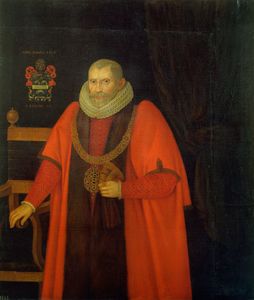
Sir John LEMAN [22733]
- Born: 1544, Saxlingham NFK
- Died: 26 Mar 1632 aged 88
- Buried: St Michael Crooked Lane LND

 General Notes: General Notes:
Funeral of Sir John Leman
His funeral on 3 rd May 1632, five weeks after his death, began at Grocer's Hall and processed to St Michael's Church on Crooked Lane 28 . There were 266 mourners listed and the procession began with children of the hospital (? Christ's), two conductors with staves, followed by poor men in gowns. There were also Officers of Christ's Hospital, two Marshalls of London, the Beadle of the Ward, several cooks, numerous maids and John Lemon's tailor. Friends in cloaks, scriveners in gowns, Doctors of Philosophy and Divinity, Sheriffs and Aldermen, the Lord Mayor, carriers of the sword and arms, as well as 'defunct servants' were present. The coffin was surrounded by officers of the Fishmongers Company, the Goldsmiths Company and their coats of arms, and also City and East India Company representatives. Among the general mourners was Ben Johnson the playwright and poet. The chief mourners were Robert Leman, Thomas Leman, Phil Leman, and William Leman together with their wives and maids. The procession included a choir and a sergeant at arms at the tail. The funeral procession appears to be slightly more impressive than others recorded around that time. Sir John Leman was buried in Fishmongers Chapel on the South side of the Chancel and a rich and very beautiful monument was erected, as requested in his will. The inscription was as follows:-
Nec non piae Memoriae
Joannis Lemanni
Viri Clariff. Civis, ac Senatoris, Integerrimi
Equitis Aurat. olim hujus Urbis Praetoris
Qui fe, in fuo munere, laudatiffime geffit,
Pietatis Cultor, Juftitiae Vindex.
Suis in Coelibatu perpetuo vixit Parens:
Et fuis, plus quam Pater, munifice mortuus:
Hie Refurrectionem expectat;
Sallinghamiae
ex
Agro Norfolcienfi
Oriundus
Probitate
Simplicitate
Nixus
Anno Salutis Humanae MDCXXXII
Et fuo Octuagefimo Octavo
Die Mart 26
Regnum Caelefte
Certa Fide
Praeftolatur
The church was destroyed in the great fire of London in 1666, rebuilt by
Christopher Wren but was later knocked down to make way for a new road in
1832. Thus there is now no trace of Sir John to be seen.
Sir John bought land (the Manor) in Warboise (Warboys) of Sir Oliver Cromwell who died 1654
https://books.google.co.nz/books?id=XQ55YQgv7oMC&pg=PA107&lpg=PA107&dq=Sir+John+Leamon&source=bl&ots=AvnZL-xFRU&sig=ACfU3U1HFX4vMyFIgqqDpDyDlUd5gy5rBg&hl=en&sa=X&ved=2ahUKEwjw2LiUjs3lAhX17XMBHbhYCawQ6AEwAnoECAUQAQ#v=onepage&q=Sir%20John%20Leamon&f=false
Wikipedia
Sir John Leman (1544\endash 1632) was a tradesman from Beccles, England who became Lord Mayor of London.
Career
Leman's business interests grew across the district of Waveney, which spans the Norfolk\endash Suffolk border. In the 1580s he moved to London and extended his business interests to trading in dairy products there before becoming a liveryman of the Worshipful Company of Fishmongers. He was elected alderman of the City of London, in 1606 served as a Sheriff of London and in 1616 he served as Lord Mayor. His agents in London and Essex bought cheese and butter for delivery by sea to London. With a few other tradesmen he cornered the market and this de facto cartel was able to sell at an inflated price that fomented butter riots in London in the 1590s.
In the early 1600s Leman bought Goodman's Fields just outside the City of London near Aldgate. He developed the area as a suburb creating four streets: Leman Street, Ayliff Street, Mansell Street, and Prescot Street, the last three names being those of some of his close relatives.[1]
In 1622 Leman, together with his nephew Robert Leman, and his late brother William's third son William Leman, bought the manor of Warboys, Huntingdonshire, from Oliver Cromwell. Sir John acquired adjacent land a year later and in 1628 Robert granted his interest in the manor to Sir John and William. The latter inherited full title to the manor on Sir John's death.
The school John Leman commissioned in Beccles
Leman died unmarried in 1632 and was buried at St Michael's, Crooked Lane, London.[2] He had retained a strong link with Beccles and provided for a free school in his will of 1631 for the education of 44 pupils from Beccles, two from Ringsfield, Suffolk, and two from Gillingham, Norfolk. The 17th century Leman House in Ballygate, a Grade I listed building,[3] was once the John Leman School and its wall still bears the motto: Disce aut Discede (roughly translated as 'learn or go'). Today the town's museum is situated in Leman House, and the town's high school still bears his name, Sir John Leman High School.
References
"Alie Street Blog Post \endash July 2015". www.rcpath.org. Royal College of Pathologists. Retrieved 19 March 2017.
Burke, John. History of the Extinct and Dormant Baronetcies of England Ireland and Scotland. p. 309. Google Books
Listed Buildings in Waveney District Area[permanent dead link] Waveney District Council, 2007. Retrieved 2009-04-24
'Parishes: Warboys', A History of the County of Huntingdonshire: Volume 2 (1932), pp. 242-46.
Oxford Dictionary of National Biography
Full text of "STORY OF SIR JOHN Leman And The Leman Family Of Warboys And Northaw"
See other formats
A Tale of Wealth
Dedication and
Fraud
Sir John Leman
and the
Leman Family
of
Warboys and North
Preface
Warboys was the centre of attention in the late 1500s when the famous Witches of
Warboys were sent to trial, found guilty and hanged in 1593. The pretended
bewitching took place in the Manor House in Warboys, which was rented from Sir
Oliver Cromwell by Robert Throckmorton. Some twenty years later the Manor and
estate was bought by Sir John Leman and remained under the Leman family
name until 1791 when it passed to William Strode.
This story of Sir John Leman and his family was begun as an exercise to present
to the Warboys Local History Society, but since there were several twist and turns
to the tale, it seemed logical to document the results of the investigation.
While the Lemans owned the Manors of Warboys, Rampton and Northaw (and
other properties and lands) they appear to have lived mostly in London.
The research has involved visits to The National Archives, to the British Library
and to Beccles in Suffolk as well as to Fishmonger's Hall in London. Norfolk
Record Office, Suffolk Record Office, Huntingdonshire Record Office, the Victoria
and Albert Museum and Pembroke College in Cambridge have provided helpful
documentary evidence. Google Books and Archive Books were invaluable in
accessing many reference books published many years ago. I am grateful to
James Woodrow (past curator of Beccles Museum) and Raya McGeorge, archivist
at Fishmonger's Hall for their help, Micol Barengo at the Huguenot Library as well
as Nick Barrett for his team's help in the transcription of Sir John's will. I also thank
Captain Victor Lucas for access to Manor House documents.
The period of study covers mid-1500 to the mid-1800s.
Brian Lake
Warboys 2013
2
John Leman = Margaret Alston Thomas Leman
3
1685-1741
The Early Leman family
The Leman family are reputed to have fled from Flanders and became established
in Norfolk around 1485 in the time of Henry VII. While the name Leman is
comparatively common in the Norfolk area and there are references to various
rectors, vicars and chaplains named Leman, from 1277 onwards, no connection
with these has been established.
There are several reported pedigrees, some of which appear to be fiction, some
with a degree of truth and others seem to have a greater degree of truth. The
following family connections are drawn from a wide variety of sources with as
much cross checking as possible.
The founder of the family was John de Le Mans, had two sons, John and Thomas.
Thomas was a rector of Swaffam and Southacre and died in 1533
John was successful tanner in Gillingham and Beccles and married Mary Alston.
They had four children, William (I), John, Margaret and Anne. The tannery in
Beccles was beside the River Waveney and is now the Waveney House hotel.
The early flint faced house built probably by William (I) Leman is still visible as part
of the recently refurbished hotel. A John Leman of Beccles died in 1566 with an
administration note only, William (I) died in 1602 and his son John carried on the
business. The house was later sold to John Morse.
Waveney House Hotel in 2012
4
The Lemans were important people in Beccles and William (I) was fenreeve
(1580) and portreeve ini 590, and also another twice. 1
The eldest son of John the tanner, William (I), had a daughter Alice and five sons.
John, of Otley and Beccles (died 1618) married Margaret Crampton and
.had sons William and Thomas who founded the Wenhaston Lemans. One of the
descendants was the Rev Thomas Leman an expert on Roman Antiquities, who
lived in Bath in the Royal Crescent and died 1826.
Thomas of Gillingham who founded the Lemans of Bruenshall,
Hetheringset and Brampton Hall..
Philip (died 1679) of Thames Ditton had an only son John.
Robert (died 1637) of Brightwell had four daughters and a son Robert by
his wife Mary. He is buried in St Stephen's Ipswich. He bought the Manor of
Warboys with his brother William (II) and uncle Sir John Leman.
William (II) who married Rebecca Prescott; he bought the Manor of
Warboys with his uncle Sir John Leman and brother Robert. More about William
later.
Note; the question arises as to why John de Le Mans fled from Flanders. The
religious persecution in Europe leading to the Huguenots flight did not begin until
early 1500 and by that time the Le Mans' were established in Norfolk.
Nevertheless it has been discussed whether the family were the first Huguenots,
and although the later family were firmly established in the Church of England,
they are recorded in the Walloon churches in the City of London.
A portreeve is equivalent to mayor but with greater powers. A fenreeve is one who is supervisor
of the fen area (or common land) and oversees the maintenance of hedges and fences.
5
John Leman
John Leman, the younger son of John the tanner, was to become Lord Mayor of
London and was never married, contrary to some claims 2 . He said in his will that
he was born in Saxlingham. In Norfolk there are several Saxlinghams- one near
Blakeney- and two closer to Gillingham named respectively Saxlingham Thorpe
and Saxlingham Nethergate. The parish records for these churches' baptisms do
not go back to 1544 which would have been the year of his birth, given his age of
88 in 1632. So there is no written proof of his birth but it is probable that St Mary's
Saxlingham Nethergate is the one since this is closer to the family seat. The
church at Saxlingham Thorpe is now in ruins.
The village sign and St Mary's Church at Saxlingham Nethergate
The early history of John is not recorded but he appears in London around 1570-
1579, as a butter and cheese merchant. He was living in the parish of St Botolph,
Billinsgate in 1576, and had agents in Suffolk and Essex buying cheese and butter
for transporting by boat to London 3 . The Exchequer Port Books show he entered
at London many barrels (each of 32-42 gallons) of butter and weys 4 of cheese in
2 Rev Alfred Suckling, History and Antiquities of the County of Suffolk, 1847; p 184 from Google
books
3 Thomas Fuller in 'Worthies of England' comments that Suffolk butter and cheese are of the best.
4 A wey of cheese was 256 pounds in Suffolk and 336 pounds in Essex. Antwerp weys were
different again.
6
The period 1579 until at least 1592. The total recorded was about 890 weys and
990 barrels, with a further 860 weys and barrels coming from the ports of
Woodbridge in Suffolk and Colchester in Essex 5 . Robert also appears as a cheese
and butter importer at the same time.
John Leman
importing from
Woodbridge 1592
John Leman
importing from
Colchester 1586
on several
occasions.
Robert Leamon
importing from
Wilton 1587
5 National Archives; Port Books for London El 90/7/6 (1585-6) and El 90/9/3 (1591-2)
7
John Leman was admitted to the East India Company in July 1601 paying £240 as
bill of adventure and later in 1608 bought 350 shares for the third voyage 6 .
The spice trade, in particular for pepper, was important for the first 20 years of the
Company, and John Leman received dividends from the pepper trade. His
nephew Robert also acquired £800 Second Joint stock shares in 1622. It may be
that John Leman was also involved in the herring trade which flourished at this
time. As a fishmonger, and later Prime Warden of the Fishmonger's Company in
1605, his trade would have been enhanced by decrees of Henry VI and Elizabeth I
that fish should be eaten every Friday to help the fishermen.
The last decade of Elizabeth Tudor's reign has been recognized by historians as
an exceptionally volatile period, characterized by "high prices, food shortages,
heavy taxation and major wars against Spain and Ireland." The years 1594-97
witnessed the most sustained and severe inflation of the sixteenth and
seventeenth centuries, culminating in 1597 in the lowest real wages in English
history - flour prices in London nearly tripled between 1593 and 1597- immigration
and population growth that far outstripped the rest of the country, and there was
an eightfold increase of vagrancy in the period 1560-1601. In London there was a
fabulously wealthy elite living cheek by jowl with a thoroughly destitute majority.
Even when gainfully employed, workers earned not much more than subsistence
wages. An 1589 proclamation prescribes wages for London linen weavers of 6d a
day with meat and drink, or 1 0d a day without meat and drink.
Having cornered the market in cheese and butter, and selling at inflated prices,
John Leman must be part at least of the cause of the butter (and possibly also of
fish) riots of 1595. In June of that year apprentices instigated riots against the
then Lord Mayor (Sir John Spencer), against high food prices and imprisonment of
their comrades. Several proclamations were issued by Queen Elizabeth from 1590
onwards concerning disturbances and uprisings. 7
The 1590 proclamation, "Enforcing Curfews for Apprentices," states:
Where the Queen's most excellent majesty, being given to understand of a very
great outrage lately committed by some apprentices and others being masterless
men and vagrant persons, in and about the suburbs of the city of London, in
assaulting of the house of Lincoln's Inn and the breaking and spoiling of divers
chambers in the said house, .hath therefore thought good for the better avoiding of
suchlike outrages hereafter (by advice of her majesty's Privy Council) straightly to
6 Court records of the East India Company 1599-1603 in The Dawn of British Trade to the East
Indies Henry Stevens, pub Henry Stevens and Son London 1886
7 Mihoko Suzuki; Subordinate subjects, gender, the political nation and literary form in England
1588-1688 Ashgate Publishing 1953
8
Charge and command all such as be any householders, that they and every of
them do cause all their apprentices, journeymen, servants, and family in their
several houses to tarry and abide within their several houses and not to be
suffered to go abroad after nine of the clock at night, upon pain of imprisonment. .
In 1595 a further proclamation was issued;
Prohibiting Unlawful Assembly under Martial Law, " which refers to "sundry great
disorders committed in and about her city of London by unlawful great assemblies
of multitudes of a popular sort of base condition, whereof some are apprentices
and servants to artifers... "
On 12 th and 15 th of June a group of apprentices protesting at high prices forcibly
bought fish and butter at lower prices.
On 16 th June, a group of apprentices, soldiers, and masterless men met in St.
Paul's to plot an insurrection against the unpopular Lord Mayor Sir John Spencer
with the aim of "playing the Irish trick on him," i.e., removing his head. 8
On 27 th June 1595 some apprentices were punished by whipping, put on the
pillory and given long imprisonment for taking 5001b of butter from a market
woman at 3d per pound instead of the seller's price of 5d per pound 9 10 . On 22 nd
July five apprentices were arrested after several riots with crowds of up to 1800,
were tried at the Guildhall for treason, condemned and on 24 th July were hung,
'bowelled' and quartered for their crime. 11
He probably entered the Fishmongers Company around 1570 having moved from
the Freedom to the Yeomanry and then on to the Livery. In 1593 he was
appointed to the Court of Assistants and a year later was elected Renter Warden
but declined with a fine of £10. He was later appointed Warden in 1598. In 1605
John Leman became Prime Warden. In that year he became Alderman of the City
of London for the Portsoken Ward and later (1616) transferred to Langbourne
Ward and then in 1617 to Cornhill. In the years 1606-7, encouraged by the
Fishmonger's Company he was appointed Sheriff of London, with William Wathall.
The Fishmongers held him in such high regard that they gave him £100 (twice that
previously given) to furnish his house, and that he should have use of the
Company's plate during his time as Sheriff. 12 The sheriffs would have been tax
collectors and had legal powers, and had to pay an extra £300 for the privilege of
having not only the square mile of the city but also Middlesex to oversee. (In 1630
8 Annals of England 1603, John Stow pps 1279-1281
9 5d in those days in now equivalent to about £2, but when earnings were 6d - lOd per day this
amounted to a large amount
10 John Stow, Annals of England 1603, p 1279
11 John Stow, Annals of England 1603 pi 280-1
12 From Rosemary Weinstein "The making of a Lord Mayor Sir John Leman. The integration of a stranger family" Proc. Huguenot Society vol 24 pps 316-324
9
The cost of being Sheriff was about £3000; the property qualification for an
alderman in 1606 was £10,000, with a fine of up to £1000 for those refusing to
serve). During this time the Fishmonger's Company had financial and military
involvement in Virginia and Ulster, and John Leman contributed to the loans for
these ventures, receiving 7% interest! He remained active in the Fishmonger's
Company, attending the Court Meetings for 39 years to his death. He was auditor
of the Company accounts, was on the committee for the Company's almshouses
at Newington Butts and obtained the right to appoint an Exhibitioner to Cambridge.
In the City of London there was a great increase in the population in the late
1500s and early 1600s, and to prevent famine and to provide for the poor, store
houses were erected. There were twelve new granaries for corn and two for sea
coal, which were begun in 1608 and were finished in 1610, the project being
overseen by Alderman Leman who 'took great care and pains in contriving and
accomplishing this useful work', (from Strype's Survey of London, Farringdon
Ward)
During his period of being Alderman he would have taken part in the lavish
celebrations in preparation for the inauguration of Henry Prince of Wales in 1610.
On 30 th May the Lord Mayor and Alderman and fifty four of the city companies in
their barges with flags set off up the Thames to Chelsea to greet the Prince, but he
was late due to the low ebb tide! He arrived at around four o'clock and was met
with speeches, and they processed to Whitehall. The Lord Mayor and retinue were
told to keep to the city side while the Prince went to Lambeth and on to
Westminster for inauguration on 4th June 13 . The cost to Sir Roger Dallison for
fireworks and shows on the water at this event amounted to £600 (£59000 today).
On 29 th October 1616 John Leman became Lord Mayor of London. His mayoral
procession was a remarkable event and was recorded by Anthony Munday 14 the
then city poet in "Chrysanaleia; The Golden Fishing, or Honour of Fishmongers" 15
on the occasion of John Leman's 'advancement to the dignitie of Lord Maior of
London'. In 1616 Munday asked the Fishmongers Company for £10 for 200 extra
Chrysanaleia books, but settled for £5. 16
The procession consisted of several floats, the first of which was a 'fishing busse'
on which there were fishermen distributing living fish to the onlookers. Following
13 Thomas Bush; The life of Henry Prince of Wales, eldest son of King James I; 1760 Dublin; p 148
14 Anthony Munday was a poet, playwright, actor, prolific writer and traveller in Europe. He
translated texts from Spanish, Italian and French. He was a contemporary of Shakespeare and
Chrysanaleia shows language usually associated with the Shakespearean era. It is known that
he covered at least eight pageants including one with Ben Jonson, and books were published for
each of his descriptions of pageants.
15 Chrysanaleia The golden fishing, or, Honour of fishmongers; Anthony Munday, Published 1616
printed at London by George Purslowe.
16 J. Robertson and D. J. Gordon, eds., 'A calendar of dramatic records in the books of the livery
companies of London, 1485-1640', Malone Society Collections, 3 (1954)
10
This was a crowned dolphin, alluding to the symbol of the Fishmongers Company
and the Lord Mayor's coat of arms 17 granted in 1615. To honour their association
with the Goldsmith's Company, the next float had the King of Moores mounted on
a golden leopard 'hurling gold and silver every way about him'. The next was a
float with a lemon tree (a play on words for Leman) laden with fruit, and at the foot
of the tree was a pelican and young. The pelican was considered a symbol of
devotion because it was thought that she pierced her breast with her beak to
provide her blood to feed the young, again alluding to the office of Lord Mayor.
The tale is in reality an extension on the last supper of Christ. However the Irish
blood transfusion service has the pelican as its symbol. It is now known that the
Dalmatian pelican has such a red colour normally on the breast at this time. There
followed a float in the form of a flowery arbour containing the tomb of Sir William
Walworth, a Fishmonger who was twice Lord Mayor. In 1381 Sir William Walworth
defended King Richard II by stabbing Wat Tyler during the peasant revolution, and
the same dagger is kept in Fishmonger's Hall. The last pageant chariot had a
statue of King Richard with an angel behind holding his crown (so that no one
could take it) and the King holding on to his sceptre. All of the floats were
accompanied by knights on horseback, flags and banners, and many symbolic
figures. On return to St Paul's Churchyard from Westminster the speeches and
poetry began.
John Leman was a bachelor and only the second bachelor Lord Mayor. Anthony
Munday picks up on this and writes:-
A Mayden-man, a Batcheler
You being the second, let me say
This is a blessed marriage day
Of you to that great dignity.
And later:-
....to convey
Our Mayden Bridegroome on his way
Home to his owne abiding place.
Your marriage Rites solemnised
Bequeathes you to the Bridall bed
Where you and your chastwife must rest.
London (it seems) did like you best,
(although you are a Bacheler,)
17 Arms; azure, a fess, between three dolphins, naiant, embowed, argent. Crest; On a wreath, in a
tree, fructed, proper, a pelican, on her nest, feeding her young, or. Motto; Cur optas quod habes
(why choose that which you have)
11
To be her Husband for a yeere:
Love her, delight her. Shee's a Bride
Nere slept by such a Husband's side
But once before. She hath had many
And you may prove a good as any
Have gone before you in this place.
The cost of the pageant is not known but records of the Grocer's Company for the
following year's pageant amounted to £882 18s lid (around £85,000 today). This
does not include the cost of the banquet at Guildhall which followed his taking
office.
Below are some photographs of the original pageant scroll taken with permission
at Fishmonger's Hall:-
King of the Moores on a
golden leopard
Lemon tree with pelican
and brood
Arbour with tomb of
Sir William Walworth
12
The Lord Mayor's
pageant 1616
entitled 'The Golden
Fishing' staged in honour of
Sir John.
Images of the Victorian book which reproduces Chrysanaleia kindly
provided by James Woodrow, past curator of Beccles Museum
John Leman had acquired a reputation for hospitality. On Saturday night 14 th
November 1616 the Knights of the Bath were to be entertained by the Lord Mayor
with supper and a play. However, it appeared that the Knights had already been
dining not wisely and too well, because they were rude, unruly and insolent
'putting citizens' wifes to the squeakes so far forth that one of the Sheri ffes brake
open a doore upon Sir Edward Sackville, which gave such occasion of scandal'.
Quite what the 'squeakes' may be and what was going on behind the door is left to
the imagination. The Knights went away without the banquet even though it had
been prepared. 18
He may have entertained Pocahontas who arrived in London in June of 1616 with
her husband John Rolfe, where they were introduced to the King and attended
many functions. They left London and she died in Gravesend in March 1617 on
her way home to Virginia.
In February of 1617 in spite of ill health John Leman had extended sumptuous
hospitality to the French ambassador and his retinue. On this event John
Chamberlain reported, the 'poore man had been at death's doore these sixe or
seven weekes A9 . He survived this illness.
John Leman was knighted by King James I on Sunday 9 th March 1617 at Court in
Whitehall. John Nichols reported "On Sunday the Lord Mayor went to Court to be
knighted, where among many other good words the King gave them thanks for
their forwardness in this loan of £100,000 which he borrowed of the City, though it
18 'A Jacobean letter writer. The life and times of John Chamberlain'; Edward Phillip Statham 1921 ;
Kegan Paul, Trench, Trubner and Co ltd, London; p 151
19 Letters of John Chamberlain, 2.55 ; also see John Nichols in reference lf > p 246
13
Be not yet raised, but it must be done nolens volens, and they called in very mean
men to bear the burden". 20 See below for further on this loan.
John Chamberlain remarks in another letter 21 that on Easter Monday 1617 the
'counseils' went to the Spittle sermon (given at three churches) and dined with the
Lord Mayor. Elsewhere, Suckling 2 comments 'in 1617 a considerable number of
Lords and others of the King's most Honorable Privy Council, his Majesty then
being in Scotland, after hearing a sermon preached at St Mary Spittle, London, by
the Rev Dr Page of Deptford, afterwards rode with Sir John Leman, Fishmonger,
then Lord Mayor of London, to his house near Billingsgate, where they were
entertained with a most splendid dinner'.
This period was marked by constant requests and demands for loans of large
sums of money by the King and earlier by Queen Elizabeth. The loans by the City
were rarely repaid causing many letters to and from the sovereign and the Lord
Mayor seeking repayment. Early in 1617, on 18 th and 20 th January King James
had written to the Common Council for a loan of £100,000 (between £9M and
£10M today) to be raised by the City of London for his 'going into Scotland', the
security being the Royal jewels!. At first the efforts of the Lord Mayor and his civic
partners were warmly praised by the King (perhaps resulting in his knighthood),
but later as the inflow of money slowed down there was sharp criticism of the
delays which were interpreted as 'backwardnes and ill affeccion, (which wee
would be loathe to find in you) or to the negligent and indiscreete carriage of the
same'. The records go on to say 'no further excuses or pretences, but service and
performance' was required. 22 Eventually only £96,400 was raised, secured by the
City and not the Crown.
There are many letters between the Lord Mayor and the King in Remembrancia 23
covering the period to 1622 'with reference to the payment of money, borrowed by him of the City on his going into Scotland, for which they had received many gracious promises, and sometimes orders by Privy Seal for a beginning of payment, but nothing had been effected, although the Petitioners had daily complaints from widows, orphans, and other decayed persons, who suffered extremely for want thereof. They therefore prayed that His Majesty would give express order for payment'
One entry in particular in 1624 [VI. 125] was a petition from the Lord Mayor and
Aldermen expressing exasperation at the failure to repay.
20 John Nichols;The Progress, Processions and Magnificent Festivities of King James the First;
vol 3 1828; p 253; printed and published by JB Nichols, London
21 A Jacobean letter writer. The life and times of John Chamberlain; Edward Phillip Statham 1920;
Kegan Paul, Trench, Trubner Co Ltd, London
22 R Ashton; The City and the Court 1603-1643; pi 78-9
23 Analytical index to the series of records known as Remembrancia 1579-1664; for the City of
London
14
'Petition of the Mayor, Aldermen, and Commons of the City of London to the King, stating
that they had often troubled him with petitions for repayment of the moneys they furnished
him on his going into Scotland, together with the interest due thereon, of which they had
received none of the principal, and only one year's interest, although His Majesty had
several times given directions for steps to be taken for payment. Time had wrought
alterations in the conditions of the lenders; some were dead, and their widows and
orphans cried out for payment; some were decayed and imprisoned, and others likely to
undergo the same calamity if steps were not speedily taken for their relief. The City's
Seal, which had been given by his commands as security to the lenders, suffered as
never it had done before, and several suits had been commenced against the Chamber of
London in the Courts at Westminster, to which they knew not how to give satisfactory
answer. They therefore prayed that he would give order for such payment to be made to
them as might give relief to the distressed and comfort to them all. '
It appears therefore, that many of the contributors were not repaid when the loan
repayments were due after one year, and that this situation lingered on.
Also there is a letter in Remembrancia 23 from the Lords of the Council on 2 nd
March 1616 to the Lord Mayor and Court of Aldermen, requesting them to procure
from the Citizens a loan of £60,000 for the use of His Majesty. Later on 28 th May
1617 there were complaints of the delay in producing the money, and on 12 th June
a further letter this time from the Earl of Suffolk, Lord Treasurer, requesting that
the balance of the loan for His Majesty's service 'might be forthwith sent in'. On
13 th July the Lords of the Council directed that the amount required to be made up
by the first of August ensuing. Clearly Sir John Leman was having a torrid time as
Lord Mayor with pressure to raise and pay demands from the King. The situation
lasted for the City for many years.
Following the gunpowder plot by Guy Fawkes in 1605, John Vicars translated and
wrote a book ' Mischeefs Mysterie' which was published in 1617 24 . The book,
concerning the gunpowder plot, was dedicated to 'The Right Honourable Sir John
Lemmon Lord Maior of the most famous city of London' and to the President,
treasurer and governors of Christ's Hospital. Vicars was educated at Christ's
Hospital and this explains the dedication.
In 1618 Sir John Leman became President of Christ's Hospital and remained so
until his death in 1632. His portrait now hangs in the seminar room of the museum
at Christ's Hospital school in Horsham, Sussex. It was initially in the Christ's
Hospital building in Newgate, London in the meeting room of the governors
flanked by portraits of other benefactors and founders. There are two other known
portraits, all being remarkably similar, showing Sir John Leman as Lord Mayor in
24 John Vicars; Mischeefes Mysterie or Treasons masterpiece, the powder plot, invented by hellish
malice, prevented by heavenly mercy; 1617; printed by E Griffin, Little Olde Bayly, London
15
His robes. It would seem that two are copies of the original. One of these portraits
is in the Beccles Museum (on loan via the Victoria and Albert Museum from the
Leman family in Brampton Hall); another is in the Royal Collection and reputedly in
Hampton Court, being the only commoner hung there.
He was present as Alderman, with the Lord Mayor Peter Proby and others when
the Consecration of St. James Duke's Place Church, Aldgate took place on 2 nd
January 1622 by the Bishop of London and the Archbishop of Canterbury 25 .
In 1626 Sir John Leman was granted a general pardon by King Charles I. The
document in the British Library 26 is in latin and the first great seal of the King is
attached. The reason for the pardon is not known without a translation, but
general pardons were usually given for political misdeeds.
He died on 26 March 1632.
Portrait of Sir John Leman.
©The Rosalinde and Arthur
Gilbert Collection on loan to
the Victoria and Albert
Museum, London
Below are shown his ring and
seal, also ©The Rosalinde
and Arthur Gilbert Collection
on loan to the Victoria and
Albert Museum, London
25 John Strype's 1720 Survey of London, Farringdon Ward
26 British Library; manuscripts Egerton Ch2226
16
Inquisition Post Mortem for Sir John Leman
From around 1240 there had to be an inquisition post mortem upon the death of
people who owned land as tenants in chief of the king. They were abolished in
1660. This was nothing to do with a post mortem examination of the body in
today's terminology but was to determine the validity of ownership and its transfer
to the legatee, and whether there was any income or rights due to the crown.
Inquisitions were held in each of the counties in which land was held. Many of
these earlier inquisitions have been transcribed (except of course those relating to
Sir John Leman!). The documents, in latin, contain the name of the 'inquisitor'
known as the escheator and the names of the jury members, followed by the
name of the deceased and a description of the lands held and from whom they
were obtained. The heirs are identified and the lands transferred to the heir. Since
Sir John Leman held properties and land in several counties there were multiple
inquisitions, some of which are very difficult to read because of the poor state of
the document, and others which are clear. The inquisition post mortem for Suffolk
shows what he had bought from Roger Bedingfield, but is not easily read.
Part of the Suffolk inquisition post
mortem for Sir John Leman from the
document at The National Archives.
17
In this extract from the Suffolk inquisition post mortem
the names of Theophilus and Beddingfield can be seen,
as well as the manor of Brampton.
At the National Archives there are inquisition post modems for Sir John Leman
relating to Suffolk, Norfolk, Middlesex and the city of London 27 . None have been
found for Cambridgeshire or Huntingdonshire. The city of London inquisition,
under liveries, as a WARD7 file, is in good condition and readable. It contains the
provenance of the Manor of Warboys and shows that John Leman bought it from
Oliver Cromwell alias Williams and that he in turn had it from Henry Cromwell alias
Williams. The Manor of Warboys consisted of eleven dwellings, ten cottages, ten
homesteads, two dovecots, two windmills, plus gardens and orchards.
Part of the
inquisition post
mortem for the
London livery
companies
WARD7 for
'Johannes Leman
wiles' (John Leman knight)
27 National Archives;WARD7 83 228 London; Cl 42 512 2 Suffolk
18
This extract from the London WARD7 inquisition post
mortem shows the detail of the Manor of Warboys.
Funeral of Sir John Leman
His funeral on 3 rd May 1632, five weeks after his death, began at Grocer's Hall
and processed to St Michael's Church on Crooked Lane 28 . There were 266
mourners listed and the procession began with children of the hospital (? Christ's),
two conductors with staves, followed by poor men in gowns. There were also
Officers of Christ's Hospital, two Marshalls of London, the Beadle of the Ward,
several cooks, numerous maids and John Lemon's tailor. Friends in cloaks,
scriveners in gowns, Doctors of Philosophy and Divinity, Sheriffs and Aldermen,
the Lord Mayor, carriers of the sword and arms, as well as 'defunct servants' were
present. The coffin was surrounded by officers of the Fishmongers Company, the
Goldsmiths Company and their coats of arms, and also City and East India
Company representatives. Among the general mourners was Ben Johnson the
playwright and poet. The chief mourners were Robert Leman, Thomas Leman,
Phil Leman, and William Leman together with their wives and maids. The
procession included a choir and a sergeant at arms at the tail. The funeral
procession appears to be slightly more impressive than others recorded around
that time. Sir John Leman was buried in Fishmongers Chapel on the South side
of the Chancel and a rich and very beautiful monument was erected, as requested
in his will. The inscription was as follows:-
28 Sir John Leman funeral procession; at British Library, Western MS 71131
19
s.s
Nec non piae Memoriae
Joannis Lemanni
Viri Clariff. Civis, ac Senatoris, Integerrimi
Equitis Aurat. olim hujus Urbis Praetoris
Qui fe, in fuo munere, laudatiffime geffit,
Pietatis Cultor, Juftitiae Vindex.
Suis in Coelibatu perpetuo vixit Parens:
Et fuis, plus quam Pater, munifice mortuus:
Hie Refurrectionem expectat;
Sallinghamiae
ex
Agro Norfolcienfi
Oriundus
Probitate
Simplicitate
Nixus
Anno Salutis Humanae MDCXXXII
Et fuo Octuagefimo Octavo
Die Mart 26
Regnum Caelefte
Certa Fide
Praeftolatur
The church was destroyed in the great fire of London in 1666, rebuilt by
Christopher Wren but was later knocked down to make way for a new road in
1832. Thus there is now no trace of Sir John to be seen.
28 Sir John Leman funeral procession; at British Library, Western MS 71131
Properties and land acquired by Sir John Leman
During his life John Leman acquired many manors and parcels of land,
presumably funded through his lucrative trading practices. It is recorded in 1606
that he was Lord of Brampton and patron (advowson) of Brampton Church in
Suffolk. This Manor was willed to William Leman (John's nephew) and remains in
the hands of descendants to this day. Many of these descendants are buried in
Brampton churchyard. He also held the Manor of Uggleshall. 1
In 1613 the Manor of Charsfield, Charsfield Hall and the desmene lands in Suffolk
(previously held by the Lord of the Manor of Framlingham) were sold by Sir Henry
Bedingfield to John Leman, and he then in 1629 settled the estate on his nephew
William Leman.
20
Also in September 1613 he sold the Manor of Barleugh Hall in Stradbroke
(Suffolk) with various lands to a Peter Marchant for £750 (now about £72,000)
The Manor of Framlingham and castle had been mortgaged by Thomas Earl of
Suffolk in 1611 for £3000 (£300,000 at today's value), the mortgage later being
redeemed in December 1613. Framlingham Castle was the place where Queen
Mary I was declared queen in 1553 and was at that time an impressive residence
which rapidly fell into disrepair. The financial problems of the Earl of Suffolk
continued and on 4 th February 1621 Sir John's nephews Robert and William
provided a mortgage of £2420 for Thomas Earl of Suffolk and his son Theophilus
Lord Howard of Walden for the manors and lordship of Framlingham at the castle
and Saxted, and Framlingham castle with yards and park. On 13 th March 1621/2
(probably 1622), there had been default in mortgage repayment and the whole of
the properties were assigned to Sir John Leman by Robert and William. 29 In
December 1631 Theophilus, Earl of Suffolk (having inherited the title on the death
of his father) authorised the selling of property to pay his debts, presumably to
regain the manors and castle.
Some years later, in May 1635, Sir Robert Hitcham and others bought
Framlingham Castle and Manor of Framlingham for £14,000 ( about £1.25M
today) from Theophilus Howard Earl of Suffolk 30 after a legal request to declare
his encumbrances on the estate. 31 The Earl said that he had heard that the Saxted
wood parcel had been mortgaged to Robert Leman but that the mortgage had
been discharged and the land resettled on the Earl. If there was any part of the
estate still remaining with the Lemans they would obtain a release. Hitcham had
bought the Castle to give to Pembroke College, Cambridge on his death.
However, it is clear from Sir John's will that he had still retained some of the
Framlingham lands which were acquired from the Earl of Suffolk and Theophilus
Lord Howard of Walden.
The Manor of Warboys was bought in 1622 by Sir John Leman with his nephews
Robert and William from Sir Oliver Williams alias Cromwell, his wife Anne, Henry
his son and Dame Anne Carr, Henry's wife, and Henry Williams alias Cromwell his
brother in 1622 . Sir John was then aged 78. In the following September, Sir
Oliver Williams alias Cromwell of Hinchingbrooke, with Henry Williams alias
Cromwell of Ramsey, his son, leased to Henry Williams land in Upwood, on
condition that he conveyed his interest in the pasture or warren of Woolvey
(about a mile north of Warboys) to Sir John Leman. Robert later granted his
29 Suffolk Record Office refs HD 1538/226/4 4 Feb 1621 and HD 1538/225/20 13 Mar 1621/2 ;
HD 1538/226/5 6 Dec 1631; HD 1538/226/6 14 May 1635
30 Robert Hawes and Robert Loder; The history of Framlingham in the county of Suffolk;
Woodbridge printed and published by R Loder, 1798; p202-203
31 From Pembroke College Archives; Framlingham D6
21
Interest in the manor to Sir John and his nephew William in 1628. Although he
owned many properties, he probably did not live in any of them for any length of
time, being taxed in 1624-1629 specifically in London for his main residence in St
Mary At Hill in Billingsgate. 32 It is said that part of the Manor House in Warboys
was extended by Sir John to include a dining room and staircase and upper hall.
His Warboys estate would have been managed by an estate manager.
In the Cromwell Memoirs 33 there was a passage in which Sir Oliver Cromwell was
praised for his great hospitality and 'upright dealings in bargain and sale'. Sir John
Leman had remarked that the Manor of Warboys was 'the cheapest land that ever
he bought, and yet the dearest that ever, he, Oliver Cromwell sold', a comment
that could be interpreted in two ways - 'what a bargain' - or more probable - 'he
may think it is a valuable estate but to me it is a mere trifle'.
In 1623 Sir John Leman held the freehold on the Blue Anchor in the Minories in
the City of London. By deed, on payment of a legal fee by the parish, there was
transfer of Sir John's interest to trustees to be held to his death, to distribute the
rent among the poor, impotent and infirm of the parish. There was some difficulty
with the lease which took up to 1635 to clear the title. The Blue Anchor had a
gruesome history with the murder of the occupant in 1588 and the trial and
hanging of the murderer.
32 National Archives El 15/254/146
33 Mark Noble; Cromwell Memoirs vol 1; 1786, p 48
22
The Manor of Rampton (five miles north of Cambridge) was sold to Sir John
Leman in 1626 (he was 82 at this time!) by Edward Alcocke who was heavily in
debt, and had obtained an act of parliament to enable him to sell the Manor.
In 1628 he bought the Manor of Barnes which comprised numerous houses,
cottages, gardens, a windmill and a pasture of 42 acres called Goodman's fields,
from William and Alice Goodman and Alan and Anne Carey. This area was known
as Stepney and Bethnal Green, and includes Whitechapel and St Botolphs 34 .
Goodman's fields were originally part of the Abbey of Nuns of St Clair where a
dairy farm was located. The area is known as the Minories.
At some yet to be determined date he acquired Mount Mascall with Jacketts Court
in North Cray, Bexley in Kent from George Cooke, later passing it on to William
Whiffin citizen of London. He also, in the same deal bought the abbey of Lesnes
(now Erith/Thamesmead) with fresh and salt water marshes, before selling on to
Sir John Hippisley who in 1632 sold it to Thomas Hawes. He in turn left the abbey
to Christ's Hospital.
34 'Stepney: Manors and Estates', A History of the County of Middlesex: Volume 1 1 : Stepney,
Bethnal Green (1998), pp. 19-52
23
The John Leman School
Sir John's house in Ballygate Street in Beccles (Suffolk) was to become the school
he founded in his will. The school has since expanded and moved to new
premises, and the original building is now Beccles Museum.
The original school
house in Ballygate
Street, Beccles,
showing the coat of
arms of Sir John
Leman on the
commemorative
plaque above the
entrance door and on
the gable end
24
The Manor of Warboys and the Lemans after Sir John Leman's death
The Leman family had inherited the Manor of Warboys, together with other
properties, and it is probable that William used the monetary inheritance to buy the
Manor of Northaw in Hertfordshire. He and his heirs had little to do with Warboys
except to receive the income from the estate, although while Sheriff of Huntingdon
it is likely that he lived in the Manor House. In the fourth year of Charles II (1660)
William Leman was taxed in the London parish of St Mary le Bowe as his main
residence. The Manor of Warboys and estate included the church and its
advowson. On the death of the current owner the manor and estate was passed
down the family line. The Lemans were patrons of the church and had the right to
appoint the rector. In Sir John's will he said that he wanted William Leman to
present William Johnson to be 'admitted, entrusted and indented' to the rectory of
Warboys when it became void. This was done and William Johnson became rector
in 1647.
It appears that the family, while owning Northaw and Warboys, lived mainly in
London as is evidenced by baptisms and marriages in London city churches. The
manors and estates were managed by tenants and bailiffs.
Robert Leman had bought the Manor of Warboys with his brother William and
uncle Sir John, but relinquished his share, and apart from his involvement in the
mortgage of Framlingham Castle in 1621, does not feature in Warboys. He died in
1637 in Brightwell, Suffolk and is buried in St Stephen's Church in Ipswich.
William (II) Leman 1593-1667
William (II) Leman baptised in Beccles on 22nd September 1593, was the son of
William (I) Leman and Alice Bourne. He was the nephew of Sir John Leman and
inherited the Manor of Warboys in Sir John's will. He was a woollen (and/or linen)
draper (but not a member of the Draper's Company), fishmonger and alderman of
London 1649 and 1653 (for Bread Street and Billingsgate wards). He married
Rebecca Prescott, the daughter of Edward Prescott (a salter, but in other
references a sadler) and Anne Mattingly, on 25 th February 1627 at St Barts
Exchange. In 1622 he is shown as having a house (the Falcon) and a shop (The
Golden Lion) with a warehouse, cellars and solars in Cheapside, St Mary le Bow,
London. He is later recorded as being in the parish of St Botolph's, Aldgate in
1630 having built a house 'away from the main street', and later in 1638 listed for
tithe return to St Botolph's. He was sheriff of Huntingdon in 1641 and when living
in Warboys he received a note from Speaker Lenthall in Parliament that he was to
take instant steps to pay the whole of the poll tax for Huntingdonshire to Sir
William Uvedale at York, the then treasurer of the army. The amount was
estimated to be about £1300-21 400. He was sheriff of Hertfordshire 1635-6, and
at some stage paid £100 to discharge the debt of the borough of Hertford. He was
elected MP for Hertford in 1645 to 1653 and again ini 659-60. He served in the
25
Rump parliament, and was responsible for raising money for the militia. He took
the Covenant (for the preservation and reformation of the protestant religion i.e
against the King) on 29 th October 1645. In this year he was treasurer of the
Eastern Association (the Parliamentarian militias of Essex, Hertfordshire, Norfolk,
Suffolk, Cambridgeshire were established as the "Eastern Association" on 20
December 1642 and later joined by Huntingdonshire and Lincolnshire. They were
the forerunners of the New Model Army). In 1647 William (II) was one of the
treasurers of the army and later in 1652 he was appointed Treasurer at War with
John Blackwell. In 1650 he was appointed to the Council of State for one year. He
was listed as being partly responsible with others for the raising of money for the
maintenance of the armies and navy, in Cambridge (£1890), Ely (£630), St
Albans, Huntingdon (£1066 13s 4d; with Oliver Cromwell and Stephen Pheasant),
Hertford (£2400) and Middlesex. He was described as an active rumper, but not a
Cromwellian.
In 1649 'an act for drayning the great level of the fens' was made in Parliament and
William Leman was among the many commissioners appointed. They were to
oversee and to 'hear, determine, order, adjudge and execute all such matters and
things as are prescribed in this Act'. The commissioners, including William Leman,
met on 21 st , 24 th 25 th and 26 th March 1650/1 in Wisbech at the School House, and
in Peterborough at the Town Hall, Minster Church and the Angel, to hear petitions
and make judgement. 35 It is possible that his association with Warboys and the fen
led to his appointment as commissioner. He does not appear to have anything
further to do with fen drainage.
William (II) had some nine plots of arable land in Cambridgeshire (in the Rampton,
Cottenham area) which he transferred to Martyn Perse, and bought five other plots
in the same area from the Martyn Perse for 5 shillings each (Cambridge Archives
306/T1). William (II) Leman bought the Manor of Northaw (two miles north of
Potters Bar) in Hertfordshire in 1632 from William Sidley whose father, Richard,
had bought it from Lord Russell Earl of Bedford. It remained in the Leman family
until 1744 when it passed to Richard Alie. He took the name Leman (see later).
Eventually the manor passed to William Strode and was sold after his death in
1809.
William (II) Leman was created baronet by Charles II on 3 rd March 1665, and
styled 'of Nin Hall in Northaw, and Warboys'. He must have been very careful not
to have been tainted by his taking of the covenant and the association with Oliver
Cromwell, or he would not have been made baronet. There is some mention 36 that
he offered Charles II pecuniary assistance before the restoration, so this may
35 The History of the drainage of the great level of the fens, called Bedford level; Samuel Wells;
R Phreney, Fleet Street, London; 1830 vol I; pages 216-225
36 The History of Parliament: the House of Commons 1690-1715, ed. D. Hayton, E. Cruickshanks,
S. Handley, 2002
26
Explain how the baronetcy came about. The creation of baronet entailed the
payment of £1095, decreed by King James I in 1612, to be for the support of 30
foot soldiers in Ireland for 3 years at 8d per day, however it appears that William
never paid, together with twelve others. In 1686 there was a Royal Warrant to
"discharge Sir William Leman of the 10951 due for the baronetcy conferred on his
father Sir William by Charles If' 37
He acquired several other properties and in 1665 leased houses with outbuildings
and surrounding land (messuages) in Great Bartholomew Close and Hartshorn
Row in the parish of St Bartholomew the Great, from the Earls of Manchester,
Warwick and Holland.
William (II) and Rebecca had many children, seven sons and eight daughters;
William (III), John, Thomas, Edward, James, Philip (who became rector of
Warboys), Tanfield, Rebecca, Ellen, Martha, Mary, Priscilla, Elizabeth, Alice, and
Anne. William (II) died in 1667 and his son William (III) succeeded his father as
baronet.
His arms, crest and motto are the same as those of Sir John Leman, and the three
dolphins have been used by nearly all of the Leman family. In the church of
Beccles there are several tombstones in the church aisle to various Lemans, and
all showing three dolphins.
Tomb of Matthew
Leman of Weston, a
descendant of John
Leman who was one of
Sir John's nephews.
The three dolphins,
naiant, embowed are
clearly shown. This is in
the north aisle of
Beccles church.
37 From Entry Book: August 1686, 1-20, Calendar of Treasury Books, volume 8 1685-1689; King's
warrant book XI, p94, money book VI, p376
27
Phillip Leman 1640-1693, was baptised at St Bartholomew the Great in London
on 19 th June 1640 and was ordained in 1671. He became rector of St Mary
Magdalene Warboys on 2 nd August 1672. He married Catherine Carter of Colne
on 14 th February 1680 at St Martin's in Threadneedle Street, London, and had at
least eight children ; William 1681, Katherine 1683-1744, Frances 1685, Philip
1686-1732, Rebecca 1687, John and Mary 1689, and Elizabeth who survived for
one week, in 1 690. In 1 685 Phillip was also rector of Rampton (the advowson was
in the Leman family). In a will by Katherine Leman, spinster of Warboys in 1744
she leaves her estate to her niece Sarah, daughter of brother Philip, and on her
death to her (Sarah's) sister Katherine. She bequeaths clothes to her own sister
Frances (Battersby). Philip died in 1693, his wife Catherine surviving him until
1727. In his will of 1694 he left everything to his 'dear and loving wife Katherine'.
In The Complete Baronetage' 38 his son Philip was shown as an apothecary in
Snow Hill, London and married Frances. Their only surviving son was Tanfield,
baptised at St Margarets, Lothbury on13th April 1714, and he succeeded the
baronetcy on the death of William (IV). The only other son of Philip and Frances,
Philip, born 24 th August 1722, died on 18 th October that year. There is a mystery
concerning John (son of Philip the rector) and a later claim to the baronetcy after
the death of Sir Tanfield Leman in 1762. John is reputed to have died in infancy,
but no burial record has been found, although Philip wanted to be buried in the
chancel 'as near to my children as may be', indicating that there may be more than
just Elizabeth buried in Warboys.
Philip's first son, another William 1681-1731, was ordained in 1709, had a parish
initially at Nettleton in Lincolnshire, and also became rector of St Mary Magdalene
in Warboys on 1 1 th February 1722. He married Jane the daughter of the Reverend
Hugh Mapletoft of Huntingdon and died without issue in 1731. The family must
have been reasonably well off because Jane, in her will of 1741 left several items
of silverware and money to her relatives and friends.
The list of rectors of
Warboys showing the
two Lemans. Note also
the name William
Johnson for 1647. He
was to be appointed
under the terms of the
will of Sir John Leman
when the post became
vacant. The owner of
the Manor held the
advowson of the church.
38 Complete Baronetage vol IV 1665-1707 edited by GEC (George Edward Cokayne), published
1904, William Pollard, Exeter, p8
28
William (III) Leman 1637-1701
William was baptised on 19 th December 1637 and was educated at Trinity College,
Cambridge. He stood for parliament in Hertford in 1681, having become baronet
on the death of his father, and trailed badly in the polls. Sir William Leman was
made freeman of Hertford in 1683, and stood for election ini 690 this time
succeeding.. Further attempts in 1695 and 1698 were met with failure. The
elections in Hertford were beset with controversy 39 , because the mayor and
corporation had decided to create freemen (from clergy, gentry and others) who by
their given status would be eligible to vote. There were claims that the honorary
voters outweighed those legally qualified and there was a petition against William
Leman's election, which was dropped on the undertaking that no more honorary
freemen would be created. The undertaking was almost immediately broken in
1692 and again in 1697 and 1698, with leading townspeople calling the mayor and
aldermen 'a pack of as great rogues as any that ever robbed upon the highways'.
Although Sir William Leman stood in the 1698 election, he was 'down with the
gouf, but was within 8 votes of being elected in a very controversial election.
In March 1688 he had been named as deputy-lieutenant of Huntingdonshire,
which may have indicated that he had inherited his father's moderate puritanism.
In a debate in parliament on the 'Bill of oaths for Ireland' in 1691, Sir William
Leman is described as Solicitor General of Ireland, and comments that the Lord's
amendment to the bill exceeds the articles. 40
He married Mary Mansell, the daughter of Sir Lewis Mansell of Margam in
Glamorganshire. The wedding, on 17 th August 1655, was at St Margaret's
Westminster. They also had a large family; Mansell, Robert (1675-1692), William
(1680-1681), Mary, Rebecca (died 1695), Elizabeth (1661), Lucy (died 1664),
Lucy (1665) Theodosia (1662) and Sarah (1667). At this time the family were
associated, presumably as Alderman, with the Alie family, and Mansell married
Lucy Alie the daughter of Alderman Richard Alie (a master of the Scrivener's
company) in 1674. Henry Alie, brother of Lucy, married Elizabeth Leman at St
Mary le Bone, London on 2 nd October 1689. Mary Leman married Peter Pheasant
of Upwood, just north of Warboys in 1674, and later lived in Northaw. The
Pheasant family had bought the Manor of Upwood from Sir Oliver Cromwell in
1649. Theodosia was married aged 17 to Lewis Newnham in 1679 in London and
in a marriage settlement the Manor of Warboys became theirs.
39 The History of Parliament: the House of Commons 1690-1715, ed. D. Hayton, E. Cruickshanks,
S. Handley, 2002
40
Grey's Debates of the House of Commons: volume 10 (1769), pp. 191-217. 'Debates in 1691 :
December 3rd-1 2th'
29
Mansell died in 1687 before his father so did not inherit the baronetcy. Mansell
and Lucy had two children, William (IV) and Lucy. At this stage the situation was
further complicated by the addition of yet another Lucy, the daughter of Elizabeth
and Henry Alie, who also had a son Richard.
On the death of William (III) the baronetcy passed to William (IV) the son of
Mansell. This William married Anna Margaretta Brett, who according to Horace
Walpole was the mistress of George I. However this seems to have been an
invention and the real tale revolves around the potential position as mistress when
she was installed in the palace while the King went away. On his return a
countess's coronet was to have rewarded the young Lady's compliance. She liked
the view from her window and had a door made in the wall so that she could walk
in the garden. The eldest of the princesses (Anne) took exception and had
building work reversed, only for the door to be reinstated. The King returned from
abroad and died. So Anna Margaretta never gained the coronet and position of
mistress. It is very unlikely that the King would have been able to take another
mistress given the formidable nature of Ehrengard Melusine von der Schulenburg,
his long term mistress and probable secret wife.
William (IV) and Anna never had children so when William died in 1741 the
baronetcy passed to Sir Tanfield Leman, the surviving son of Philip (who was the
son of Philip the rector of Warboys) and Frances. Tanfield (1714-1762) wrote a
booklet of 40 pages entitled 'an historical deduction of government in a letter to a
friend in the country' which was published in 1748 and cost 6d. He died and
having no male heirs the baronetcy became extinct.
The manor of Warboys and the associated estate lands were handed down
through the family, with some divisions and settlements on marriage. The Manor
had been given to Theodosia Leman and Lewis Newnham on their marriage in
1679, but occasional legal challenges were made with Sir Robert Swayne claiming
he owned the Manor in 1682 in a dispute with Francis More and Sir Alexander
Pitfeild against Ludovic Newnham and Mansell Leman 41 . In 1695 Sir William (III)
with his wife Mary, and Mansell were in dispute with Richard Alie and Sir Edward
Mansell over the rightful occupancy. Sir William, Mary and Mansell were the
'deforcients' which in legal terms means keeping the rightful owners out, and in his
will of 1701 there is no mention of Warboys. However in a complicated will by
William (IV) of 1712, proved ini 742 after his death, he said the Manor of Warboys,
had been in the possession of his grandmother Dame Mary Leman, and that it had
passed to his mother Lucy when Dame Mary died. Furthermore he wanted the
manor to pass to Richard Alie on the death of Lucy and for Richard Alie to take the
name of Leman. Lucy died in 1742 just after William and left the residue of her
estate (after debts etc) real or personal to Richard Alie, so this would have
41 Proceedings for common recovery 5 July 1682 at Cambridge University Library, Department of
Manuscripts and University Archives; GBR/001 2/MS Doc.31
30
Included Warboys. In 1743 there was a further legal wrangle between the Lemans
and the Newnhams, with Dame Anna Margarita Leman denying she refused to
disclose any of Sir William's effects and that Warboys was encumbered by a
mortgage by a former owner but did not know whether the mortgage had been
paid.
Richard Alie (now Leman) died in 1749 having made his will in 1746 leaving his
portion of the manor of Warboys to his sister Lucy. She in turn, in her will of 1754,
left 'my real estate in the parishes aforesaid and also all my manors messuages
lands tythes and real estate whether freehold or copyhold situate and being in the
several counties of Hertford Cambridge Huntingdon Middlesex and in the City of
London or elsewhere in the kingdom of Great Britain' to John Granger of Smith
Street, Westminster. She also charged her 'real estate situate lying and being in
the parish of Saint Botolph without Aldgate London and in the parishes of Saint
Botolph Aldgate Saint Mary Matfellon otherwise Whitechapple and Stebunheath
otherwise Stepney in the County of Middlesex' with the payment of the several
annuities she left. It is clear that she was very rich having property handed down
through the Leman family, and the amount of money she left (excluding the value
of property) amounted in today's value to £245K on retail price index or £3.4M
based on average earnings.
In the will of William (IV), Richard Alie was to inherit the manors of Northaw,
Warboys and Rampton, even though the manor of Warboys had already been
given to Theodosia and Lewis Newnham on their marriage in 1679. There was a
clause in the will which said . 7 will and desire the said Richard Alie immediately
upon the possession of all or any of my estates to take upon him the name of
Leman'. Consequently there was an act of parliament in 1745 42 'to enable
Richard Leman Esquire, formerly called Richard Alie, and the Heirs Male of his
Body, to take and use the Surname of Leman, pursuant to the Will of Sir William
Leman Baronet, deceased.' Richard died, not having married in 1749 leaving his
half part of the Manor of Warboys and the houses belonging, as well as his part of
the Manors of Northaw and Barnes (Goodmans Fields) and other properties in
London to his sister Lucy Alie. Lucy later died in 1753 leaving in her will all her
properties to John Granger of Smith Street, Westminster. She left £50 per year to
Christopher Wood of Warboys, her bailiff, and other cash bequests in addition to
the properties. The will was contested by Elizabeth Newnham, sister of Theodosia,
but the will was declared valid. In 1754 John Granger changed his name to Leman
in an act of parliament in which he sought permission to bear the arms of Sir
William Leman 43 . He said that it was for the great regard he retains for the
memory of Sir William Leman, and although there is no record found of their ever
meeting, they both lived in Northaw. The act reads in part:-
42 Parliamentary Archives; Private Act, 19 George II, c.3 ref HL/PO/PB/1/1 745/1 9G2n10
43 Parliamentary Archives; Private Act, 27 George II, c. 1 ref HL/PO/PB/1/1 754/27G2n9
31
And whereas the said John Granger from the great regard he retains for the memory of the
said Sir William Leman from whom he derives the said estates in manner aforesaid is
desirous to take and use the surname of Leman only and to bear the arms of the said Sir
William Leman. May it therefore please your Majesty that it may be enacted and be it
enacted by the King's most excellent Majesty by and with the advice and consent of the
Lords spiritual and temporal and commons in this present parliament assembled and by
the authority of the same that the said John Granger and his heirs shall take upon him and
themselves and use and write and call and describe themselves by the surname Leman
and shall bear and use the Arms of the said Sir William Leman Baronet deceased
There was nothing in the will of Lucy or Richard which required the name change,
and the right to bear arms, not given to or requested by Richard, may be an act of
vanity. A later Private Act of Parliament in 1756 confirmed the division of several
estates in London, Middlesex and Huntingdon between John Newnham, Elizabeth
Newnham and John Leman 44 , so perhaps the argument over the will of Lucy Alie
was resolved amicably. John Leman in 1755 also exchanged lands with the Lord
Mayor of London and the Governors of Christ's Hospital, presumably for money.
John Leman, described himself of Northaw, possibly where he had met Sir William
Leman, had extensive property in London. Very few details of his life have been
found. He had married Elizabeth Worth, (born 29 th August 1728 in Stepney,
daughter of Captain Philip Worth of the East India Company and his wife
Elizabeth) in Northaw on 2 nd July 1757, but had no children. He died in Bath on
29 th September 1781 , and in his will wanted to be buried in the family vault he had
built in the church in Warboys. After his death Elizabeth married William Strode,
and on her death was buried in Warboys. Two monuments record their burial
place in the chancel of St Mary Magdalene, Warboys. The monuments, in marble,
are the work of the famous sculptor Francis Bacon RA.
On the left is the monument to John Leman, and to Elizabeth on the right.
44 Parliamentary Archives; Private Act, 29 George II, c. 51 ref HL/PO/PB/1/1756/29G2n145
32
In his will he left money to his sister and nieces, and all his manors, houses and
lands he left to Elizabeth, with the proviso that should she die then all the property
should go to 'my worthy friend' William Strode of Northaw.
William Strode 1738-1809 was exceedingly rich with numerous properties. He
had been elected as MP for Yarmouth, Isle of Wight in 1768, but was unseated on
petition. It is sure that he never spoke in the house and doubtful he ever voted.
No other attempt to enter parliament was made. He married Elizabeth Leman
(John's widow) on 9 th November 1783, and when she died in 1790 he married
again, this time to another widow - Mary Finch (1 766-1 81 3).
In his will of 1809 he wanted to be buried in his vault in Hatfield, and that his
relative's bodies be brought from St Mary Axe when the church was rebuilt and
buried in the vault. He left money in trust to various relatives to a total value today
of approximately £75M (average earnings) or £8M (rpi). All his manors and
property were to be sold at public auction, the money raised to be invested and
the interest gained to go to his sister in law. He also provided for the rebuilding of
Northaw Church by using the profits from the sale of the estates. The will
proceedings were put into Chancery in a dispute by the nephew John Cranbourne
Strode, which was resolved in 1810.
Northaw is where the later Lemans lived and died. In 1708 Sir William Leman
added a chapel to the church in which there was a Leman vault where the family
was buried. This church was pulled down in 1808 and all traces of the family were
lost. As with Sir John Leman, they did not have much luck with their choice of
resting place. The new church, rebuilt with the bequest from William Strode, later
proved to be poorly built and destroyed by fire in 1881. The latest church built in
Victorian times has no evidence of the Leman family, except that in the
churchyard there is a tomb for the Overman family erected in 1735 by William
Overman with the permission of Madam Leman wife of Sir William Leman. Earlier,
in 1669, Thomas Overman had married Mary Leman daughter of William (II). The
Northaw estate comprising manor, mansion, sundry villas and 2600 acres was
sold at auction in 1811.
The sale at auction of the Warboys estate was in two parts. Firstly the land
comprising some 900 acres and the Royal Oak public house was auctioned on 4 th
April 1812 at the George Inn, Huntingdon. Later on 22nd April 1812 at
Southampton Buildings, Chancery Lane, London the rectory of Warboys and
advowson, with two lots of land (950 acres and 1500 acres), was auctioned
together with the advowson and rectory of Rampton. The Manor house was not
included since it had not been in the possession of William Strode.
33
The various lots of land in Warboys were sold in Huntingdon as follows;-
Lot 1 Blacklands Farm and Grange Farm 337 acres for £16,816 to John
Carstairs
Lot 2 Old Grange Farm 1 1 acres for £1111 to Oliver Dring for Johnson Dring
Lot 3 Mill Green for £140 to Benjamin Harvey
Lot 4 40 acres for £2183 to Henry Sweeting
Lot 5 32 acres for £2132 to Henry Sweeting
Lot 6 part of Old Grange Farm 27 acres for £1 670 to William Elmer
Lot 7 part of Old Grange Farm 49 acres for £2810 to Thomas Longland
Lot 8 Wilthorne, Clapgate and Pingle Woods, and Heath Common 224 acres
for £13,331 to Thomas Longland
Lot 9 Fenside Common 1 0 acres for £930 to Thomas Meadows
Lot 1 0 Turf fen 3 acres for £1 1 5 to David Darwood
Lot 11 Turf fen 7 acres for £240 to John Hobbs
Lot 12 Fen Farm 140 acres for £6000 to John Longland
Lot 13 Royal Oak Public House and meadow for £560 to William Elmer
Lot 14 cottage and 8 acres for £570 to Oliver Dring
The rectory was later
pulled down and replaced
by the Moat House,
opposite the church.
The remaining properties of William Strode was sold at auction in London in 1814.
The Leman Estate Fund Fraud
The sale of the various parcels of land would seem to be the end of the tale but
ini 838 there was a claimant to the baronetcy which according to the claimant
would have resulted in the possession of the auctioned lands as well as the
properties in London and elsewhere. John Leman a framework knitter of
Nottingham claimed descent from the John Leman, son of the rector Philip Leman.
He claimed he was the next male in line to inherit the baronetcy on the death of
Sir Tanfield Leman in 1762. He pursued his claim in the Scottish Courts (he was
living in Edinburgh at the time) and according to the Caledonian Mercury of 19 th
May 1838 the jury ruled in his favour. The now titled Sir John Leman, Bart then on
the same day entertained the judge, jury and select friends at the Waterloo Hotel,
to a 'superb and substantial dinner with wines of a superior quality'! This sounds
very suspicious.
A report in the Times of December 1838, quoting reports in the Loughborough
Chronicle and the Blackburn Standard, says that Sir John Leman Bart, 'the poor
Nottingham mechanic' had been making a friendly tour of his old haunts and had
35
Met with old friends and acquaintances at the Moira Arms in Castle Donington.
There he distributed his new found wealth liberally among his fellow craftsmen in
the blond trade (silk and lace) and 'many a bumper was drunk to his health'. He
died in Wakefield in the summer of 1839 and. a further claim was made resulting
in a note in the Edinburgh Gazette of 21 st June 1842 to the effect that Edward
Godfrey Leman is entitled to the baronetcy.
In March 1843 a Joseph Leman, a farmer from North Cadbury in Somerset, wrote
to The Era 45 claiming not only the title but also the lands in the will of William
Strode. He said that he had had his claim investigated by 'a jury of the first
respectability in Scotland' and quoted the Edinburgh Weekly Chronicle. He stated
that he had contacted Parkes solicitors and they denied knowledge that they were
acting for Sir Edward Godfrey Leman. Joseph Leman is widely reported in the
national and provincial press in early 1843 said to be the heir of Benjamin Leman,
the son of Sir William Leman and Mary. The Lincolnshire Chronicle of 7th April
1843 reported him driving into Warboys with four horses on a dashing equipage,
accompanied by his solicitor with the intention of serving eviction notices on the
occupants of the properties he claimed. After that date he does not appear again.
BARONETCY\emdash CHANCERY.
I N Pursuance to a Brief issued out of Her Ma-
jesty's Chancery, for EDWARD GODFREY
LEMAN, with a view to obtain for him the status
of a Bahonet, by legal authority ; his claim was
tried at Edinburgh, on Monday last, the 13th in-,
stant, before a Jury of honourable men, the ma-
jority of whom were composed of Members of the
College of Justice, and Erskine Douglas Sandford,
Esq. Steward of the Stewartry of Kirkcudbright,
Presided as Chancellor. A Verdict was given in
favor of the Claimant, and his service has since
been duly retoured to Chancery ; whereby he is
entitled to the honor, rank, and dignity of Baronet,
in terms of the Patent granted by King Charles.
II, to Sir William Leman of Northaw, Bart,
dated 3d March 16*65.
MESSRS. PARKES & SON, 1, Verulam Buildings,
Gray's Inn, London, Solicitors for the Claimant
in England.
ALEX. HAMILTON, W.S. Agent in Scotland.
Mb. FITZSTRATHERN, Law Genealogist.
The supposed pedigree of the claimants begins with a John Leman who was
claimed to be the son of Philip, rector of Warboys, (but this John probably died in
infancy). He is said to have married and had two sons Edward and John. Edward
was a stocking maker in Nottingham and then a soldier and died in the West
Indies in 1790. John was a soldier, abroad and never assumed the title, but had
married and had a son Godfrey, who became sick, impoverished and an 'imbecile'
and never assumed the title. Godfrey had married and produced a son John who
was the initial claimant 'proving' his descent in Edinburgh in 1838. After John's
death ini 839, Edward Godfrey Leman a brickmaker, the son of Edward was put
45 The Era, Sunday 5 th March 1843.The Leman Case.
36
Forward as claimant of the title and of the estates. As a result Edward Godfrey
Leman, a 'simple looking old man dressed in a clean blue smock frock' who could
not write, appeared in the insolvent debtors court in Nottingham in 1846 46 . In his
statement he said that a Mr Keightley brought a paper for him to sign but he did
not know what was in it. At his arrest in November 1845 he stated that he had
'claimed to be entitled to an estate situated in Goodman's Fields, London and also
one at Warboys and in Hertfordshire. I give up all my right, title and interest (if any)
in the said property, but I have no knowledge of what the estate consists'. He had
been arrested for insolvency because a Mr Hawkins who legally owned part of the
Leman Estate in London had taken the claim to the Court of Queen's Bench. The
claim was thrown out leaving the claimant (Edward Godfrey Leman) liable for
costs. The Nottingham court and Mr Hawkins decided he had been 'a blind tool in
the hands of other parties' and he was discharged from insolvency.
However in two letters to the Times of December 1845 and March 1846, the
solicitor for Sir Edward Godfrey Leman, ETS Kightley states that all had been
explained several times before several witnesses, and that Sir Edward was fully
aware of what was being done. He also said that Sir Edward's son Edward had
power of attorney and should have been allowed to speak at the hearing. It would
appear, if Kightley can be believed, that Sir Edward was acting the poor mislead
dupe. He died in 1847 aged 82.
m 1718
John Leman = Sarah
m 1765 | m 1745
Edward = Elizabeth Bates John = Mary Smitham
1733-1790 I 1724-1792 I
Edward Godfrey = Mary Burton Godfrey = Ann Whittaker
Edward
1804-1884
John
1781-1839
Pedigree of the claimants to the baronetcy after the death of Sir Tanfield Leman in 1762
The claim to the baronetcy was widely reported in the national papers ranging
from The Cork Examiner, The Norfolk Chronicle, Huddersfield Chronicle,
Leamington Spa Courier, Blackburn Standard, Exeter and Plymouth Gazette,
46 Manchester Guardian 4th April 1846 Curious case of insolvency.
37
Taunton Courier and Western Advertiser, to the Leicestershire Mercury as well as
the Times and Guardian. All said that the baronet would speedily come into the
possession of the lands and properties in dispute! They seemed to feel sorry for
John Leman who was a mechanic, framework knitter in Nottingham, and later for
Edward Godfrey Leman.
In January1850 an Arthur Henry Leman appeared at the Insolvency court 47 for the
second time. He claimed to be a descendant of Sir William Leman and a claimant
to the Leman Estate. He had been employed as an agent for a Mr Newnham who
had married into the family and had supposedly given a bond for £100,000 to
claiming parties, payable on recovery of the property. Arthur Henry Leman had got
possession of a house in Goodman's fields, but the rightful owner had brought an
action for recovery. Mr Newnham did not appear, no explanation was given, and
the insolvent Arthur was arrested.
A fund had been established early in 1853 and a prospectus issued by a set of
people who sold shares for 10s in the Leman Estate Fund. They said that the
rightful heir had foregone the full claim because he could not afford the legal
costs, but had allowed them to act on his behalf so that he could enjoy some of
the profits when the claim was settled. The amount purported to be £500,000 in
chancery and up to £3M in total. There were notices in the National Press until late
in 1853 to that effect. The company secretary was Robert Waters. The trustees
were William Thomas Parkes solicitor, Robert Waters, William Richardson,
Thomas Bond Loader, John Nicholles, James Williams and Capt Archibald
Douglas (who later removed himself from the trustees). There were letters to the
Times and other papers warning prospective investors that they were unlikely to
get their money back or indeed any of the profits. There was also support for the
fund from a new claimant Joseph Leman.
In August 1853 there was a letter from JW Pycroft of New Inn drawing to the
attention of Horace Waddington at the Home Office that the claims to the
baronetcy had been thoroughly investigated by himself and Sir Charles Young the
York Herald of the College of Arms in the years 1837, 1838, 1839 and 1840. They
had discovered a forged will and parish records with leaves removed and
transcripts stolen. He wrongly attributes John Leman as the father of Edward
Godfrey, and states that John 'Lemmon' had defrauded the 'poor ballast heavers
on the Thames side' of around £30,000 and that legal proceedings were about to
be taken, but John Lemmon had died. The thorough investigation was not as
thorough as might have been expected from the College of Heralds. Pycroft,
however, rightly asks for the public to be alerted to the fraud now being
perpetrated. The Home Office forwarded the letter and prospectus to the
Commissioner of Police to make enquiries, with the comment
47 The Observer 27 January 1850 The Leman Estates; in the matter of Arthur Henry Leman
38
This is a most barefaced attempt to defraud the public by getting dupes to
subscribe to a pretended fund for the recovery of a property of three millions value.
The fund had been identified as illegal as early as April 1853, but was not brought
to court until 27 th November 1853 when summons were issued at Bow Street
against the company secretary and nominal trustees. On December 3 rd Thomas
William Parkes solicitor, Robert Waters (the 'company' secretary), William
Richardson, Thomas Bond Loader, John Nicholles, James Williams and Capt
Archibald Douglas were due to appear at Bow Street. Parkes was unavailable
because he was in Whitecross prison (as a debtor), and Captain Douglas was no
longer a trustee. Although Parkes had been a solicitor, the firm of Parkes Solicitors
had denied in their correspondence, according to Joseph Leman in 1843, of
acting for Sir Edward Godfrey Leman (although their name appeared on the note
in the Edinburgh Gazette of 1842).. After much discussion lasting all afternoon the
defendants were allowed bail to appear at the Old Bailey. At the Central Criminal
Court on 12 December 1853 the case opened and the Grand Jury retired - no
record of the result, but a later note that the case had been sent to the Court of
Queen's Bench in January 1854. No trace of the court proceedings have been
found.
Leman and the City of London
Sir John Leman was one of the richest Londoners, and his contemporaries
regarded him as 'father of the city' 11 . His influence and that of the later Lemans on
the City of London is reflected in the street names just to the north of the Tower of
London. Within a short distance can be found Leman Street, Alie Street, Mansell
Street and Prescott Street, and in addition there is the Goodman's Field public
house. Few families can claim such a legacy.
Appendices.
Properties and land belonging to Sir John Leman
Legacies distributed in Sir John's will of 1632
Properties and land belonging to Sir John Leman and mentioned in his will
The 'Swan' in Thames Street, given to Henry Leman, Robert Leman's servant
The 'Cock' given to Henry Leman, Robert Leman's servant
Property in St Botolph's Lane given to Henry Leman, Robert Leman's servant
School house and garden in Ballygate, Beccles, to be a school
House known as Willowbies or Girdlers plus lands in Gillingham, Geston, Windell
and Welston
Land of 30 acres in Barsham
Lands, tenements know as Great Cobbs, little Cobbs, Cobbs meadow, Forcknells,
Blamhards acre and the horse close in the parish of St Andrew in llkettishall,
Ringsfield and Barsham
Manor of Rampton, Cambridgeshire, given to William Leman
Manor of Warboys, Huntingdonshire, given to William Leman
Lease of land in Hereford
Estate and lease of lands in Woodbury alias Westhorpe, Gamlingay and Everton in
the counties of Cambridge and Huntingdon
Lease and estate (place not given) mortgaged to him by William Ayloffe sergeant at
law
Lands called Buttenhaw wood, Buttenhawe Lawne and Buttenhaw Meade, Newell
wood, Bradley wood, and Oldffrith wood lying in Framingham in Suffolk
Manor of Barnes (Goodman's fields) all other property lying in the parishes of St
Mary Mattel Ion (Whitechapel) in Middlesex and St Botolph without Aldgate
Land and property called Gardiners and other lands and property lying in Otley,
Clopton, Great Thorneham, Wickhamskeigh and Gislingham in Suffolk
Manor of Charsfield
40
Legacies distributed in his will of 1632
To the poor of St Thomas hospital £100
To the poor of St Bartholomews hospital £100
To the poor of Bridewell £50
To poor prisoners at the Counter near Poultry £20
To poor prisoners at the Counter in Woodstreet £20
A further £20 to release poor prisoners from the above with debts of 40s or less
To poor prisoners of Ludgate £20
To poor prisoners of Newgate 40s
To poor prisoners in the Marshalsea, the King's Bench, the White Lion, and the
Compter in Southwark 40s each prison
To the poor of Bethlem (Bedlam) £5 paid to Bridewell masters
To 20 poor men and 20 poor women of Beccles cloth at 8s per yard for a gown each
plus 6s 8d each
To poor of Gillingham St Mary 40s
To poor of Gillingham All Saints 40s
To poor of Otley £5
To poor of parish of Gillingham £3
To poor of Great Thornham £3
To poor of Ringsfield £3
To poor of Saxlingham £10
To poor of Charsfield £5
To poor of several London parishes £40 for bread to be distributed
To poor of Cornhill Ward £10
To those attending funeral £40 or more for a dinner
To poor old men of Fishmongers cloth at 8s/yard
To Fishmongers and hospital governors attending funeral £50 for a dinner
To Fishmongers £60 to give to 60 poor men and widows
To Fishmongers £30 for a salt of silver to remember him
To Fishmongers the rent of £1 2 per year from the Swan for sea coal for the poor in
their almshouses
To the mayor £10 from rent to pay preachers at St Paul's Cross twice a year
To churchwardens of three parishes 52s/year for distribution of bread to poor of
the parish (St Mary at Hill, St Botolph, and St Michael Crooked Lane)
To the school in Beccles the rent and profits of certain lands
To Henry Mantrup £10 per year for 40 years from Manor of Warboys
To Nicholas Sheene £10 per year for 40 years from Manors of Warboys and
Rampton (later revoked in a codicil)
To Gervase Browne £20 per year for 40 years from Manors of Warboys and
Rampton
To Robert Royden £1 0 per year for 40 years from Manors of Warboys and
Rampton
To Gervase Browne £20, Henry Mantrup £10 and Nicholas Sheene £10
To all servants their wages plus 20s per year for each year worked with him
To Master Deynes, preacher at Beccles £10
To Master Baker, preacher at St Mary Hill, London £10
To children of William Crickmore £100 divided amongst
To Mary Crickmore, mother £100 to bring them up
To Anne Barbour, daughter of his sister Margaret Collen £200
To Children of Anne Barbour and Richard Barbour £200 divided amongst
To Philippa Mewse, daughter of Richard Pearse and Joan, £100
To Thomas Mewse £150
To the two sons of Philippa Mewse £50 each
To Simon Hammond to bring up his children by Anne deceased, daughter of Philippa
Mewse £300, and to Simon a mourning gown
To Richard Leman (living with Robert Leman) £100 (later revoked in a codicil)
41
To John Leman, brother of Richard (living with Alderman Whitmore) £100
To children of the late John Burrell by Philippa his wife £50 each
To John Deyes, son of William Deyes £1 00
To daughter of William Deyes £1 00
To William Deyes and wife Elizabeth gown cloths at 26s 8d per yard
To John Bristowe, apprentice, £100 when apprenticeship completed
To William Cason, apprentice, £10
To Henry Haslefoote, haberdasher, £5 and gown cloth at 26s 8d per yard
To William Crane, his late linch boy, £10
To Philip Leman, nephew, land in Hereford, Woodbury (Westhorpe), Gamlanghay
and Everton
To Robert Leman, nephew £1000
To Thomas Leman, nephew, £2500, and lands in and around Framlingham
To William Leman, nephew, £1000 and he must appoint William Johnson to rector of
Warboys when rectory becomes vacant
To governors of Christ's Hospital £100 per year from rent of properties in London;
(this annuity was sold in 1 799 for £2400, equivalent to £250K at today's value)
To William Johnson £40 per year from rent of properties in London
To Richard Barber £1 00 to build a house
To children of William Kniveton alias Clifton by wife Leman £100 each
To Joseph Cutlove, his apprentice £300 when 24 years old and apprenticeship to
continue with William Leman
To Alice Barwick wife of Thomas Barwick, daughter of brother William Leman £40 per year for 40 years; if her
husband dies before her 1000 marks
To children of Priscilla Johnson wife of late William Johnson, £1 50 each, except
William
To Alice Leman, daughter of nephew John Leman deceased £1 000 and £500 each
to other daughters
To executors all land and estates mortgaged for £2000 by Sir Francis Fulford
To Laurence Lomaxe of Eay and wife £6 13s 4d to buy a ring for remembrance
To children of Laurence Lomaxe £100 each
To George Almery and his wife, mourning gowns; and to their children £5 each
To William, Thomas, Robert, Philip estates and manors already done by deed
To Anne, daughter of brother William, wife of Rowland, £300, and to her children £50
Each
To Margaret Leman, widow of nephew John £50 per year for 40 years from rent of
Properties, and to her 4 children £50
To Samuel Smith of Grays Inn £40 and a mourning gown (later revoked in a codicil)
To John Winterbourne £5 and mourning
To Thomas Martin schoolmaster of Beccles £10 per year for 3 years
To Robert Leman and William Leman the residue of the estate etc
To Sir Martin Lumley and Humphrey Smith, aldermen £20 each, and a mourning
gown and a gold ring value £5 each
To Sir Martin Lumley a further £30 to buy a pair of coach horses
42
https://archive.org/stream/STORYOFSIRJOHNLemanAndTheLemanFamilyOfWarboysAndNorthaw/STORY+OF+SIR+JOHN+Leman+and+the+Leman+Family+of+Warboys+and+Northaw_djvu.txt
Research Notes:
A number of pedigree's list Mary Alston d of John of Pavenham BDF this is unproven 2015
LEMAN, Sir JOHN (1544 -1632), Lord mayor of London, born at Saxlingham, Norfolk, in 1544, was younger son of John Leman, of Gillingham in Norfolk and Beccles in Suffolk, and Mary, daughter of John Alston of Pevenham, Bedfordshire. The family were descended from John de la Mans, who fled to England from the Netherlands, and died about 1485. Leman carried on business in Thames Street, near Botolph Lane, and was a member of the Fishmongers' Company, of which he served the office of prime warden in 1616. He was elected alderman of Portsoken ward on 15 Aug. 1605 (City Records, Rep. xxvii. f. 64), and served the offices of sheriff in 1606 and of lord mayor in 1616-1617. He was 'removed' from Portsoken ward, apparently to Langbourn, which he represented in the year of his mayoralty (ib. Rep. xxxii. f. 355). By his prerogative as lord mayor he again removed, on 8 Oct. 1617, from Langbourn to Cornhill, which he represented until his death (ib. Rep. xxxiii. f. 173 b, xlvi. f. 190). Upon his inauguration as lord mayor, the Fishmongers' Company provided a pageant of unusual magnificence. It was composed by Anthony Munday, the city poet, and was entitled 'Chrysanaleia, the Golden Fishing; or Honour of Fishmongers …,' London, 1616. The original coloured drawings for the devices are still preserved at Fishmongers' Hall, and were reproduced for the company in facsimile, with a reprint of the pageant and historical notes, by Mr. J. Gough Nichols, F.S.A., in 1859.
In February 1616-1617 Leman, while mayor, was very ill. 'The French ambassador and his company last night,' John Chamberlain wrote to Sir Dudley Carleton, 22 Feb., had a 'great supper at the Lord Mayor's, who, poor man! had been at death's door these six or seven weeks' (Nichols, Progresses of James I, iii. 246). Leman was knighted on 9 March following (Metcalfe, Book of Knights, p. 169), and later in the year sumptuously entertained at his house near Billingsgate several lords and other members of the privy council while the king was in Scotland. To him while lord mayor John Vicars dedicated his translation of Francis Herring's poem on the Gunpowder plot, 'Mischief's Mysterie,' 1617.
Leman was possessed in 1606 of the manor of Brampton in Suffolk and the advowson of the church; he also bought the manor of Warboys in Huntingdonshire of Sir Oliver Cromwell (cf. Fuller, Worthies of England, 1811, i. 474). He died 26 March 1632, at the advanced age of eighty-eight, and was buried in St. Michael's Church, Crooked Lane, where a rich monument was erected to his memory in what was then called the Fishmongers' Aisle (Stow, Survey, bk. ii. p. 187). The church was pulled down in 1831. Leman was unmarried and was the first bachelor lord mayor since 1491. Suckling erroneously gives him a wife, whom he calls Margaret Collen. Leman was succeeded in his Suffolk estates by a son of his elder brother, William Leman, portreeve of Beccles in 1590, M.P. for Hertford, and treasurer-at-war to the parliament, with whose descendants the manor of Brampton still remains (Suckling, History of Suffolk, ii. 184-5).
By his will, dated 8 July (codicil 17 Dec.) 1631, and proved in the P. C. C. 28 March 1632, Awdley, 30, Leman devised his messuage and garden in Ballygate Street in Beccles, with about thirty acres of land in Barsham, and lands in other parishes of Suffolk, for the foundation and support of a free school at Beccles for forty-eight boys (Suckling, Suffolk, i. 31). He also left, among other charitable bequests, an annuity of 12l. to the Company of Fishmongers, to purchase sea-coal for the company's almsfolk at Newington Butts. During his lifetime he conveyed his house called the Blue Anchor in the Minories to trustees for the benefit of the poor of the parish of St. Botolph without Aldgate.
A three-quarter length portrait of Leman by an unknown artist is at Hampton Court Palace, the only citizen in that gallery. He wears an alderman's scarlet gown and a ruff, and is represented as a bare-headed, diminutive old man, with pointed beard, grey whiskers and hair. In the background are his arms and crest. A duplicate of this picture is in the court-room at Christ's Hospital, of which institution he was president in the year of his death. Another portrait of Leman, of three-quarter length, in his robes and chain as lord mayor, remains in the dining-room at Brampton Hall.
Ref: https://en.wikisource.org/wiki/Leman,_John_(DNB00)
|