Rev William JONES of Nayland [26211]
- Born: 30 Jul 1726
- Died: 6 Jan 1800 aged 73

 General Notes: General Notes:
Jones is not a member of this family but he had a significant effect on family members living in Nayland Suffolk in the late
18th C.
His image was added to the Fenn Family photograph album, albeit some 60yrs after Jones death.
William Jones (30 July 1726 - 6 January 1800), known as William Jones of Nayland, was a British clergyman and author.
He was born at Lowick, Northamptonshire, but was descended from an old Welsh family. One of his ancestors was Colonel John Jones, brother-in-law of Oliver Cromwell. He was educated at Charterhouse School and University College, Oxford. There a taste for music, as well as a similarity of character, led to his close intimacy with George Horne, later bishop of Norwich, whom he induced to study Hutchinsonian doctrines.
After obtaining his bachelor's degree at University College, Oxford in 1749, Jones held various preferments (Vicar of Bethersden, Kent (1764); Rector of Pluckley, Kent (1765)) . In 1777 he obtained the perpetual curacy of Nayland, Suffolk, which he held to his death, and on Horne's appointment to Norwich became his chaplain, afterwards writing his life. His vicarage at Nayland became the centre of a High Church coterie, and Jones himself was a link between the non-jurors and the Oxford Movement. He could write intelligibly on abstruse topics.
In 1756 Jones published his tract The Catholic Doctrine of a Trinity, a statement of the doctrine from the Hutchinsonian point of view, with a summary of biblical proofs. This was followed in 1762 by an Essay on the First Principles of Natural Philosophy, in which he maintained the theories of Hutchinson in opposition to those of Isaac Newton, and in 1781 he dealt with the same subject in Physiological Disquisitions. Jones was also the originator of the British Critic (May 1793). Eighteenth century high churchmen were more concerned with ecclesiology than with the sacraments. The status of Anglican ministry was crucial to high church ecclesiology. The ground of the Anglican ministry was trinitarian orthodoxy and this doctrine was reasserted by high churchmen against Arians, Deists and Socinians JCD Clark, "English Society 1660-1832" rev. edn., Cambridge, 2000>. Jones's "A Full Answer to the Essay on Spirit" (London 1753), co-authored with George Horne, responded to Robert Clayton's Arian work of three years earlier and sharpened the trinitarian controversy according to Jones himself <William Jones (ed.), "The Works of the Right Reverend George Horne, D.D." (2nd edn., 4 vols, London, 1818, I pp. 59'9660)>.
His collected works, with a life by William Stevens, appeared in 1801, in 12 vols., and were condensed into 6 vols in 1810. A life of Jones, forming pt. 5 of the Biography of English Divines, was published in 1849.
Wikipedia.
Other Records

1. Rev William Jones of St James Nayland Suffolk.
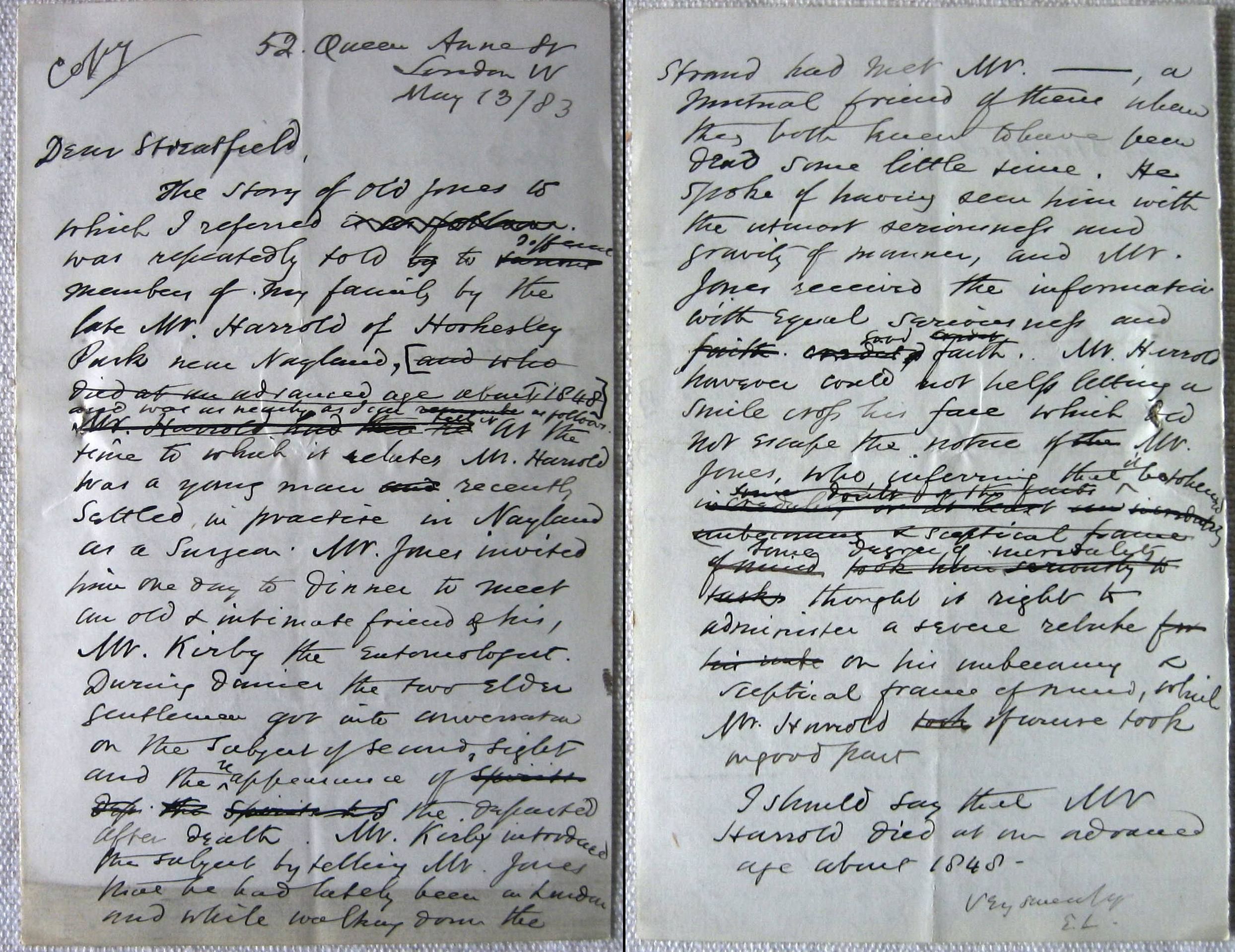
2. Edward Liveing FRCP: Copy of letter to Streadfield re William Jones, 13 May 1883, London.
Liveing Archive. IMG3614/5
52 Queen Anne St
London W
May 13/83
Dear Streatfield,
The story of old Jones to which I referred was repeatedly told to different members of my family by the late Mr Harrold of Horkesley Park near Nayland, and was as nearly as I can tell it as follows.
At the time to which it relates Mr Harrold was a young man recently settled in practice in Nayland as a Surgeon. Mr Jones invited him one day to dinner to meet an old and intimate friend of his, Mr Kirby the entomologist1. During dinner the two elderly gentleman got into conversation on the subject of second sight and the reappearance of the departed after death. Mr Kirby introduced the subject by telling Mr Jones that he had lately been in London and while walking down the
Page 2
Strand had met Mr . . . . ., A mutual friend of them whom they both knew to have been dead some little time. He spoke of having seen him with the utmost seriousness and gravity of manner, and Mr Jones received the information with equal seriousness and good faith Mr Harold however could not help letting a smile cross his face which could not escape the notice of Mr Jones, who, inferring that it betokened some degree of in credibility thought it right to administer a severe rebuke on his unbecoming and sceptical frame of mind, which Mr Harold of course took in good part.
I should say that Mr Harold died at an advanced age about 1840 (1765-1849)
Very sincerely
E L
Footnote.
1. William Kirby (19 September 1759 - 4 July 1850) was an English entomologist, an original member of the Linnean Society and a Fellow of the Royal Society, as well as a country priest, making him an eminent parson-naturalist. He is considered the "founder of entomology". Wikipedia
|
