John WEDDERBURN [32517]
- Born: 9 May 1825, Bombay India.
- Baptised: 20 Aug 1825, Bombay India.
- Marriage (1): Alice BELL [22774] on 29 Jan 1856 in Edinburgh
- Died: 29 May 1857, Hissar India aged 32

 General Notes: General Notes:
John WEDDERBURN
Birth 09 May 1825
Location:Bombay
Parents:John, Accountant-General; Henrietta Louisa
Notes:Haileybury 1842
Event type:Baptism
Date:20 Aug1825
Location:Bombay
India Office Records Reference:
J/1/64 f.82
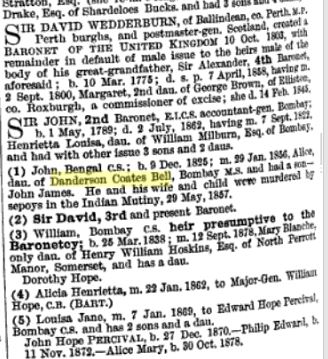
John his wife and son were murdered by sepoys at Hissar in the Indian Mutiny 29 May 1857.
John Wedderburn [1825-57].
Born in Bombay 9 May 1825, and there baptized (Bl. 93; J.W. 30; Bombay Bapt., India Off., vii., 144). Educated at Loretto School, the Edinburgh Academy, and at Haileybury, from which he entered the Bengal Civil Service. He married 29 Jan. 1856, at S. Thomas' Episcopal Church, Edinburgh, Alice Bell, daughter of the late Dandisson Coates Bell of the Bombay Medical Board Gent. Mag., vol. 45, p. 417), and by her had issue a son, John James Wedderburn, born at Edinburgh, 15 Nov. 1856, died 1857. Both parents and child were killed in the Indian mutiny, 29 May 1857, and were buried at Hissar with the other victims (Gent. Mag., N.S. vol. 3, p. 565).
The following account of her eldest brother is from the pen of his sister, Louisa (Mr. Percival) : " Mr. John Wedderburn, one of the early victims of the Indian Mutiny, entered the Bengal Civil Service in 1844, and while serving in Behar was one of those selected for an appointment in the Punjaub when first annexed under the Lawrences in 1849. There he received the thanks of Government for his services in organizing and settling a newly acquired district near Mooltan, and while subsequently filling the important position of Deputy Commissioner of Lahore, his exertions in constructing roads and other public improvements were again acknowledged. Mr. Wedderburn came home on furlough after ten years' service, and returned to India in the spring of 1857, accompanied by his young wife and infant son; and was immediately appointed Magistrate and Collector of Hissar in the North West Provinces, which station he had joined only a few weeks when the mutiny at Meerut and Delhi broke out. The isolated situation of Hissar now rendered the position of Mr. and Mrs. Wedderburn one of extreme danger, and he at once realised to its full extent the peril to the British Empire in India, and to every individual European in it, but resolved to act with the determination of a man and the faith of a Christain. He exerted himself with the utmost energy in the adoption of measures for the security of his district ; removed the Government treasure with his own family into the fort under the protection of the Hurrianah infantry, assumed the responsibility of raising a regiment of irregular horse, and procured 100 troopers from the Dadree chief, who gave repeated assurances of fidelity, thus endeavouring to secure one faithful body of troops, but all proved traitors.
https://digital.nls.uk/histories-of-scottish-families/archive/95655747?mode=transcription
A CONTEMPORARY STORY (from an article by Balram Tandon, in the mid 1900s)
"... One of the hundreds of thousands of Englishmen who served the Raj in 19th-century India and were killed during the Sepoy mutiny in 1857, has been given the status of a "Pir" or Moslem saint, with supernatural powers.
People from the Punjab, Haryana and other very distant Indian states travel to Hissar where in the local garden stands a stone memorial to Mr. John Wedderburn, collector of the Hissar district, who with his wife and infant son was killed by mutinous Sepoys on May 29, 1857.
None of the Wedderburns were buried where the stone memorial in the garden was erected in later years by the Government to commemorate an official who served the district well and was popular.
The Wedderburns were buried in the graveyard of the East India Company which ruled India until the 1857 mutiny. It remained little more than an attraction for visitors to the town until 20 years ago.
The story goes that some years ago, an old woman from Sriganganagar village went to the local courts to help her only son fight a criminal case in which he had been falsely implicated. Fatigued by her ordeal in the court, she decided to rest by the trees surrounding the memorial.
When she woke up she looked at the stone column with the cross under steeple top arches and mistook it for the grave of a "Pir" to which India's highly superstitious people make offerings for the granting of favours.
The old woman asked for the acquittal of her son. Luckily her son was discharged and when he was released she took him to Pir John Wedderburn Sahib's Maqbara (resting place) and made generous offerings of country liquor, fruit, sweets and an ornate sheet. She also lit a small earthen and wicker lamp.
The woman then told the village how the good Pir Sahib of the Company Bagh - the East India Company garden - had blessed her son. In time the story spread and offerings at the memorial pedestal became common.
Over the years the custom of a bottle of country drink in the offerings has given way to a bottle of Indian whisky since they say that this particular Pir Sahib was British and drank only whisky, not the strong rough arak of India. They now also light candles instead of lamps since he was a Christian....."
Ref: http://freepages.rootsweb.com/~wedderburn/genealogy/blackness/zapn11.htm#741 John Wedderburn No 159.
Research Notes:
Image supplied by M Bourne - 2019
John married Alice BELL [22774] [MRIN: 11613], daughter of Dandeson Coates BELL [22771] and Jane SMYTTAN [22772], on 29 Jan 1856 in Edinburgh. (Alice BELL [22774] was born on 29 Dec 1833 in India, baptised on 23 Feb 1834 in Surat Bombay India and died on 29 May 1857 in Hissar India.)
|