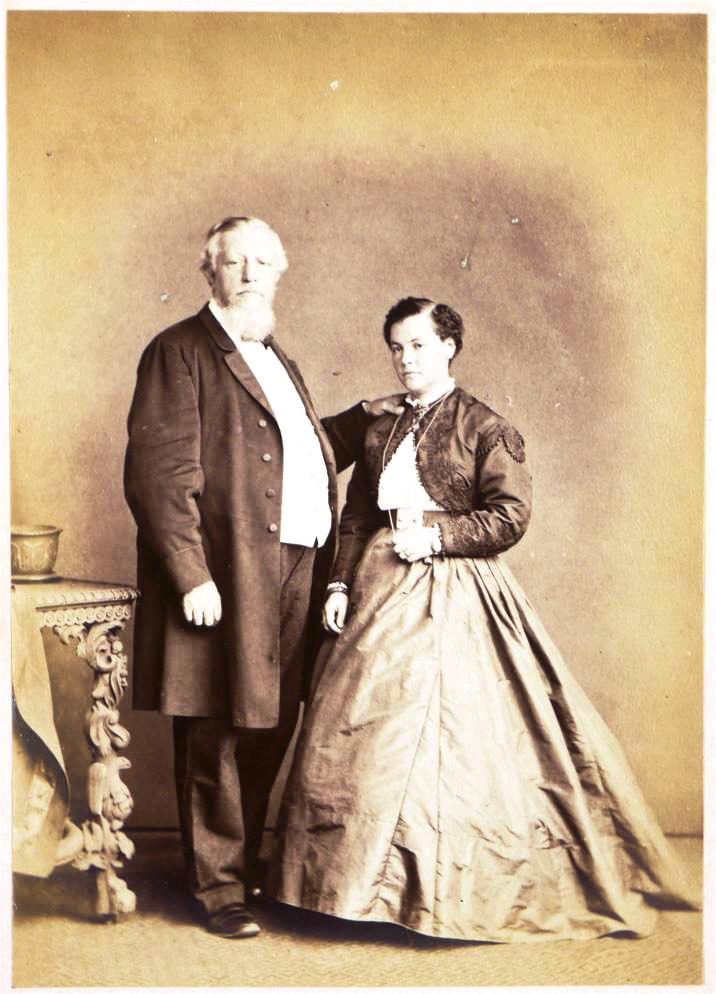
Emily ALSTON [4741]
- Born: 24 Jun, Leicester
- Baptised: 21 Jul 1837, St Margarets Rutland
- Marriage (1): Dr Charles Tilstone BEKE [4742] on 25 Apr 1856 in St James Cathedral Port Louis Mauritius
- Died: 11 Aug 1911, France
- Buried: France

 General Notes: General Notes:
Emily was an active participant and support in her husbands research and travels.
Emily Beke's description of a 'Kite'
Recently, we found a description of the function of a kite by Mrs Emily Alston Beke, wife of Charles Tilstone Beke. She wrote the following:
"It is curious how these animals are caught by the Beduins in the desert country lying to the east of Harran. Two walls of considerable length are erected, commencing at some distance from each other, and converging to a point. Before the two ends quite meet, a mound of earth is thrown up between them, and the two walls, being continued beyond this mound, are united by a cross-wall of about half their height; behind this lower wall is a large pit, the earth dug out of which had served to form the mound. Horsemen now contrive to drive a herd of gazelles between the two walls, where they are furthest apart. The timid animals rush forward towards the extremity of the enclosure, at first not seeing the low cross-wall, which is hidden by the mound of earth; and when, at length, they find themselves closed in on both sides, they naturally try to escape by ascending the mound and leaping over the low wall, when they fall into the pit beyond it, and are taken, often as many as twenty or thirty at a time."
Mrs Beke 1865 Jacob's Flight; or a Pilgrimage to Harran and thence in the Patriarch's footsteps into the Promised Land, with illustrations, London: 145-6.
The entry is dated Tuesday December 24th, 1861 when Emily and her husband were visiting a Dr. Wetzstein in Damascus where they were sampling wine made from Helbon/Halbon grapes. The description must be that of a Kite. The description is particularly useful as what we currently know about the function of a kite is almost entirely derived from their remains and some inscriptions, whereas here we seem to have a contemporary account of their use, and what's more, it implies that Kites were still being used to trap gazelle into the 19th century. The area she refers to 'in the desert country lying to the east of Harran' is the northern tip of the Harrat ash-Sham east of Harran al 'Awamid. A large group of kites are located in this area, beginning roughly 15 km east of Harran al 'Awamid (or 40km east of Damascus), which we have located using satellite imagery freely available through Google Earth and Bing Maps. These kites were first photographed by Poidebard - one is published in La Trace de Rome (1934: Pl. XIV) (see Bewley & Kennedy, 2012, 'Historical Aerial Imagery in Jordan and the Wider Middle East', in Hanson & Oltean (Eds), Archaeology from Historical Aerial and Satellite Archives: Fig. 13.2 p. 226).
In exploring Harran in pursuit of a theory about an Old Testament place name, the Bekes discovered an inscribed stone (p. 199 ff.) which was later identified as a Roman milestone (p. 124ff.). Another was later found in a neighbouring village the name of which Emily gives as Ghassule (p. 125). Very unexpected.
Emily was 37 years younger than her husband but a fitting companion and his equal in many respects. Her published diary, and notes in the archival material of her husband show that she is highly intelligent, independent and active woman- accompanying her husband on at least one journey, helping him in his academic pursuits and publications as well as running their household as smoothly as she could with the expenses from research tours and publishing. After her husband's death she remained a staunch advocate for his lifetimes work, continuing to publish his research at considerable cost to her financial position.
Ref: http://www.apaame.org/2013/08/research-emily-bekes-description-of-kite.html
A Pilgrimage to Harran
by Emily Beke.
http://books.google.co.uk/books?id=Wo06kOP5MiAC&printsec=frontcover&dq=beke+jacobs+flight+to&hl=en&sa=X&ei=x_q-Ua2_EYml0QXKwYHoCw&ved=0CD4Q6AEwAA
Beke Testimonial Fund. A fund is being collected for the benefit of Mrs Beke, who for 16 years assisted her husband, the late Dr Beke, in his numerous labours for the cause of commerce and civilisation, and, let us add, geography. The committee is formed of men of influence, and we trust its appeal will be liberally responded to. Contributions should be paid to Messrs Roberts, Lubbock and Co., Lombard Street.
A correspondence to Charles Darwin, from Agnes Taylor
20 March [1882]
8 Rue Croisc de Marbre Nice
France
Sir,
I beg to apologize for troubling you, but I feel sure you will excuse me when I tell you I am writing on behalf of the Widow of the late Dr. Charles Beke, whose sad case, & claims are so well known. & for whom much sympathy has been expressed. Her trials & troubles for the past 8 years since the death of her husband have indeed been very great, & to add to them she has of late partially lost her sight, so that she has been, & is quite unable to pursue her Literary occupations, & her home has had to be broken up. The many powerfully signed Memorials which have been presented, amply testify that it is the sincere wish of all her Patrons & friends, that she should obtain the continuation of her Husband's "Civil List Pension" but in this she has not been successful, so that her extreme need of help, makes me the more urgent in trying to get her a Permanent Annuity of not less than L50.
Towards this object I will gladly contribute L300 myself provided she can succeed in getting the remaining L500. necessary to effect this object. the value of which Annuity is about L800. I am happy to say from a letter received from the Premier I have reason to hope for assistance from "Royal Bounty Funds" so soon as I am able to submit to the Premier the amount I have collected. The proposal happily meets with the entire approval of the following Noblemen & Gentlemen who have promised me their assistance & support.
As of course I shall have a great deal to do to get up the money . . . . . I shall be most thankful if you will benevolently send me a kind contribution out of sympathy for the Widow of one, whose Public Services in respect of Abyssinia, as well as his Literary, Scientific & Philanthropic Labours in which his wife so ably assisted him claim your sympathy & support.
I am, Sir,
Yours. very faithfully
Agnes Taylor
Contributions Received
The Duke of Wellington L10.
The Earl of Malmesbury L5
Contributions Promised
Myself . . . L300
Sir David L Salomons L5
The Duke of Devonshire L. . . ?
The Duke of Bedford L. . . ?
P.S.
Permit me to beg that contributions be sent direct to Mrs. Beke's account with
Messrs. Hammond & Co.
Canterbury Bank
Canterbury
From Emily Beke
16 October 1879
A Maison Colbert
Pau,
Pyrenees
Dear Sir,
I beg to thank you most gratefully for your very very kind response to my letter, and to assure you that I shall never cease to appreciate your great kindness, though I deeply regret, that there should be such real necessity for it. However, I have got over my worst difficulties, I trust, owing to the generous & continued help of my friends . . . . .
Thanking you for your good wishes for my health & success.
I remain Sir,
Yours sincerely & obliged
Emily Beke
The Maison Colbert is described by a traveler a year later so it is relevant
Well knowing the comfort of a good pension, and intending to make a long stay, we drove straight from the station to the well-known Maison Colbert, and were soon as comfortable as we could wish. There are many people we are aware who detest "pensions." "We don't approve," say they, "of meals at fixed hours, of a drawing-room common to all, and of such a small house that everybody must know everyone else before the first dinner is over!" Well! why should they? They can go to the hotels; but let all those who are suffering or delicate put away thin-skinned feelings of superiority, till they have a good enough constitution to support them, and in the meantime seek peace and kindness, such as may be experienced at the Pension Colbert.
If, on the other hand, it can be taken as a criterion that those living in hotels are not invalids, then the visitor contingent of Pau must consist principally of healthy people, who prefer a good climate and lively society to the attractions that England and America have to offer from October to May. This is hardly correct, but there can be no doubt that more than half the foreigners [Footnote: From the French standpoint--i.e., English and American.] who come for that period, do so for comfort and pleasure alone. And it is not to be wondered at. Who, that was untrammelled by the cares of business, or shortened purse-strings, but would not gladly exchange the bill of fare England has to offer, of London fogs, east winds, Scotch mists, and Irish dynamite, for the handsome menu awaiting him at Pau? Drives, kettledrums, dinners, balls, lawn tennis, polo, pigeon-shooting, golf, racing and hunting; and, if he particularly wishes it, a balloon ascent as well. This last-named is an expensive pleasure, as the aeronaut, judging by the prices on the bill, requires a substantial fee, and it is besides an amusement life insurance companies do not readily countenance.
In Dec 1889 Emily wrote a letter to Mr Stanley (of Livingstone fame!!) She was living in Rapallo Italy at the Casa Canessa, another pension similar to the Maison Colbert. From this we can assume she got her Annuity from the Testimonial Fund. Needless to say she didn't go down without a fight. There is a dossier in The Welcome Archives in Euston dated March 1902
Materials relating to Dr C.T. Beke's public services, collected by his widow Mrs Emily Beke, including a volume of extracts (262 folios) from official correspondence relating to Dr Beke and to Abyssinia from 1836 to 1874, in support of Mrs Beke's claim for L10,000 from the British Government. (In 1865 they had gone officially for four months, on a fruitless mission to effect the release of some British subjects that were being held captive, a journey that was very expensive, and the government didnt didn't pay them.)
She pasted a note on the cover
These "Extracts" of Official Correspondence during Dr Beke's Life were submitted to Lord Knollys Private Secretary to the King and it was forwarded by him (at the King's order) to the First Lord of the Treasury, The Rt. Hon. Arthur J. Balfour, M.P. I received it back by post from the Treasury without any remark!!! Nothing was done.
Emily Beke.
Obituary.
Mrs C.T. Beke
The death took place on Friday at her residence in France, after many years of illness, of Mrs Beke, widow of the Abyssinian and Nile explorer, Charles Tilstone Beke.
Mrs Beke, who was 74 years of age, was before her marriage Miss Emily Alston of Mauritius, daughter of Mr William Alston, of Leicester a claimant to the baronetcy of Alston. Dr Beke's first wife, a grand niece of Sir J.W. Herschel, died in 1853 and he married for the second time in 1856, being then a partner in a Mauritius mercantile house. Mrs Beke accompanied her husband on his travels in Syria and Palestine in 1861 and 1862, the object of the journey being to explore and identify the Haran or Charran of Scripture, and other localities mentioned in the book of Genesis, in accordance with the opinions expressed in Dr Beke's "Origines Biblicae" in 1834. They also travelled in Egypt, in order to induce the Egyptian merchants to form a company for carrying out Dr Beke's plans for opening up commercial relations with Central Africa, and for promoting the growth of cotton in Upper Egypt and the Sudan. On their return the travellers were publicly awarded the thanks of the Royal Geographical Society. Beke subsequently visited Abyssinia to urge on King Theodore the release of Captain Cameron and other British subjects who had been imprisoned by the King and was temporarily successful - though the prisoners were subsequently reincarcerated, and the incident led to the Abyssinian War and the defeat and death of King Theodore. For these and other services Beke received a grant of L500 and subsequently a civil list pension of L100 a year. He died in 1874 - at the same age as that subsequently attained by his widow - and was buried at the village of Bekesbourne, which takes its name from the old Kentish family to which he belonged. After his death his widow issued his most important work, entitled "Discoveries of Sinai in Arabia and of Midian" for which it was claimed that it paved the way for the final settlement of the questions connected with the exodus of the Israelites.
Ref: The Times 16 August 1911 Page 9. (M.Terbrack)
Research Notes:
Portrait of Emily and her husband Charles Tilstone Beke photographed by Ernest Edwards (Lovell Reece, 1867, 'Dr. and Mrs. Beke', in Portraits of Men of Eminence, Vol. 6, London: L. Reeve & Co.: 21. Original in the Natural History Museum, London: 051942).
Emily married Dr Charles Tilstone BEKE [4742] [MRIN: 668], son of James BEEK [18941] and Susannah HINDLE [18942], on 25 Apr 1856 in St James Cathedral Port Louis Mauritius. (Dr Charles Tilstone BEKE [4742] was born on 10 Oct 1800 in Stepney London and died on 31 Jul 1874 in Holly Villa Springhill Bromley KEN.)
|