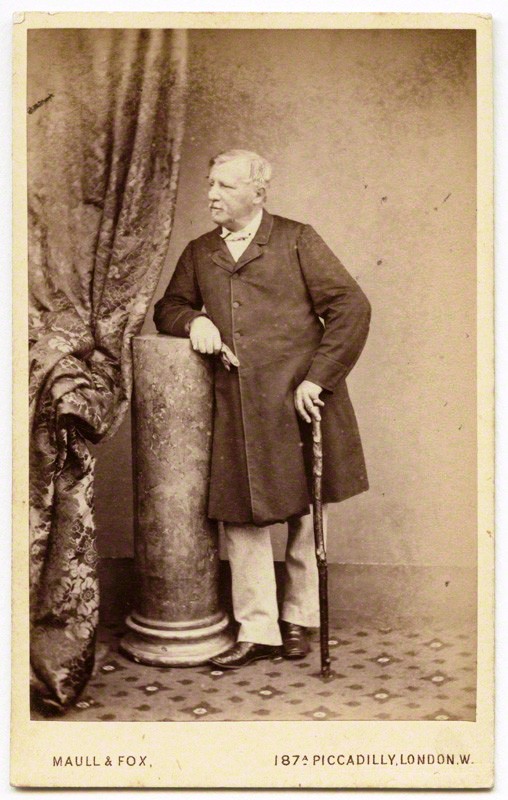
Dr Charles Tilstone BEKE [4742]
- Born: 10 Oct 1800, Stepney London
- Marriage (1): Eliza GRIESBACH [18967]
- Marriage (2): Emily ALSTON [4741] on 25 Apr 1856 in St James Cathedral Port Louis Mauritius
- Died: 31 Jul 1874, Holly Villa Springhill Bromley KEN aged 73
 Another name for Charles was BEEK Prior To 1833. Another name for Charles was BEEK Prior To 1833.

General Notes:
Charles was of Bekesbourne Kent, he elected from 1833 to spell his surname Beke. He searched for sources of the Nile from 1840-1843 and later and was an expert on the biblical lands but some of his findings, approaches and beliefs were so controversial that following his death the National Portrait Gallery, to his young wife's distress, refused to hang a copy of his portrait.
Ref: The Joyous Chain by Anna Philpott & Alexander Low.
Charles Tilstone Beke (10 October 1800 - 31 July 1874) was an English traveller, geographer and Biblical critic. Born in Stepney, London, the son of a merchant in the City of London, for a few years Beke engaged in mercantile pursuits. He later studied law at Lincoln's Inn, and for a time practised at the Bar, but finally devoted himself to the study of historical, geographical and ethnographical subjects.
The first fruits of Beke's researches appeared in his work Origines Biblicae or Researches in Primeval History, published in 1834. An attempt to reconstruct the early history of the human race from geological data, it raised a storm of opposition on the part of defenders of the traditional readings of the Book of Genesis; but in recognition of the value of the work the University of Tubingen conferred upon him the degree of Ph.D..
Between 1837 and 1838, Beke held the post of acting British consul in Saxony. From that time until his death, his attention was largely given to geographical studies, chiefly of the Nile valley. Aided by private friends, he visited Ethiopia in connection with the mission to Shewa sent by the Indian government under the leadership of Major (afterwards Sir) William Cornwallis Harris, and explored Gojjam and more southern regions up to that time unknown to Europeans. Among other achievements, Beke was the first to determine, with any approach to scientific accuracy, the course of the Abay River (Blue Nile). The valuable results of this journey, which occupied him from 1840 to 1843, he gave to the world in a number of papers in scientific publications, chiefly in the Journal of the Royal Geographical Society.
On his return to London, Beke re-engaged in commerce, but devoted all his leisure to geographical and kindred studies. In 1848 he planned an expedition from the mainland opposite Zanzibar to discover the sources of the Nile. A start was made, but the expedition accomplished little. Beke's belief that the White Nile was the main stream was, however, shown to be accurate by subsequent exploration.
In 1856, he endeavoured, unsuccessfully, to establish commercial relations with Ethiopia through Massawa. In 1861-1862 he and his wife travelled in Syria and Palestine, and went to Egypt with the object of promoting trade with Central Africa and the growth of cotton in the Sudan. In 1865, he attempted to visit Ethiopia to negotiate from Emperor Tewodros the release of the British captives. On learning that the captives had been released, Beke turned back, but Tewodros afterwards re-arrested the party. To the military expedition sent to effect their release, Beke furnished much valuable information, and his various services to the government and to geographical research were acknowledged by the award of L500 in 1868 by the secretary for India, and by the grant of a civil list pension of L100 in 1870. In his 74th year he undertook a journey to Egypt for the purpose of determining the real position of Mount Sinai. He conceived that it was on the eastern side of the Gulf of Aqaba, and his journey convinced him that his view was right. It has not, however, commended itself to general acceptance. Beke died in Bromley, in Kent.
Ref: Wikipedia
They were resident in Nice in 1898.
BEKE, CHARLES TILSTONE (1800-1874), Abyssinian explorer, was born at Stepney, Middlesex, 10 Oct. 1800. He came of an ancient Kentish family, which, in the twelfth century, gave its name to Bekesbourne; and there Beke himself resided for some years. His father was a prominent citizen of London. Beke was educated at a private school in Hackney, and in 1820 he entered upon a business career. His commercial pursuits called him from London to Genoa and Naples. Upon his return from the latter place he determined to abandon, commerce, and entered himself at Lincoln's Inn, where he studied law. While pursuing the legal profession, he published several papers in the Imperial Magazine and other periodicals concerning biblical and archaeological research. His first work of importance, entitled Origines Bibliae, or Researches in Primeval History, was published in 1834. His object was to establish the theory of the fundamental tripartite division of the languages of mankind, from which have arisen all existing languages and dialects. Dean Milman described the work as 'the first attempt to reconstruct history on the principles of the young science of geology;' and for this literary effort the university of Tubingen conferred upon the author the degree of doctor of philosophy.
In 1834 and 1835 Dr. Beke published a considerable number of papers upon the writings attributed to Manetho, upon Egypt, Midian, the Red Sea of Scripture, and other collateral subjects, and in the latter year he was elected a fellow of the Society of Antiquaries. In consideration of these Eastern researches Beke was successively elected a fellow of the Statistical and Syro-Egyptian Societies of London, of the Oriental Society of Germany, of the Royal Geographical Societies of London and of Paris, and of the Asiatic Society. From July 1837 till May 1838 Beke was British acting consul at Leipzig. In 1840 he made his first journey into Abyssinia, with a view not only to the opening up of commercial relations with that state and adjoining countries, but also to the abolition of the slave trade and the discovery of the sources of the Nile. His journey resulted in his first making known the true physical structure of Abyssinia and of eastern Africa generally, showing that the principal mountain system of Africa extends north to south on the eastern side of that continent, and that the Mountains of the Moon of Ptolemy are merely a portion of the meridional range. Dr. Beke was the first to ascertain the remarkable depression of the Salt Lake, Assal. He fixed, by astronomical observations, the latitude of more than seventy stations, and mapped upwards of 70,000 square miles of country. He visited and mapped the watershed between the Nile and the Hawash, along a line of fifty miles northward of Ankober, and he discovered the existence of the river Gojeb. He constructed a very valuable map of Gojam and Damot, and determined approximately the course of the Abai. In this expedition Beke also collected vocabularies of fourteen languages and dialects spoken in Abyssinia. In recognition of his discoveries he received the gold medals of the Royal Geographical Societies of London and Paris.
After his return from Abyssinia in 1843, Beke resumed his commercial pursuits in London, devoting the whole of his leisure, however, to the study of the questions which deeply interested him. From 1844 to 1848 many papers connected with Abyssinian exploration appeared from his pen. In the latter year he prepared a bill, which became law, authorising British consuls to solemnise marriages in foreign countries. During the same year he set on foot an exploring expedition for the discovery of the sources of the Nile, the expedition to penetrate for the first time inland, from the coast of Ptolemy's Barbaricus Sinus, opposite Zanzibar, and to descend the river to Egypt. The Prince Consort and other distinguished persons gave their countenance to the expedition, and Dr. Bialloblotzky was appointed to command it; but unfortunately the leader was compelled to abandon the undertaking when it was only partially completed. It is stated that Captain Speke became aware of Beke's plan in 1848; and later explorers have proved the soundness of his theories by discovering that Lake Nyanza is within the basin of the Nile.
In 1849 Beke was appointed secretary to the National Association for the Protection of Industry and Capital throughout the British Empire, and on the dissolution of that society in 1853 he was formally thanked through the Duke of Richmond for his services to the cause of protection. M. Antoine d'Abbadie, a French traveller, having published an account of his alleged journey into Kaffa for the purpose of exploring the sources of the Nile, Beke issued a critical examination of his claims, severely criticising his 'pretended journey.' The Geographical Society of Paris having awarded to M. d'Abbadie its annual prize for the most important discovery in geography, on the ground of his travels, a warm controversy arose. The charges made by Beke, and M. d'Abbadie's defence, were brought before the society, and after considerable discussion the society decided that no action should be taken, and simply passed to the order of the day. This decision being unsatisfactory to Beke, he returned the gold medal which had been awarded him in 1846 for his travels in Abyssinia, and withdrew altogether from the society.
In 1852 Beke edited for the Hakluyt Society Gerrit de Veer's True Description of Three Voyages by the North-east, towards Cathay and China. Notes were added to the work, which had also an historical introduction relating chiefly to the earlier voyages to Novaya Zemlya. The ensuing year he addressed the Foreign Office and the Board of Trade upon the subject of politics and commerce in Abyssinia and other parts of Eastern Africa. Beke had married a grandniece of Sir J. W. Herschel, but this lady dying in 1853, in 1856 he married secondly Miss Emily Alston, a Mauritius lady, the daughter of Mr. William Alston of Leicester, a claimant of the baronetcy of Alston. He had three years before become a partner in a Mauritius mercantile house, and in 1856 he despatched a sailing vessel to the port of Massowah for the purpose of endeavouring to open up commercial relations with Abyssinia. The attempt proved a failure, however, and entailed on Beke considerable pecuniary loss. But Beke was so convinced of the feasibility of establishing commercial relations with Abyssinia, that he applied, though unsuccessfully, to the Foreign Office for the appointment of British consul at Massowah, with the object of developing his scheme.
In 1860 Beke published The Sources of the Nile; being a General Survey of the Basin of that River and of its Head Streams. With the History of Nilotic Discovery. The work was based upon the author's essay 'On the Nile and its Tributaries', and various subsequent papers. But much new information was added. The author showed how the truth of his previous contentions respecting the interior of Africa had been established by Captain Burton and other travellers; and that the 'dark continent' possessed fertile and genial regions, large rivers and lakes, and an immense population, which, if not civilised, was yet to a large extent endowed with kindly manners, humane dispositions, and industrious habits. The writer therefore pressed upon the serious consideration of the British merchant, as well as the Christian missionary and philanthropist, the necessity for opening up the continent of Africa and civilising its inhabitants.
Dr. and Mrs. Beke travelled in Syria and Palestine in 1861-62, for the purpose of exploring and identifying the Harran, or Charran of Scripture, and other localities mentioned in the book of Genesis, in accordance with the opinions expressed in Dr. Beke's Origines Biblicse in 1834. They also travelled in Egypt, in order to see and induce the merchants of Egypt to form a company for carrying out Dr. Beke's plans for opening up commercial relations with central Africa, and for promoting the growth of cotton in upper Egypt and the Soudan.' On their return, the travellers were publicly awarded the thanks of the Royal Geographical Society, and several papers were the result of this visit to the East. Beke also entered into controversy with Bishop Colenso on the subject of the exodus of the Israelites and the position of Mount Sinai.
In 1864 great indignation was caused in England by the news that Captain Cameron and a number of other British subjects and missionaries had been imprisoned by the King of Abyssinia for pretended insults. Beke at once undertook a journey to Abyssinia for the purpose of urging on King Theodore the necessity of releasing the British consul and his fellow-prisoners. Beke obtained the temporary liberation of the prisoners, but the subsequent conduct of the king, in again imprisoning and ill-treating the captives, led to the Abyssinian war, which resulted in the complete defeat, and the death, of King Theodore. During the Abyssinian difficulty Beke furnished maps, materials, and other information to the British government, and to the army, by which many of the dangers of the expedition were averted, and in all probability many lives saved. Beke received a grant of L500 from the secretary of state for India, but his family and friends regarded this remuneration as very inadequate for public services extending over a period of thirty or forty years, and culminating in his aid and advice in connection with the Abyssinian campaign. In June 1868 Professor E. W. Brayley, F.R.S., drew up a memorandum of the public services of Beke in respect of the Abyssinian expedition. Two years later the queen granted Beke a civil-list pension of L100 per annum in consideration of his geographical researches, and especially of the value of his explorations in Abyssinia.
Amongst other questions of oriental interest studied by Dr. Beke, that of the true location of Mount Sinai had always a special fascination for him. In December 1873 he left England for Egypt, accompanied by several scientific friends, for the purpose of investigating this question in person. The Khedive of Egypt placed a steamer at his disposal, and the exploring party performed a tour round the alleged Mount Sinai, and made valuable discoveries along the coast of the gulf of Akaba. They occupied themselves with the sites connected with the passage of the Red Sea by the Israelites, and afterwards proceeded into the interior, and discovered 'Mount Sinai in Arabia' called by the natives Mount Barghir. In March 1874, Beke arrived in England, and though apparently in good health, considering his advanced age, died suddenly on 31 July ensuring. He was buried at Bekesbourne on 5 Aug.
After his death his widow issued his most important work, entitled 'Discoveries of Sinai in Arabia, and of Midian,' which was accompanied by geological, botanical, and conchological reports, plans, maps, and engravings. It was claimed for him that by this work he had paved the way for others to arrive at a final settlement of the whole of the important questions connected with the exodus of the Israelites. But the questions raised in his latest volume led to much controversy, his opinions being by some vehemently opposed.
In addition to the works mentioned in the course of this biography, Dr. Beke was the author of:
'The British Captives in Abyssinia,' published in 1865.
'King Theodore and Mr. Rassam,' 1869.
'The Idol in Horeb,' 1871.
'Jesus the Messiah,' 1872.
'Discovery of the true Mount Sinai,'
'Mount Sinai a Volcano,' (1873);
and many other sketches, pamphlets, and papers.
[Beke's various works; Summary of Beke's published works, by his Widow, 1876; Annual Register for 1874; Transactions of the Royal Geographical Society; An Enquiry into M. A. d'Abbadie's Journey to Kaffa, 1850; The Idol in Horeb, 1871; Letters on the Commerce of Abyssinia, 1852; Reports of the British Association, 1847; The Sources of the Nile, 1860; Views in Ethnography (new ed.), 1863; Men of the Time, 8th ed.
Ref: Dictionary of National Biography, 1885-1900, Volume 04 Beke, Charles Tilstone
by George Barnett Smith.
Research Notes:
Image Courtesy National Portrait Gallery 75747; charles tilstone beke
Charles married Eliza GRIESBACH [18967] [MRIN: 6816]. (Eliza GRIESBACH [18967] died in 1853.)
Charles next married Emily ALSTON [4741] [MRIN: 668], daughter of William ALSTON of Charter House LND [4709] and Elizabeth Wagstaff CLARKE [4710], on 25 Apr 1856 in St James Cathedral Port Louis Mauritius. (Emily ALSTON [4741] was born on 24 Jun in Leicester, baptised on 21 Jul 1837 in St Margarets Rutland, died on 11 Aug 1911 in France and was buried in France.)
|