William Warner JULIUS [720]
- Born: 1838, St Kitts Leward Is Carribean
- Marriage (1): Sarah Jane ELLIS [721] on 11 Dec 1866 in Sandridge Victoria, By Rev K Johnston.
- Died: 30 Apr 1908, 97 William St Sydney aged 70
- Buried: 1 May 1908, Rookwood Cemetry Sydney

 General Notes: General Notes:
William according to his wife did not get on well with his Stepmother so he ran away to sea, having inherited money from his mother who came from a wealthy family. He was a Junior Officer on a ship sailing to Australia, and met his future wife who was a passenger .
They appear to have settled in the Northern Rivers District of New South Wales about 1886, then he was growing sugar at Sunnyside, near Brisbane, and later in partnership with John Robb of Melbourne.
He built a sugar mill at Cudgen, on the Tweed.
It appears that he owned several restaurants and boarding houses in Sydney as follows :-
1868 an Eating Housed at 635 George St. & 46 Erskine St.
1869 a Restaurant at 28 York St.
1870 a Restaurant at 46 - 48 Erskine St.
1871 an American Restaurant 46 - 48 Erskine and 192 Pitt St.
1873 a Restaurant at 264 Pitt St.
1875-76 a Restaurant at 262 & 264 Pitt St.
1877 the Temperance Family Hotel 301 - 303 Pitt St.
1879 a Restaurant at 303 Pitt St.
1880 a Restaurant 255/305 Pitt St. Paddington.
1882 a Boarding House 34 York St.
1884 a Boarding House & Restaurant 34 York St.
1885 a Boarding Establishment & Restaurant 34 York St.
George Dinman was charged with assault. William Julius, of Pitt-street, resturant-keeper, deposed that yesterday evening the defendant came to his rooms and ordered supper, which was supplied to him he was about to leave without paying, and when asked for payment he said, "Take it, out of me." and put himself in attitude, the witness declined the invitation, but defendant, saying that he would knock him down, struck him with his fist, first on the chest and then on the nose; his nose bled profusely in consequence of the blow. To pay a penalty of L5, or to be imprisoned two months.
Sydney Morning Herald 23 Feb 1876
Frederick Owen, found, on the premises of William Julius, Pitt-street, between 10 and 11 o'clock at night, under circumstances denoting an intention to commit a felony, was committed to take his trial at the Quarter
Sydney Morning Herald 9 Dec 1876
Post Office Directory Entries.
1893/6 Perth Coffee Tavern Howich Street Perth (now Hay St)
1897 Restaurant Forest Street and Bailey Street Coolgardie.
1898/9 Coffee Tavern Forest Street and Bailey Street Coolgardie
1900 Forest St Coolgardie.
1901 Manager Coolgardie Fresh Spring Water Company Forest Street. Resturant Outridge Tce Kalgoorlie.
1904/5 Restaurant 128 William St Sydney
1907/8 Restaurant 97 William St Sydney
NOTICE.
HAVING Sold my Right, Title and Interest
in and to the Business known as the
PERTH COFFEE TAVERN, Howick-street,
to my Son, Mr. EDWARD JULIUS, all DEBTS
due by and to the Firm will be settled by
him.
WILLIAM WARNER JULIUS.
I beg to say that having PURCHASED the
above, I am prepared to carry on the Business
with energy, and, I trust, with satisfaction to
my Patrons.
EDWARD JULIUS.
Ref: West Australian 27 Feb 1894
William moved to Coolgardie W.A. and opened a coffee Tavern in 1899. In 1900 he lived at Forest Street and in 1901 was running the Fresh Spring Water Co. from there and (or his son) a restaurant in Kalgoorlie about 40 km away.
Unidentified source.
CLARKE V. JULIUS.
This was an action brought by Henry Clarke, of Murwillumbah, Tweed River, against William Warner Julius, manager partner of Robb and Co., of Cudgen, Tweed River, to recover compensation for alleged breach of agreement on the part of the defendant for the purchase from plaintiff and his tenants of sugar-cane at tho price of 14s. per ton. . . . .
Tho defence was a denial in toto of the plaintiffs allegations. Defendant stated that after the first agreement was drawn up plaintiff came to him and represented that the tenants were unable te bear the expense of cutting, loading, and carting tho cane if they were to make a profit, and that they wished to have another arrangement entered into. Defendant thereupon instructed plaintiff to call the tenants together, and this having been done the defendant made a new agreement, under which he undertook to pay 10s per ton for the cane, and cut, load, and cart it himself, which would involve an increased expenditure of 7s 9d per ton. Plaintiff then recommended tho agreement to the tenant, who unanimously adopted and signed it. . . . .
At the close of the defendant's evidence the parties consulted, and a verdict for defendant waa agreed upon, each party paying his own costs.
Sydney Morning Herald 12 Mar 1890
Australian Electoral Rolls 1903 NSW.
William Warner Julius Bucca Creek Roll 29 Div Cowper Lower Bucca occ Farmer (near Coffs Harbour)
NZSOG CD A29741533
EXTRACT FROM A LETTER FROM SARAH ANN JULIUS.
St Kitts : November 23 1906
"Last week a gentleman from on board a Canadian Steamer here came to the Hospital and asked to see me ; he said he was in Demerara? and had been asked by some persons there to find out if anyone named William Warner Julius had ever been in St Kitts and also to find out all he could; he said that some person of that name had lately died in Australia (I think it was there he died) about 70yrs of age; he said there are many Julius's in Australia and very wealthy. This William Warner Julius had lived in Sandy Point and ran away from his father to go to sea; all that I could tell him was that my father had an illegitimate brother who lived at Sandy Point ( Sandy Point was the town formerly) ; this brother had a son by marriage who ran away to go to sea but I think his name was Edward". cont as it refers to Edward Julius (RIN 718)
IN THE SUPREME COURT Of NEW South Wales
Probate Jurisdiction.- In the Estate of WILLIAM WARNER JULIUS, late of 97 William-street, Sydney, in the State of New South Wales, Restaurant-keeper, deceased, intestate. Application will he made after, fourteen days from the publication hereof that administration of the Estate of the ahovenamed deceased , may be granted to SARAH JANE JULIUS, the Widow of the said deceased, and all notices may be served at 97 William-street, Sydney.
Sydney Morning Herald 12 Jun 1908
BURIED. Section T. Plot 5217 C/E Rookwood Cemetery, Lidcombe Sydney. On his gave it says :
"In Loving Memory of William Warner Julius Died 30th April 1908. Aged 70 yrs. " And I heard a voice from heaven saying unto me, Write, Blessed are the dead which die in the Lord from henceforth : Yea saith the spirit, that they may rest from their labours, and their works do follow them". Rev. Chap 14. Verse 13.
Research Notes:
WHITE STAR LINE'S BEGINNING AND EARLY YEARS
The Aberdeen White Star Line was first founded in Liverpool in 1845 by John Pilkington and Henry Threlfall Wilson. The shipping company's focus was on the Australian gold mine trade. It was a sound company but the original ships (mostly leased) eventually became water soaked, over strained and slow.
These were clipper ships with composite hulls (iron and wood frames.) In these early days of the White Star Line, the fleet consisted of the Blue Jacket (later renamed White Star) the Red Jacket, the Ellen and the Iowa.
John Pilkington left the company and was replaced by John Chambers in 1861. White Star Line commissioned it's very first steamer named Royal Standard in 1863. In an attempt to expand it's services, White Star merged with the Black Ball and Eagle Lines to form a conglomerate called the Liverpool, Melbourne and Oriental Steam Navigation Company Limited, which was financially doomed from the start.
White Star was looking at a very bleak future at this point. In 1868, a marine engineer named Sir Edward Harland and a businessman named Thomas Henry Ismay, had become partners and purchased the White Star Line as an investment. The intent was to build faster, longer lasting iron ships and continue in the North Atlantic shipping trade market.
The Titanic was a White Star ship
Ref: History of White Star Line Internet.
The picture 0f White Star is from the website, but unproven as Williams ship.
Posted at Murwillumbah NSW Australia 21 August 1905.
Cudgenbil
17 August 05
Dear Jenny,
Your letter came to hand all right - and I am pleased to hear you are gradually rising in your profession. You will be able to save up now and like Lizzie buy a farm so that by and by when you are tired of teaching you can retire and take up the healthy occupation of poultry raising.
I suppose it will be a long time yet for you to look forward to. Meantime perfect yourself and aim for the top rung of the ladder. I believe you capable of reaching it at all events. Let your aim be high and backed up with industry and perseverance. There will be no fear you will succeed. I am here . . . . . a bit and not unlike "waiting for something to turn up". I keep myself meantime occupied in various ways: one day gardening and then carpentering with occasional laying a few bricks in the fireplace but my chief occupation is pig and poultry feeding. I may say I like this last best and although things goes "contrarie" at times owing to the initial bad arrangements taking it on the whole it's "not too bad".
Frank is doing very well with his pigs now and Maggie it is doing remarkably well with her fowls, bye and bye she has just had a shock. We discovered a hen sitting away by the old pig stys on a large nest of eggs and I advised her to remove her to the hen house but she decided to let her take her chances. She has just returned from a visit to the nest where she found the eggs and a lot of feathers. She says she will never no never let a hen sit out again. It's a pity for she was a high-class Leghorn owing to the . . . . . she has got now well netted. She has had no loss previous to this.
Everywhere about the Tweed has much improved. The people all being well to do and they are not lacking in amusement and social gathering. They have just had a ball here at the local hall in aid of the hospital and I am told it was well attended people riding and driving to it from 20 miles away. These are great changes from what I knew of it in the early times.
I hope you look after your health and do not sit up to late hours early to bed.
Tell Lizzie I forgot to inform her that a trunk containing a Gertie's things is at Edwards. She ought to have it sent to her.
Your loving Father
W W Julius
Letter from William Warner Julius to his daughter Annie Jeanette Julius in Perth. Gudgenbil is near Murwillumbah.
William Julius, Mrs Julius and 4 children
Port of Departure: Brisbane
Port of Arrival: Sydney, New South Wales
Voyage Arrival Date: 5 Nov 1880
Vessel Name: Elamang
NSW Unassisted Immigrant Passenger Lists, 1826-1922
Mr W Julius
Nationality or Origin: Barbados
Arrival Date: 1900
Arrival Port: Albany
Departure Port: Adelaide
Vessel Name: Sobo
Western Australia, Australia, Crew and Passenger Lists, 1852-1930
Mr W W Julius
Port of Departure: Rockhampton
Port of Arrival: Sydney, New South Wales
Voyage Arrival Date: 5 Mar 1890
Vessel Name: Fitzroy
NSW Unassisted Immigrant Passenger Lists, 1826-1922
W Julius
Port of Departure: Brisbane
Port of Arrival: Sydney, New South Wales
Voyage Arrival Date: 28 Dec 1884
Vessel Name: Maranva
NSW Unassisted Immigrant Passenger Lists, 1826-1922
W W Julius
Port of Departure: Cooktown
Port of Arrival: Sydney, New South Wales
Voyage Arrival Date: 2 Mar 1885
Vessel Name: Maranva
NSW Unassisted Immigrant Passenger Lists, 1826-1922
W W Julius
Port of Departure: Brisbane
Port of Arrival: Sydney, New South Wales
Voyage Arrival Date: 17 Jan 1874
Vessel Name: Lady Young
NSW Unassisted Immigrant Passenger Lists, 1826-1922
W W Julius
Port of Departure: Cooktown, Cardwell, Townsville, Bowen & Brisbane
Port of Arrival: Sydney, New South Wales
Voyage Arrival Date: 8 Oct 1874
Vessel Name: Leichardt
NSW Unassisted Immigrant Passenger Lists, 1826-1922
Other Records
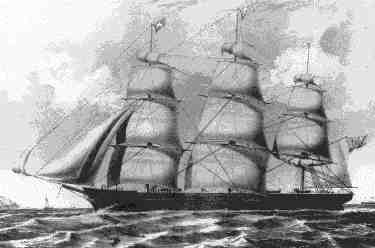
1. Census: England, 7 Apr 1861, Royal Navy: at sea aboard "White Star".
William is recorded as at sea aged 22, an unmarried cook/steward, born a British subject in St Kitts West Indies. Although the census place is given as Royal Navy, only a crew of 12 are mentioned and no Naval ranks given. The skipper named James Brough is described as Master with no rank mentioned.
The White Star was one of the fastest clippers in the World in its day and was on the Australian run where she could complete the journey Liverpool to Melbourne in between 69 & 74 days.
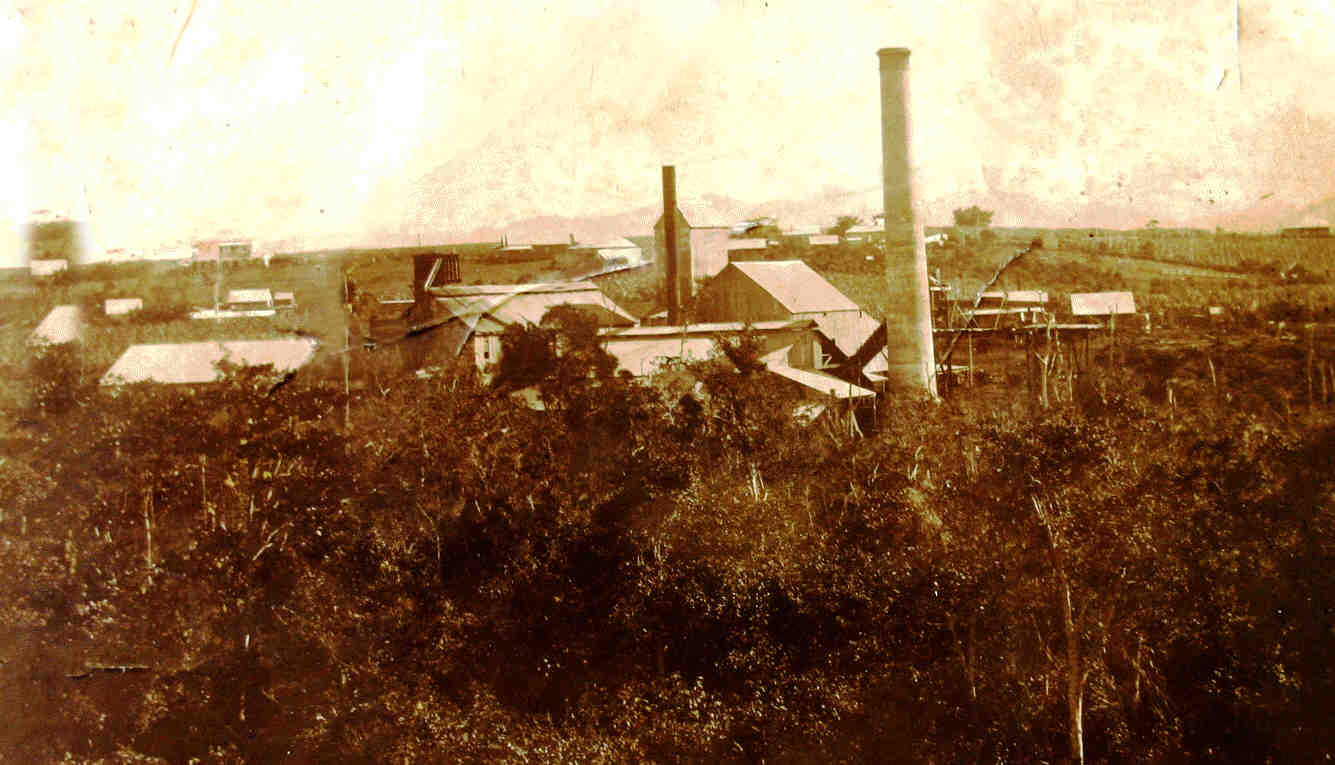
2. A History of the Sugar Industry in the Northern Rivers of New South Wales.: The Cudgen Sugar Mill, 1870-1978.
The story of the sugar industry on the three Northern Rivers, the Clarence, the Richmond and the Tweed, falls naturally into two parts. First was the period of experimentation, of trial and error. It was a period that proved very unprofitable to many farmers. This period is neatly summed up by N. Bartley when he wrote of the beginnings of the industry on the Clarence. What he wrote may be applied to the same period on the Tweed: "Nearly everyone was bitten with the sugar mania and all burned their fingers. It was not seen that the successful prosecution of that, or any other industry, required knowledge and experience, and nobody had it"
Some farmers devised their own mills for their own harvest and sometimes that of their neighbour as well. Some of these mills were very primitive. An article in the Grafton "Daily Examiner" told of one farmer who "constructed a set of wooden rollers which were worked by hand power. His wife would trim the cane and place it in the roller, while the husband worked the handle turning them". Horse power, and later steam, were used to drive the mills. Beneath the rollers, vessels were placed to catch the juice from the cane. The juice was boiled over an open fire and the syrup or molasses was allowed to drain away "from the crude mixture" and, a C.S.R. publication reveals, "what was left was regarded as sugar". The waste, and the inefficiency, and the uncertainty of these methods, together with the need for a steady supply of good quality cane on the one hand and the lack of a reliable market for the sale of the crude sugar on the other, cut short the operations of many of the mills.
Details of those early mills on the Tweed are scant, and perhaps not always reliable. Henry M. Scammell owned a mill at Bilambil Creek. He was able to keep it in operation from 1874 to 1881. At North Tumbulgum, Henry Skinner operated the "Inglewood" Mill between 1875 and 1885. In the same year that Skinner began his mill, Alexander Pringle, Thomas Shankey and Patrick Byrne built the Abbotsford Mill for a Mr. Kent. This was probably the most successful of the old mills of that first period of the sugar industry, but even it was closed down in 1895. It is said that Joshua Bray and S.W. Gray obtained some sugar cane from Michael Guilfoyle, of Cudgen, planted it, harvested it and from it made some sugar by a process of infusion. In or about 1877, they installed a small mill. The second period of this history began in 1872, when some Tweed cane growers, apparently dissatisfied with the results from the small sugar mills, asked the Colonial Sugar Refining Company - which had established two mills, Southgate and Chatsworth, on the Clarence - to build a mill on the Tweed. At that time, the C.S.R. could not comply, for it was faced with its own problems connected with the Clarence River mills and the Darkwater mill on the lower Macleay. Nevertheless, two of its officers, E.N. Stephens and E.W. Hayley, were sent to the Tweed to assess the situation. By 1876, the outlook had greatly improved, and E.W. Knox, the Superintendent of Mills on the Clarence, was able to inform his head office that he had been induced "to consider seriously the question of increasing our operation by obtaining a footing on the Tweed and erecting another mill there". A site was purchased from John McLeod, construction work was put in hand, and the mill was ready for the 1880 crushing season. To ensure that a constant supply of cane would be available (a matter that had caused some difficulties on the Clarence), Knox bought up over a thousand hectares of land to be put under cane. Arrangements were made with Robert Langley, a ship owner of 84 Sussex Street, Sydney, to ship coal for the mill from Newcastle and to carry the raw sugar to the Sydney refinery.
The other strand of this second period in the story of the Tweed sugar industry began on the Cudgen upland in the mid 1870's when W. Julius took up land at Cudgen. Having cleared the land, he planted his cane and built a mill to process his cane (Pictured). Julius had grown cane in the West Indies. However, in Australia his first venture was not successful. The C.S.R. had opened the Darkwater Mill on the lower Macleay and Julius was one of the planters who hoped to supply cane to the mill, but things did not turn out as expected. Frosts and floods played havoc with the cane and the mill was forced to close. So Julius moved to the Tweed. During the next few years he received several offers for his plantation and mill, but he would not entertain any of them.
Then came an offer from John Robb and Co., a Victorian firm. John Robb was born in Northern Ireland. He reached Victoria when that Colony was in the grip of the "gold fever" and he joined the crowds who were making for the goldfields. In his thirties he turned his attention to railway construction and built lines in Tasmania, South Australia and Queensland. In his Cudgen venture, Robb was closely associated with J. J. Casey, a Victorian judge. Robb laid trainlines through the Cudgen cane lands and brought in several locomotives to haul the cane trucks. He employed over 300 men to work on the plantations and at the mill.
Many of these men were South Sea Islanders Kanakas as they were often called. In the little' cemetery at Chinderah there are inscriptions on tomb stones that remind us of those South Sea Islanders of so long ago - "Willie Bc, ulco, Native of Tongoa" (presumably Tonga), Harry Brown. Estate, New Hebrides", "Dick Longsickie, Solomons". Those were the great days of the Cudgen Village. Robb had a home there and the village could boast a Public School, a Police Station, a Court of Petty Sessions, J.H. Turnock's store, a public hall, two churches, two hotels, a Post Office and a billiard room. Mr. Robb died in 1911. The C.S.R. bought the plantation and dismantled the mill. From then on the cane was taken down to Chinderah - once called Cudgen Wharf - and went by punt to Condong for crushing. The years have brought their changes. The old cane wharves that dotted the river banks fell into disuse and the powered launches that towed their strings of punts loaded with cane to the mill are now no more. Road transport has superseded them. In the 1970's C.S.R. decided to dispose of their mills in New South Wales. This decision led to great concern amongst the cane farmers that supplied Condong, Broadwater and Harwood mills. Finally, after much discussion and after many difficulties had been overcome, the New South Wales Sugar Milling Co-operative Ltd. was floated and it took over the three mills in August, 1978.
Regrettably no attribution is available for this article.
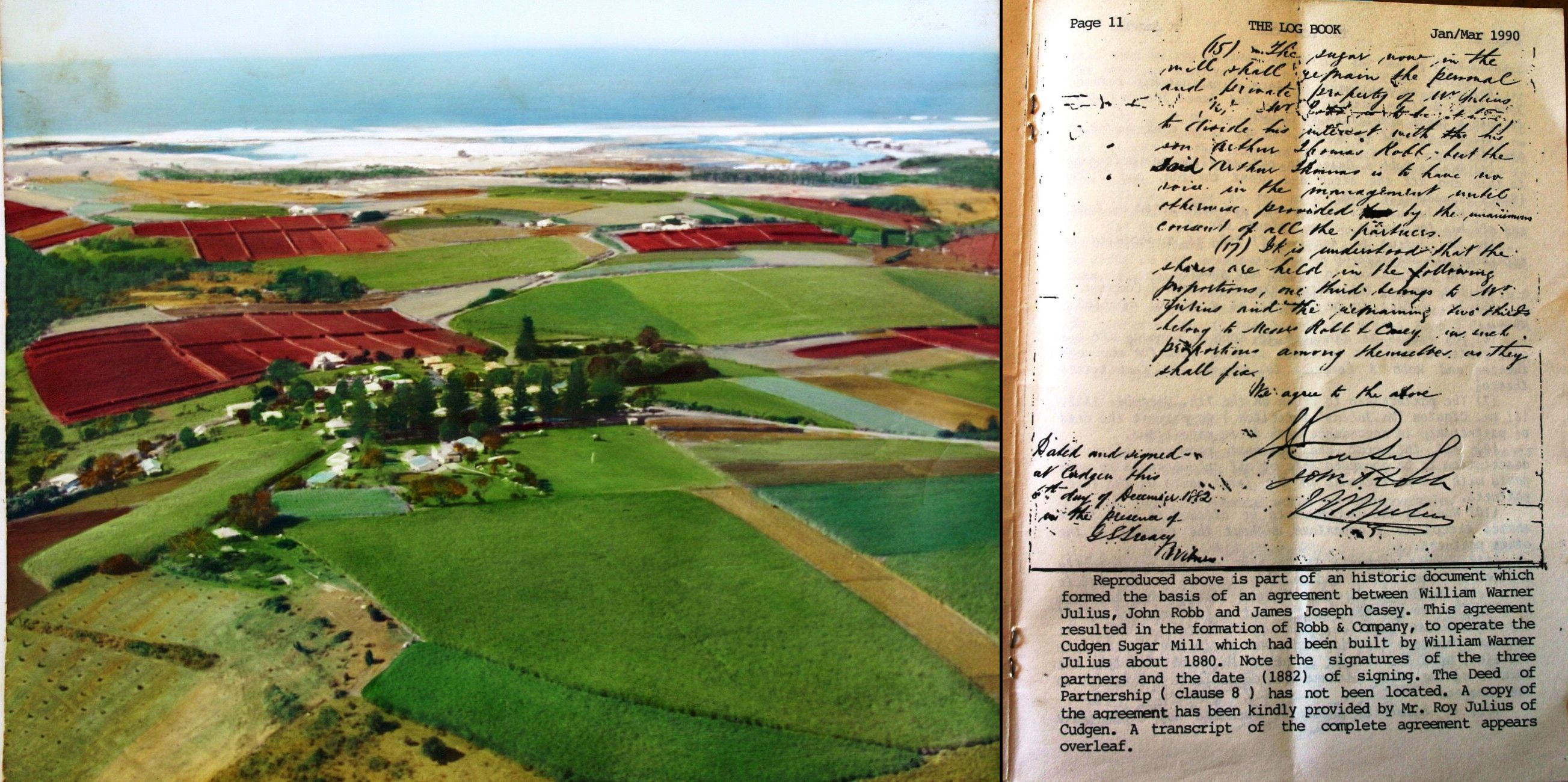
3. William Warner Julius: Cudgen Sugar Mill History, 1882.
Early History of Cudgen Sugar Plantation and Mill.
By Frank H. Julius.
When the C.S.R. Company decided to erect a sugar mill on the Macleay about 1870, my father William Warner Julius, purchased three of the best farms on that river to grow sugarcane.
When the C.S.R. transferred the mill to Harwood Island on the Clarence, my father sold the Macleay Farms, and decided to purchase Harry Clark's selection at Cudgen. This was about 1875. My father paid clerk L12 10 0. per acre for his farm which at that time was practically all virgin scrub.
My father decided to build his own sugar mill, and work commenced immediately on both projects. The clearing of the land and the building of the mill as well as the planting of the cane in preparation for the first crushing, which took place in 1880, two years earlier than at Condongg (mill).
At the time, Cudgen was the busiest place on this river. About 500 men were employed in the mill and on the plantation. Abbotsford Mill, at Tumbulgum, owned by three men, Messrs Pringle, Shankey and Byrne, was also operating, but proved a failure, and growers in that area, and on the river flats above Murwillumbah transferred their cane to the Condong Mill. Frost at that time took a heavy toll on cane crops, which were mostly non-resistant.
Mr Issacs, the first manager at Condong, approached my father at this stage with an offer to purchase the whole of his cane crops grown on the Cudgen plantation at 10/-per ton, including inverse of was the harvesting and the milling of it at Condong. My father turned down this offer and accepted an offer from two Victorians, Messes John Robb and J. J. Casey. John Robb was at that time a wealthy Victorian, accredited a millionaire. He was a railway contractor and connected with building and banking companies. It included in his projects was the construction of a railway line from Cairns to Atherton, in north Queensland, and Robbs Jetty at Fremantle, prior to the construction of the breakwater there. Casey was a judge of the Supreme Court of Victoria.
Guilfoyle House.
The plantation had been extended at that time to include the lands held by the Guilfoyle family, who held between them approximately 1280 ac., some of the richest part of Cudgen.
The home of the Guilfoyle's was situated in the most beautiful part of Cudgen, it was a home in bungalow style, with a shingle roof, with a view of the ocean from Byron Bay to Fingal and Cook Island. The timber used in the construction of this home was grown on the plantation, and comprised cedar, beech, teak, rosewood, etc. Its orchard and gardens were some of the finest in Australia, and contained some of the rarest fruits and plants to be found anywhere. These gardens and orchard were established by two of the greatest botanists the world has ever known, Baron Von Mueller, who has by talking machine K.C.M.G. and William Guilfoyle.
As a result of the depression in the 90's my father was compelled to sell his interest in the mill and plantation at Cudgen, and later the property was sold to the C.S.R. after the last crushing went through in 1911, 31 years after the first crushing.
This was the only mill in New South Wales with its own cane the supply, and the only one to carry on through the depression in NSW except the three Mills owned by C.S.R. Coy., at Harwood, Broadwater, and Condong.
When the C.S.R. purchased the Cudgen plantation in 1911, I wrote to the general manager about our old Homestead block. In response to my letter, Mr Dowling, the C.S.R. Coy. first cane inspector at Condong (father of Admiral Dowling, who was born and received his first education at Condong) came to see me and told me I could have this part of the plantation.
This is where I have raised my own family, and where the Julius is a reached the fourth generation, thanks to the wonderful assistance given at all times to us by the management and staff of that great company C.S.R.
Ref: News Paper article.
AGREEMENT
Basis of an agreement to form a partnership between John Robb,William Warner Julius and James Joseph Casey to work a sugar plantation at Cudgen.
(1) The capital to be £21,000 and to be contributed as follows
(a) Messes Rob and Casey to put in 420 acres belonging to them and all the stock and plant thereon and £7000 in cash.
(b) Mr Julius puts it in his mill and 1131/2 acres of land, and all his leaseholds, stock, plant etc.
(2) Mr Julius to receive £1000 as a gratuity to represent his services up to date.
(3) The partnership to be for 10 years.
(4) The name of the partnership to be Robb and Company.
(5) Mr Julius to be manager and a salary of £400 a year.
(6) Mr Julius to transfer to Robb & Co all his cane contracts and the benefits arising from the advances there on and Robb and Co to assume the liabilities thereof.
(7) The partnership to begin on 7 December 1882.
(8) Mr Clayton (Mr Julius's solicitor) to prepare the deed of partnership in accordance with these provisions.
(9) All the real and personal property of every description to be conveyed free of all encumbrances by each party into the partnership in the joint names of the three partners.
(10) None of the partners to be allowed to sell their shares except to a co-partner without the consent of the other parties.
(11) Proper accounts to be kept and to be periodically audited and examined, and monthly reports to be sent to John Robb, Melbourne by the manager stating what has been done during the previous month, and a full account of all the expenditure incurred, and a statement of what the manager proposes to do and the estimated expenditure therefor, upon the receipt of which Mr Robb will take the opinion of the other partner and communicate the result to the manager.
(12) No liability shall be incurred nor expenditure paid away by any partner exceeding the sum of £500 without the previous knowledge and consent of all the partners.
(13) At all meetings of the partners the majority shall decide.
(14) If in the opinion of the majority of the partners, that the management of Mr Julius is not . . . . . managers imprudence or incapacity the manager may be removed and another person appointed in his stead.
(15) The sugar now in the mill shall remain the personal and private property of Mr Julius.
(16) Mr Robb to be at liberty to divide his interest with his son Arthur Thomas Robb; but said Arthur Thomas is to have no voice in the management until otherwise provided by the unanimous consent of all the partners.
(17) It is understood that the shares are held in the following proportions, one third belongs to Mr Julius and the remaining two thirds belong to Mrs Rob and Casey in such proportions amongst themselves as they shall fix.
We agree to the above.
J Casey, John Robb, W W Julius
Dated and signed at Cudgen this 8th day of December 1882 in the presence of:
G S Treacy, R . . . . .
Footnote.
John Robb was a wealthy businessman from Victoria, and James Casey was a judge of the Supreme Court of Victoria.
The depression of the 1890s compelled William Julius to sell his interest in Robb & Co, in 1892. It was later sold to C.S.R. in 1911.
More on the Sugar Industry in Cudgen.
"Cutting the Cane" by Deborah Wallace
"G'day, I'm Frank McDonald.
I'm an Australian. I was born in the Tweed Valley and I have lived here my whole life. I'm getting on a bit now, nearly 50 (date 1912). I'm a farmer. I've worked in the sugar industry since it was introduced to the Tweed and will continue to do so for the rest of my life.
By 1880 two sugar mills started operating in the Tweed Valley. One was built by the C.S.R. (Colonial Sugar Refining) Company at Condong. The other one was built by William W. Julius at Cudgen. Mr. Julius had a lot of experience in the sugar cane industry. He had worked for many years in the West Indies, before moving to Australia. He started growing cane on the Macleay River down south, but it was too cold for growing there. So Mr. Julius moved to Cudgen by purchasing land from Harry Clark to grow sugar cane and build his mill. I started working for Mr. Julius as a foreman in the mill. It was really busy at this time. Mr. Julius had about 500 men working for him in the mill and on the plantation. There were some women who worked for him, but not many. Most of the workers were the Kanakas and they had come from up North from the cane fields up there.
About two years after Mr. Julius opened his mill, he went into partnership with two Victorians. They were John Robb and J.J. Casey. Mr. Robb was very wealthy. He was a railway contractor and was connected with building and banking companies. When the partnership started Mr. Julius and Mr. Robb extended their lands, by including the lands owned by the Guilfoyle family. It was during this time that the sugar industry really developed in the Tweed. You need a lot of labour to grow and harvest sugar cane. This was why Mr. Julius hired the Kanakas. They were cheap labour and hard working. They also came with experience from working in the fields and mills up North."
Ref: scu.edu.au/scunews/download.php?doc_id=15223&site_id... (This is only an extract from an interesting publication on the industry see Books section of this website)
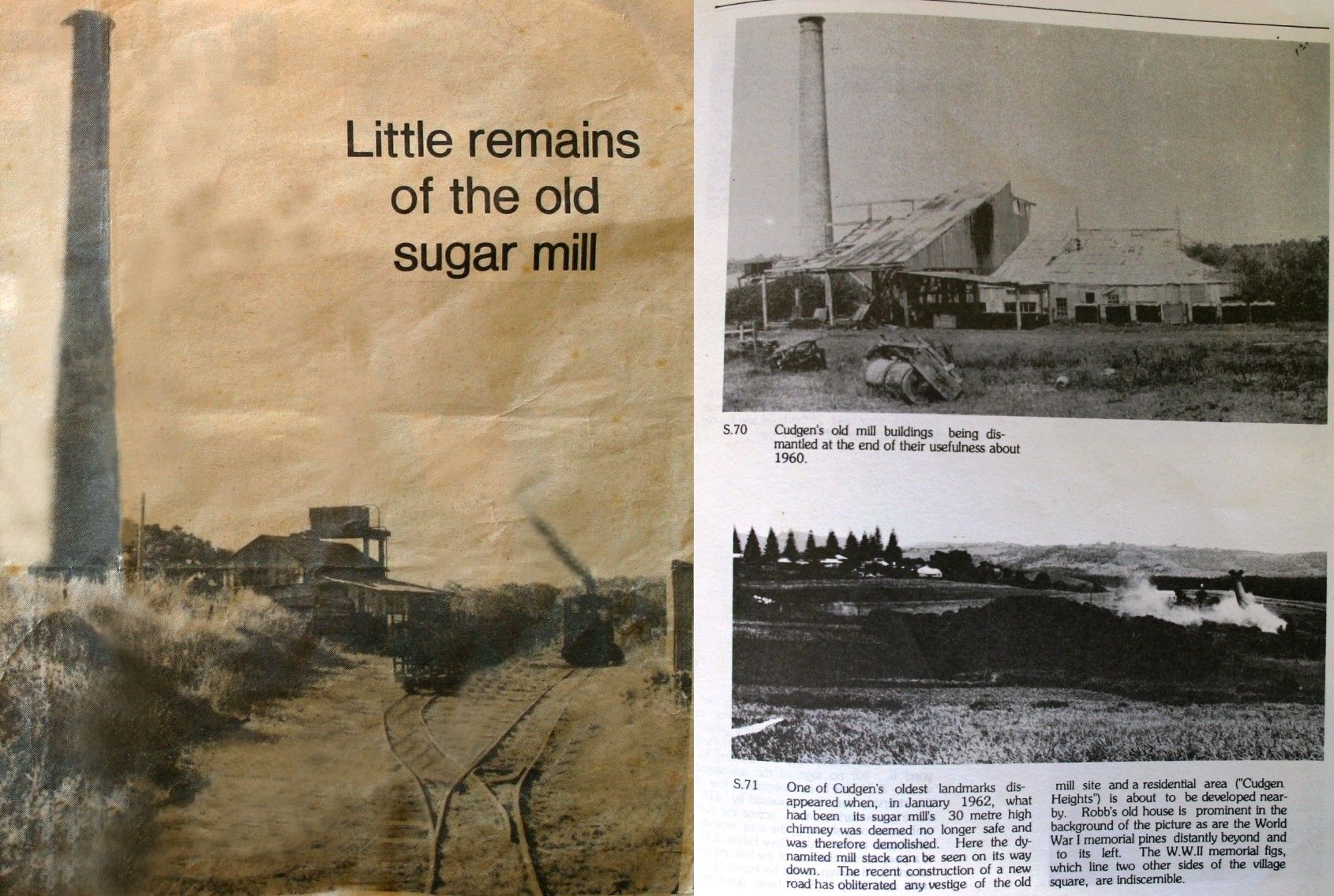
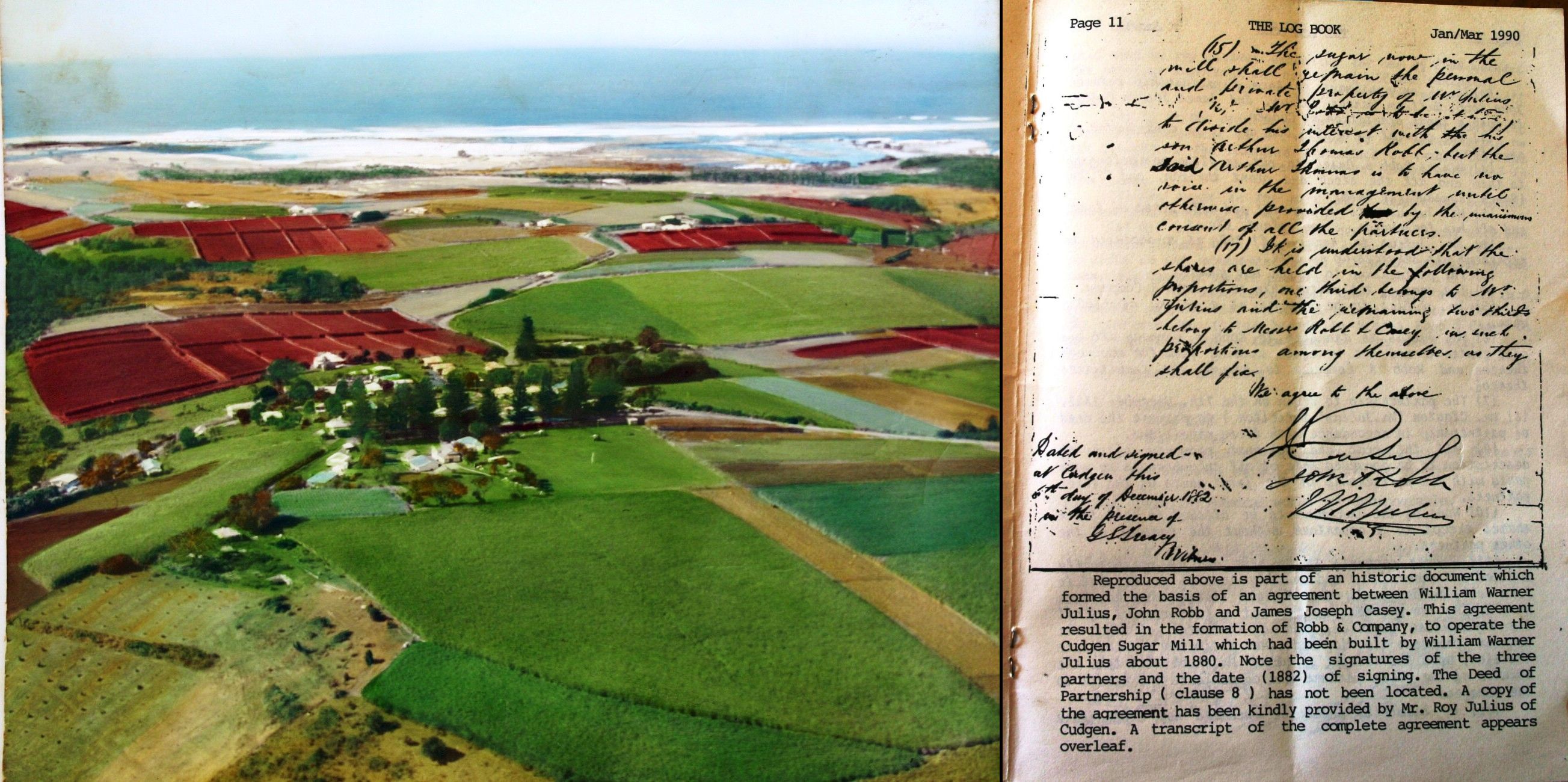
4. William Warner Julius: Cudgen Sugar Mill, 1936, Cudgen NSW AU.
Cudgen Mill
A recent feature in the Daily News \endash Gold Coaster highlighted the sugar mill that used to operate and Cudgen more than 100 years ago.
This picture of that old mill was taken in 1936 long after the mill ceased production. The train seen chugging away beside the old mill is heading for Chinderah where the cane was loaded onto a river barge and taken to Condong.
I believe the Cudgen Mill began operations back in 1869 by W Julius with about 200 acres of cane field serving the mill. The mill operated until about 1911 when it was bought by the CSR company whose operations were centred at Condong. The chimney and the skeleton of the old mill have long since disappeared from the Cudgen landscape and this would be 1 of the very few pictures that remain as a reminder of Cudgen's early days in the sugar industry.
Pictures From Past - Fred Lang.
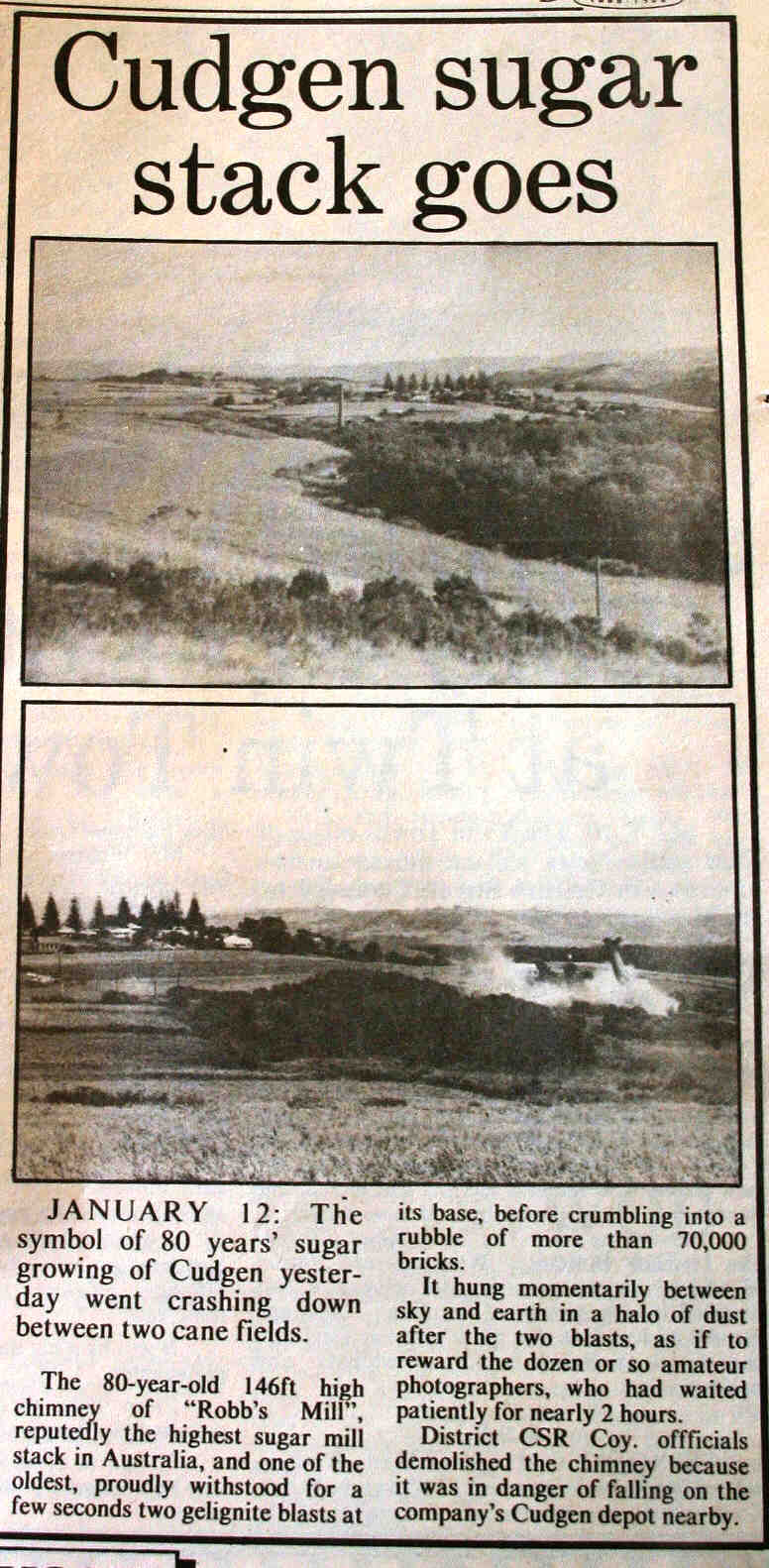
5. William Warner Julius: Cudgen Sugar Mill demolition of chimney, 1962, Cudgen NSW AU.
January 12, 1962.
The symbol of 80 years sugar growing of Cudgen yesterday went crashing down between two cane fields.
The 18-year-old hundred and 46 foot high chimney of "Rob's Mill", reputedly the highest sugar mill stack in Australia, and one of the oldest, Bradley was stood for a few seconds two gelignite blasts at its base, before crumbling into a rubble of more than 70,000 bricks.
It hung momentarily between sky and earth in a halo of dust after the two blasts, as if to reward the dozen or so amateur photographers, who had waited patiently for nearly two hours.
District CSR company officials demolished the chimney because it was in danger of falling on the company's depot nearby.
Daily News 1962.
Later Article.
. . . . . The recent construction of a new road has obliterated any vestige of the old mill site and a residential area "Cudgen Heights" is about to be developed nearby. Rob's old house is prominent in the background of the picture as are the world War 1 Memorial Pines distantly beyond and to its left. The World War II memorial figs, which line two other sides of the village square, are indiscernible.
William married Sarah Jane ELLIS [721] [MRIN: 230] on 11 Dec 1866 in Sandridge Victoria, By Rev K Johnston. (Sarah Jane ELLIS [721] was born in 1844 in Co Tyrone Ireland, died on 8 Jun 1933 in Cudgen N.S.W. and was buried on 16 Jun 1933 in Tweed Heads Aust..)
|