Charles James Fox JULIUS [757]
- Born: 27 Jul 1797, St Kitts Leward Is Carribean
- Marriage (1): Barbara Louise AMORY [758] in 1835
- Died: 5 Jul 1872, St Kitts Leward Is Carribean aged 74
- Buried: St Kitts Leward Is Carribean

 General Notes: General Notes:
When Charles was about 13, his father Richard died and his grandfather [Julius Caesar] sent him to England to be educated. Unfortunately, the politician Charles James Fox (pictured) had already died 1806, so his godson did not profit by his influence.
Charles was known in St. Kitts as " Fox Julius", he kept a school in Basseterre, and is generally believed to have unwittingly set fire to the town? which was then the capital of the island. Whilst the destruction of much of the old town was welcomed as it was then rebuilt on better lines, the result of the fire was a destruction of many of the early historical records.
This is family lore, Charles is not mentioned in the two newspaper reports of the fire.
Origional Returns of Slaves.
Charles James Fox Julius. Proprietor 25 Jun. 1817
William-male Colour-sambo Age-40 Creole-St Kitts. House servant
Ref: Ancestry Pg. 289
Triennial Return of Slaves B.
Charles James Fox Julius. Proprietor 9 Jan. 1822
William male Sambo 45yrs Creole of St Kitts House servant manumitted.
Kitty female mulatto 40yrs Creole of St Kitts seamstress purchased of Mr Haugher.
Catharine female mulatto 8yrs Creole of St Kitts seamstress purchased of Mr Haugher
Ancestry Page 221
Charles & John Julius.
Claim St Kitts No. 589.
2 Nov 1835 for 3 enslaved L52 3s 11d
Parliamentary Papers p92.
His daughter Sarah Ann writing to Florence Stevens 25 Mar 1906 :
"I have heard my father speak with much feeling of his being at the bedside of his father just before he died and his telling him to be a good boy, he was 8 years old then he said, if so then Richard must have died in 1805; it must have been the grandfather Caesar who sent the boy (my father) to school in England almost immediately.
My father was named Charles James Fox after the Statesman who died in 1806; Mr Fox and my fathers father were intimate friends and he wished the boy to be his Godson; it was done by proxy. Mr Fox died before the child was sent on. . . . .
He came back to St Kitts from England in his 20 something. . . . . but he never looked after any property left by his father who died intestate; I suppose all that went to the Crown. . . . . . about my fathers family; he had spoken of trying to find them out, but never did. . . . . He was an affectionate father and he made of me more a companion than anything else ; he spoke to me as if I was equal to him in knowledge ; he was of a lively disposition and had a keen sense of the ludicrous . . . . . I have sent Mrs Brewin by this mail a photo of my father. . . . . taken in 1866 when he was 69 years old"
Sarah Ann writing to Florence 8 April 1906 :
"when you see it (the photo of her father) . . . . . he was very stout. . . . . his mind was troubled ; rather I should say his heart was heavy and the poor fellow does not look cheerful he had just lost his wife and the year following the town was destroyed by fire; and we lost everything ; we could not save anything as the fire began in the house in front of us and we could just escape with our lives ; that was the beginning of our great poverty for we could never replace the furniture we lost and among that a piano that was my greatest delight".
Sarah Ann writing to Louisa (Brewin) 25 May 1906 :
. . . . . I am glad to hear that you got my dear fathers photo all right it was taken not long after the death of my mother and my only brother - the latter died four months before my mother - he died suddenly of heart disease, and all that depressed the dear old parent whom I loved more than I can express . . . . . "when I was about 16 my father went to New York thinking he might get on well in the States with his family but the winter was too severe for my mother and he returned so I have some experience of what winter is when you write me of the cold and snow I know what it all means". . . . .
Research Notes:
There is a suggestion that Fox was also a solicitor which needs to be verified as it may come from the tale of the "Duel" wrongly attributed to him.
NEWSPAPER REPORTS of the FIRE at BASSETERRE 1867
Tremendous Conflagration In St Kitts
the following letter describing the destruction by fire of the town of Basseterre, St Kitts, has been received in Glasgow:
St Kitts July 11, 1867.
Our town of Basseterre is burned to the ground; over 1400 houses are consumed, and in fact the town is totally and entirely destroyed. Not a single store or remains, or indeed any place of business whatever, and it is difficult even to recognize what were once the streets of the town. Other great fires have occurred in different islands, but I doubt if it is possible, comparatively speaking, for any fire to effect more total destruction than that we have just experienced. The terrible work of destruction was accomplished in the short space of about eight hours.
The alarm of fire was given about 11.30 on the night of the 3rd July, and was found to have broken out in an unoccupied house in an alley at the back of Fort Street, and close to the Gazette newspaper office. The house was undergoing repairs, and was full of shavings and wood. The cry of fire was hardly given before the house was in a complete blaze, giving the occupants barely time to escape. Before any material assistance could be got the large warehouses of Messrs Wade and Abbott were discovered to be on fire. These comprised a dry goods establishment, provision store, and lumber yard. During the burning of Messrs Wade and Abbott's store the fire engines came on the spot, but sad to relate, they proved utterly useless, and the fire brigade worse than useless. The engines would not work, and the hose was found to be out of order. The men were most incomplete accoutred. Not a hatchet, or rope, or a bucket was to be found amongst them and everything was in the utmost confusion and disorder. . . . . . although the town is abundantly supplied with water, it was found in the hour of need that no water was to be had, as it was locked off at the reservoir, about 2 miles out of town. During the burning of Messrs Wade and Abbott's store, the stores and dwelling houses of Mr Udale and Mr Palmer the other side of the same street were discovered to be on fire. These buildings burned with the most astonishing rapidity and the flames now spread in one direction towards the Public Library and Reading Room, and the stores in Liverpool Row, and in another direction towards the officers of Messrs Wigley and Burt and the houses in Pall Mall Square. The utmost panic now prevailed; the terrified people from all quarters of the town rushing from their houses with what furniture and valuables they were able to collect, as it was now pretty well apparent that all efforts to check the fire in its course would be unavailing. In the first place, the wind was blowing almost a gale, and besides acting as a bellows of the flame, it carried pieces of burning shingle to all parts of the town. Then the houses of the town for the most part were almost entirely built of wood, and, in some cases the shingles were old and acted like tinder when the slightest spark fell on them, and was proved by many houses in different parts of the town taking fire before the body of the flame had reached them. My father and I and others from the country came into town as soon as we were aware of the fire, and we all did our utmost to save the town by pulling down some houses in the flanks of the fire. But the people in town seemed panic stricken and could render little or no assistance; and the negroes behaved excessively badly. By 2.30 on the morning of the 4th July the fire was general all over the town, and little effectually was done to check it. Here and there are few energetic men would be working, trying to save a solitary house, but there was the most lamentable absence of all plan of action by the town authorities, and everyone acted as he thought best. By this time the Colonial Bank and all the houses in Bank Street, in colluding with us for of Messrs Phillip and Watson, were burning, as well as all the stores along the beach; in fact, the mercantile part of the town was entirely destroyed, and the fire was quickly finding its way to the dwelling houses in the upper part of the town and at Cazoy Street, towards the houses of Miss Clifton and Mr Hart. These two last mentioned houses escaped, but how they did so is a wonder to everybody. Up to this time no one had thought that the church was in any danger, and numbers of people had put what they had saved in it, in fancied security. About 4.30 this beautiful edifice, the pride of the colony, and I might say of the West Indies, was reported on fire, and this was the last work of the destroyer. The clock on the town struck seven, and at two minutes past the body of the tower fell in, leaving the hands ominously pointing at two minutes past seven as an indication of the end of the terrible work.
The dawning day brought fearful sight to view, and one, perhaps, more appalling then the fire itself. Thousands of houseless, homeless, and in some cases utterly ruined people, were scattered about the fields adjoining the town, with what few articles they had managed to save; some but partially clad, and all looking the picture of despair and misery. The cry is for food of these people soon became heartrending, and a grave consideration came upon us as to how are these people were to be fed, as every barrel of flour had been consumed and likewise every other kind of provision. The Lieutenant Governor very promptly sent off to Nevis for flour and bread, which they generously supplied, and a dispatch was sent to Antigua soliciting aid.
Nothing that I can write will give you anything like an approximate idea of the terrible scene on the night of the 3rd inst. and the following day. The fire itself was the grandest sight I have ever seen, and the glare was so great that a gentleman assured me that at Charlestown, in Nevis, 12 miles distant, he could see to read a paper in the street.
There is no doubt the island has received a blow from which it will not recover for generations to come. The Government have already proposed a scheme to borrow money on Government security, to lend the merchants, to enable them to rebuild their houses, but the scheme is not matured, and the details are not yet known.
The Liverpool Mercury Thurs 1 August 1867
The Great Fire in St Kitts
Archdeacon Gibbs gives the following account of the fire which almost entirely destroyed the town of Basseterre, St Kitts, on the night of the 3rd ult. " In a very short time it was apparent that no means within our power (for neither sufficient water nor efficient engines and men were available) could arrest the fury of the fire. From a house after house the poor inhabitants were driven almost naked, and carrying little remnants of their property, which were all they could snatch in their awful haste. The streets became in quick succession lines of flame - Bank Street, Fort Street, Liverpool Row, Church Street, College Street, and at length Cayon Street - leaving in about five hours not one single store remaining, and very few dwelling houses. During this time all the chief people were actively engaged in trying to save their own houses and property and those of their friends, our valued Governor, Capt Mackenzie, taking a leading part. We continued near each other, endeavouring to get houses pulled down, rum shops emptied, furniture rescued, and the latter placed for safety in the churchyard and church.
Rushing into the church I proceeded to save what I could. I reached the vestry, opened the safe, took out a communion plate, the register books and vestments, and gave them to the sexton to be taken to Government House, while I proceeded to do whatever was possible in the church itself. I said the Bible and Prayer Book, but when with an other, I endeavoured to remove the beautiful lectern, we've found it beyond our strength, and were compelled to make a hasty retreat. So that the communion table, altar cloth, chairs, pulpit, lectern, organ, and painted glass windows all were destroyed. About half past 6 a.m. the heavy groined roof began to fall in. As, with the Governor, I passed under the tower at seven, the clock struck for the last time, an end to minutes after stopped and fell to pieces with all the bells. The tower remains with the loss of the wooden beams and floors; the main walls and buttresses apparently sound; the pillars and arches of the aisles in several instances split, calcined, and unsafe; all the monuments on the walls are utterly destroyed or beyond renovation. The loss in the town is variously estimated at a quarter of a million and upwards. From 1000 to 1200 houses destroyed, leaving at least 5000 homeless. The buildings saved, being all on the outskirts, are the jail, the Treasury, and the courthouse, and last, not least, the miniature chapel at Irish Town, where our sacraments will be administered and our weekday services held. The whole town, from the jail in the North East to Miss Clifton's and Mrs Hart's (each barely saved) in the North West, down to the sea on the south side, is, with exception of the Treasury on the beach entirely gone, so that at times one becomes quite bewildered as to the localities lately so familiar.
The Government have appointed a board to administer relief - flour, cornmeal, biscuit, and rice - to thousands of starving people. The people are comparatively quiet, but special constables and troops of militia cavalry are in continual patrol, the latter especially at night.
Glasgow Daily Herald Sat 3 Aug 1867
Several newspaper reports say "Three men are in custody, one of whom confessed to firing a house which led to the destruction of the town"
Pall Mall Gazette 29 Jul 1867
Relief Committees were formed in Britain and elsewhere to help the citizens of Basseterre
A traveller in the area describes Basseterre in 1899.
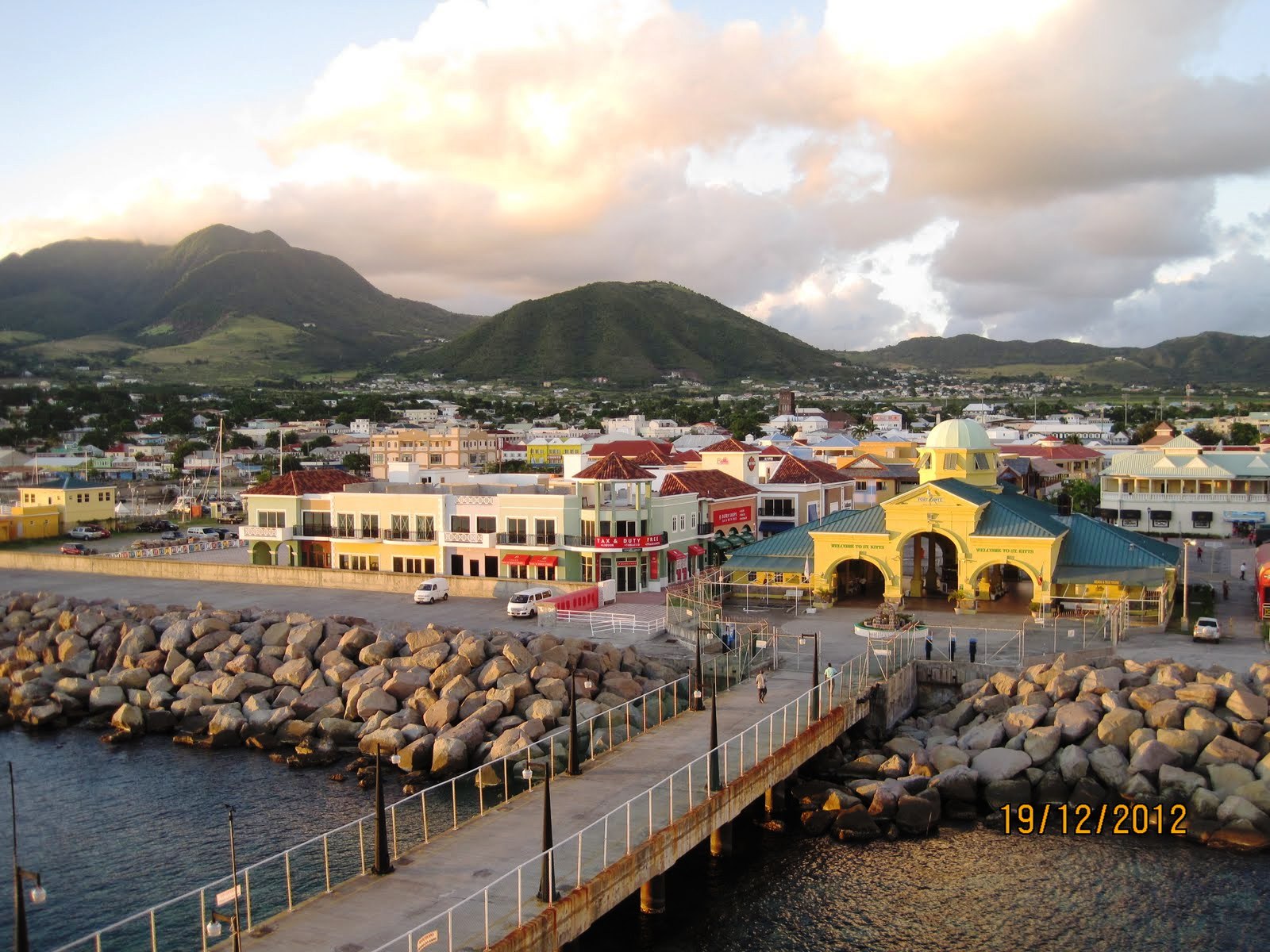
. . . . . low red and white roofs of Basseterre look well from the sea, and indeed the streets are neither narrow nor dirty when one sees them at close quarters. The thoroughfare in which Basseterre Post Office is situated confuses it self oddly in my recollection with the east end of High Street and Windsor. At any rate it is quite as civilised in externals as the latter, if more exotic. . . . . .
Pall Mall Gazette 23 Aug 1899
Colonial Office and predecessors: Bermuda, Original Correspondence CO 37/18. . . . .
Reports on the conditions surrounding the disposal of a twenty-five acre plot of land in Smiths Parish, formerly the property of Anthony William Somersall who died in St. Kitts in 1811; encloses Minutes of Council for 25 April and 10 May 1862, and copies of letters from Brownlow Gray, Charles James Fox Julius (who writes from St. Kitts on behalf of his wife and other descendants of Ann Somersall), William R W Taylor (who writes from St. Kitts claiming Somersall is his great grandfather), Robert Thompson Peniston, Postmaster at Hamilton William Bennett Perot, and Brownlow Tucker. The governor and council endorsed the petition of Perot who had received the land from his father, who had been appointed Somersall's attorney in Bermuda in 1803.
Harry St. George Ord, Governor of Bermuda, 58, Folios 434-451 Covering dates 1862 May 15 Availability Open Document, Open Description, Normal Closure before FOI Act: 30 years Former reference (Department) 5653/1862 Held by
The National Archives, Kew.
Picture courtesy Caroline Macpherson 2013
Other Records
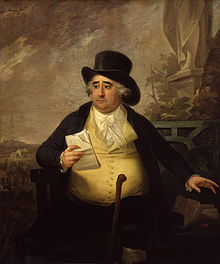
1. Charles James Fox Julius: Known as Fox Julius, 1797-1872, St Kitts.
Charles James Fox, after whom Fox Julius was named.
Charles James Fox (24 January 1749 \endash 13 September 1806), styled The Honourable from 1762, was a prominent British Whig statesman whose parliamentary career spanned 38 years of the late 18th and early 19th centuries. He was the arch-rival of the Tory politician William Pitt the Younger; his father Henry Fox, 1st Baron Holland, a leading Whig of his day, had similarly been the great rival of Pitt's famous father, William Pitt, 1st Earl of Chatham ("Pitt the Elder").
Fox rose to prominence in the House of Commons as a forceful and eloquent speaker with a notorious and colourful private life, though at that time with rather conservative and conventional opinions. However, with the coming of the American War of Independence and the influence of the Whig Edmund Burke, Fox's opinions evolved into some of the most radical to be aired in the British Parliament of his era.
Fox became a prominent and staunch opponent of King George III, whom he regarded as an aspiring tyrant. He supported the American Patriots and even dressed in the colours of George Washington's army. Briefly serving as Britain's first Foreign Secretary during the ministry of the Marquess of Rockingham in 1782, he returned to the post in a coalition government with his old enemy, Lord North, in 1783. However, the King forced Fox and North out of government before the end of the year and replaced them with the 24-year-old Pitt the Younger. Fox spent the following 22 years facing Pitt and the government from the opposition benches of the House of Commons.
Though Fox had little interest in the actual exercise of power and spent almost the entirety of his political career in opposition, he became noted as an anti-slavery campaigner, a supporter of the French Revolution and a leading parliamentary advocate of religious tolerance and individual liberty. His friendship with his mentor, Burke, and his parliamentary credibility were both casualties of Fox's support for France during the French Revolutionary Wars, but Fox went on to attack Pitt's wartime legislation and to defend the liberty of religious minorities and political radicals. After Pitt's death in January 1806, Fox served briefly as Foreign Secretary in the 'Ministry of All the Talents' of William Grenville before he died on 13 September 1806, aged 57 etc see.
https://en.wikipedia.org/wiki/Charles_James_Fox
Charles married Barbara Louise AMORY [758] [MRIN: 243] in 1835. (Barbara Louise AMORY [758] died in 1865.)
|