Richard JULIUS [710]
- Born: 14 Jul 1770
- Baptised: 24 Jul 1770, St George Basseterre St Kitts
- Partnership (1): Mary DANIEL [33439]
- Marriage (2): Sarah Ann CROOKE [756] on 23 Jul 1797 in St Mary Cayon By Licence.
- Died: 18 May 1806, St Kitts Leward Is Carribean aged 35

 General Notes: General Notes:
Register of St George and St Peter Basseterre 1747-1800 SOG London.
Baptisms: 1770 Jul 24 Richd s. of Julius Caesar & Susanna Julius 10 days old . . . . . private baptism.
Richard was admitted to Lincolns Inn 27 May 1789 - Richard was described as the "only son Julius Caesar Julius of the Island of St Christopher West Indies Esq."
Ref: Lincolns Inn Admission Register 1420 - 1893, Folio 129 Page 531.
Although 21 yrs his junior, Richard was, as was his father, a personal friend of Charles James Fox, 1749-1806, (pictured), Whig statesman and orator, after whom he named his second son. Fox, third son of Lord Holland had a very liberal and unfettered upbringing, mixing a brilliant education in the classics, with much drinking and gambling. His support for the French Revolution saw him denounced in Parliament and marginalised between 1789 & 1800.
That Richard had an illegitimate son William, is part of family lore, see letters by Sarah Ann Julius [760], but in 2009 this remained uncorroborated.
However in 2018 Barbara Roach a direct descendant of Richard Julius has located documents, recording Dr John Maddox Titley manumitted a Mary Daniel in 1818, she is now taken to be the Mary mentioned as the mother of William Julius recorded in the manumission document dated 16 April 1799 of a William Julius by Dr Titley.
This is further supported by a DNA test taken by Barbara showing 6% African in her genetic makeup, this view is now highly probable
The following incident was ascribed to Richard's son Charles, by earlier researchers Florence Stevens, and Sir George Julius. However a recent search (2003) of the London papers by E L Fenn, shows the date and details to fit only with Richard. This is further confirmed by the evidence of Richards admission to Lincolns Inn in 1789
GENTLEMANS MAGAZINE
12 July 1791
Domestic Occurrences Page 672
and the
LONDON CHRONICLE
July 12 1791
Report as follows;
An unfortunate recontre took place this morning upon Blackheath between Mr Graham, an eminent special pleader of the Temple, and Mr Julius a pupil in the office of Messrs Grahams, Attorneys of Lincolns, who are brothers of the former.
The parties had dined together at the house of Mr Black, the surveyor, upon Epping Forest on Sunday and after dinner, having drunk freely, the latter expressing some free opinions concerning religion, much abrupt language passed between them. They were reconciled however on that day, and returned to town in the same carriage.
On Monday they met again, after dinner, at the Chambers of Mr Graham the brother of the deceased, when the dispute was unfortunately resumed, though apparently without malignity. No challenge was given that night, but on the ensuing morning the deceased called upon Mr Julius for an apology for some expressions; which being refused they went out together, Mr Graham attended by Mr Ellis and Mr Julius by Mr Maxwell.
A pupil of an eminent surgeon accompanied them to Blackheath, where Mr Graham fell by a shot which had almost passed through the lower part of his belly. He was brought to town in a Post Chaise, and the exertions of the most eminent of the faculty were in vain used for his relief. The ball having laid open the femoral artery and it being impossible to stop the discharge of blood he expired in the afternoon of the next day.
Ref: Greater London Record Office Library - Annual Register 1791 Vol 33 p28.
GENTLEMANS MAGAZINE reports further as follows;
Mr Graham was a gentleman of considerable eminence in his profession and of an esteemed character in private life.
Mr Julius is the son of a very respectable Attorney at St Kitts and is said not to have been the least to blame in this quarrel.
These Gentlemen had for some time been extremely intimate and are not suspected to have had any serious cause of quarrel. Some harsh words they might perhaps have used; and the remembrance of these might have excited a dislike, but certainly not such to make either desire the life of his adversary.
The duel therefore like most others was the consequence of an absurd unwarrantable fear of what might be said and thought if they did not expose their lives to each other.
Ref London Metropolitan Archive (2003)
EUROPEAN MAGAZINE AND LONDON REVIEW: July - December 1791.
Vol 20 p 159.
MONTHLY OBITUARY for July - August 1791.
13. John Graham Esq of Lincolns Inn in consequence of a duel fought the preceding day at Blackheath with Mr Julius a young gentleman from the West Indies, who was in the office of Mr Graham, his adversary's brother.
The quarrel originated on Sunday, in a mixed company on a religious controversy. The subject was hypocrisy and in impropriety of preaching a doctrine contrary to notorious practice in affairs of serious gallantry which was considered as applying too closely to the circumstances of one of the parties; and this produced a violent bustle at the time amongst the company, without producing an amicable adjustment.
The first fire which Mr Graham received lodged a ball in his groin which proved fatal, after the best assistance afforded which could be procured. A mortification took place and he died the succeeding day about noon at his chambers.
Mr Julius, by the advice of Mr Graham after receiving the wound, immediately set of towards Dover as may be supposed for the Continent.
Both parties had previously lived on terms of amity, and the fate of the deceased is much lamented, having been generally esteemed as a very unoffending and respectable character.
St James Chronicle British Evening Post Tuefday 12 July 1791
Tuefday morning for gentlemen called at George's coffee houfe at the top of the Haymarket, and enquired where Mr Hunter the surgeon lived, and fent for him; Mr H. . . . . not being at home, one of his pupils attended them. In a chaife to Blackheath where the two principals fought a duel with piftols
the parties were John Graham Esq of the Temple, and Mr Julius, a young gentleman from the West Indies, who was then the office of Mr Graham, his adversary's brother.
The quarrel originated the preceding night, in a mixed company on a religious controverfy.
The firft fire which Mr Graham received launched a ball in his groin, which has proved fatal, the beft affistance being afforded which could be procured. A mortification took place, and he died yefterday about noon at his brother's Chambers
Mr Julius, by the advice of Mr Graham after receiving the wound, immediately fet off towards Dover, as may be fuppofed for the continent.
Both parties had previoufly lived on terms of amity; and the fate of the deceafed is much lamented, having been generally efteemed as a very unoffending and refpectable character.
General Evening Post Tuesday, July 12, 1791
Duel
One of the unfortunate rencontres took place on Tuefday morning upon Blackheath between Mr Graham and eminent fpecial pleader of the Temple and Mr Julius a pupil in the office of Meff Graham, Attorneys, of Lincolns Inn who are brothers of the former The parties had dined together, at the houfe of Mr Black, the surveyor, upon Epping Foreft on Sunday; and, after dinner, the latter exprefsing fome free opinions concerning religion, much abrupt language paffed between them. They were reconciled, however, on that day, and returned to town in the fame carriage.
On Monday they met again, after dinner, at the Chambers of Mr Graham, Lincoln's Inn, the brother of the deceafed, where the difpute was unfortunately renewed, though apparently without malignity. No challenge was given that night; but in the enfuing morning the deceafed called upon Mr Julius for apology for fome expreffions; which being refuted, they went out together, Mr Graham attended by Mr Ellis, and Mr Julius by Mr Maxwell.
A pupil of an eminent furgeon accompanied them to Blackheath, where Mr Graham fell by a fhot, which paffed almoft through the lower part of the belly. He was brought to town in a poft-chaife, and the exertions of the moft eminent of the faculty were in vain ufed for his relief. He expired yefterday afternoon.
Mr Graham was a gentleman of considerable eminence in his profeffion, and of an efteemed character in private life.
Mr Julius is the fon of a very refpectable attorney at St Kitts, and is faid not to have been the leaft to blame in this quarrel.
Thefe gentlemen had been for fome time extremely intimate, and are not fufpected to have had any ferious caufe of quarrel. Some harfh words they might, perhaps, have usfd; and the remembrance of thefe might have excited a diflike, but certainly not fuch as to make either defire the life of his adverfary. The duel, therefore, like moft others, was the confequence of fear - the fear of what might be faid and thought, if they did not expofe their lives to each other.
See below Reflections on Dueling by Rev Dr Rowland Ingram, Richard's kin.
Evening Mail Wed 13 Jul 1791
The following are the particulars of the unfortunate recontre that took place on Tuefday laft at Blackheath.
The gentlemen were Mr Graham of the Temple, and Mr Julius of Lincoln's Inn; the latter was in the office of Mr Graham's brother, and both parties were on terms of ftrict acquaintance. The difpute originated on Monday evening, in a company where both were prefent -- Mr Graham was fpeaking to a lady, when Mr Julius faid he was a hypocrite in affairs of gallantry, and cautioned the lady on the fubject; at the fame time he gave his reafons for thinking fo.
Mr Graham found himfelf hurt at the imputation, and some words enfued, but the affair was feemingly made up, through the interpolition are taken of friends, and both the parties fhook hands. The circumftance, however, rankled on Mr Graham's mind, and the next day he called at his brother's Chambers, where he knew of Mr Julius attended. He told the latter that he confidered thofe chambers as his own, and infifted on his walking out of them. He followed him down the ftair-cafe when fome further words paft; on which, Mr J faid he could not put up with them, and that Mr G. muft go out with him. He faid, it was what he wifhed. The party is immediately called on to friends, who attended them in poft chaifes, and they took one of Mr Hunter's pupils with them, Mr H. not being himfelf at home.
On coming to the ground on Blackheath, both parties fired together, and Mr Graham fell. The report of the piftols foon drew together several people, who wifhed to ftop Mr Julius from going off, by taking hold of the horfes of the chaife. Mr Julius's swore he would fhoot the firft perfon that attempted fo to do, and at the defire of Mr Graham the people fuffered him to proceed towards Dover. Mr Graham was fhot above the hip, and languished until Wednesday morning when he died.
WEDNESDAY July 13.
Yesterday the Worshipful Company of Apothecaries held there annual herbalizing feast at the Green Man at Blackheath: when about 160 of the Company sat down to a dozen haunches of venison and other delicacies of the season.
Yesterday a duel was fought on Blackheath ; one of the parties was supposed to be dangerously wounded. Had the Seconds been acquainted with so numerous a meeting of the faculty near the place, they might have procured immediate assistance.
General Evening Post Thurs Jul 14 1791
The late duel gives us caufe for regret, that no fyftem of laws has yet been contrived of efficacy enough to prevent their abfurd and this deteftable practice; that the moft trifling difference may be productive of the moft fatal confequence, and that fociety has no better fecurity than opinion for the lives of its moft valuable members.
Further particulars of the late duel between Meff Graham and Julius:-when the former unfortunately fell, Mr Julius came up to him, fhook him by the hand, and after exchanging forgivenefs with him, he and his friend took to the poft chaife and were fetting off for a Dover; a crowd, however, furrounded the carriage, and would not let it proceed until Mr Graham's carriage came up to the fide of it. Mr G. then, with what remaining ftrength he had, put his head out of the carriage window, and requefted they would let him pafs, " as whatever may be the confequences, the gentleman has behaved like a man of honour" this inftantly fatified the crowd, and the chaife paffed on.
Without meaning to allude to either of the above parties, this unfortunate circumftance short hold out in example to all people who differ, either in politics or religion, to do so with temper and moderation: as for the want of this conduft, we find that the fubject of all others which recommends peace and forgivenefs of injuries has unfortunately produced the death of a very valuable member of fociety.
THURSDAY July 14.
We are extremely concerned at having it authenticated to us last night that one of the persons who fought the duel at Blackheath mentioned in our paper of yesterday, is dead. His adversary has made his escape. We forbear to mention the names of the parties, lest it might give to sudden an alarm to the relatives of each.
Also Star Thus 14 Jul 1791 as the Times, but adds the meeting took place about 11 o'clock on Tuefday on Blackheath, near the Duke of Buccleugh's wall
Reported in Lloyd's Evening Post Fri 15 Jul 1791 as "Monday morning laft"
DIED:
Yesterday John Graham Esq of the Temple at his brothers Chambers in Lincolns Inn.
THE TIMES - Friday 15 July 1791 Pg 2 Col d.
"We are now at liberty to mention the particulars of the unfortunate recontre that took place on Tuesday last at Blackheath, as friends of the deceased have 'ere this been apprifed of the melancoly event.
The Gentlemen were Mr Graham of the Temple and Mr Julius of Lincolns Inn; the latter was in the office of Mr Graham's brother, and both parties were in terms of ftrict acquaintance. The difpute originated on Monday evening, in a company where both were prefent, Mr Graham was fpeaking to a Lady, when Mr Julius faid, he was a hypocrite in affairs of gallentry, and cautioned the Lady on the fubject; at the fame time he gave his reafons for thinking fo.
Mr Graham found himfelf hurt at the imputation, and fome words enfued, but the affair was feemingly made up, through the interpofition of friends, and both parties fhook hands. The circumstance however rankled on Mr Graham's mind, and the next day he called at his brothers Chambers where he knew Mr Julius attended. He told the latter that he confidered thofe Chambers as his own, and infifted on his walking out of them. He folled him down the fair-cafe, when fome further words paffed; on which Mr J. faid, he could not put up with them, and that Mr G. muft go out with him. He faid, it was what he wifed. The parties immediately called on two friends, who attended them in poft-chaifes, and they took one of Mr Hunter's pupils with them, Mr Hunter not being himself at home.
On coming to the ground on Blackheath, both parties fired together and Mr Graham fell. The report of the piftols foon drew together feveral people, who wifhed to stop Mr Julius from going of, by taking hold of the horsfes of the chaife. Mr Julius fwore he would fhoot the firft perfon that attempted fo to do, and at the defire of Mr Graham the people fuffered him to proceed towards Dover. Mr Graham was fhot above the hip and languished until Wednefday morning when he died"
Reported in London Chronicle Sat 16 Jul 1791 with addded comment - In the evening the corpfe was interred in Lincolns Inn burial-ground. This funeral prefented an awful example of the fatal confequences of a cuftom which has fo long difgraced the world, and gives us caufe to regret, that no fyftem of laws has yet been contrived of efficacy enough to prevent that abfurd and deteftable practice; that the moft trifling difference may be productive of the moft fatal confequence, and that fociety has no better fecurity than opinion of the lives of its moft valuable members.
THE TIMES Monday July 18th 1791 Pg. 3 Col c
"Friday the coroners inqueft fat upon the body of Mr Graham of the Temple, who was killed in a duel Tuefday laft. He was shot through the crural artery, and bled to death. After a due inveftigation of this melancholy tranfactin, as well its origin in every fubfequent part, the Jury brought in a verdict of Manflaughter againft Mr Julius, the principle, and acquitted the Seconds. On Saturday evening his corpfe was interred in Lincolns Inn burial-ground"
(It appears dueling was not a specific crime or offence but depending on circumstances persons may be charged with manslaughter, murder, etc. These first two would generally carry a death penalty)
Also Morning Post & Daily Advertiser Mon 18 Jul 1791 & General Evening Post Sat 16 Jul 1791
Morning Herald Tue 19 Jul 1791
When Mr Graham fell in the late unfortunate duel on Blackheath, there were not lefs than 20 fpectators prefent, who were about to take Mr Julius into cuftody until Mr G. with almoft his laft breath, requefted that no perfon would interrupt his departure.
Also reported in
Lloyds Evening Post Wed 13 Jul 1791 Similar to European Magazine Obituary above
London Chronicle Thurs 14 Jul 1791 Similar to Times
Star Thus 14 Jul 1791 similar to Times but adds the meeting took place about 11 o'clock on Tuefday on Blackheath, near the Duke of Buccleugh's wall
Public Advertiser Fri 15 Jul 1791 as General Evening Post
London Recorded or Sunday Gazette Sun 17 Jul 1791, adds nothing further to the matter
Diary or Woodfall's Register Mon 18 Jul 1791 ditto
Public Advertiser Mon 18 Jul 1791 ditto.
From: Frances Bellis
Sent: Thursday, 23 July 2009 10:59 p.m.
To:
Cc: Guy Holborn
Subject: RE: Richard Julius admitted Lincolns Inn 27 May 1789
Dear Mr Fenn
Thank you for your enquiry to Miss Hutchings, on whose behalf I am replying. The Mr Graham who died as a result of the duel was one John Graham who was admitted to Lincoln's Inn on 3 May 1781 "the 3rd son of Thomas Graham of Edmond Castle, Cumberland" but he was not called to the bar. Instead as your extract states he became a special pleader which was a type of quasi-barrister, members of the Inns of Court who specialised in drafting, the then particularily arcane, written proceedings in actions in the common law courts. They were permitted to do this without being called to the bar and so were said to practise under the bar. In an early legal directory for 1790 he is listed as having chambers at 7 Fig Tree Court, Inner Temple which matches your extract saying he was "of the Temple". He was indeed buried in the undercroft of the Chapel, our records showing that he was buried on 16 July 1791, having died on the 13 July and that his executors paid L.1 for the privilege.
His two elder brothers were Thomas and James Graham who were attorneys with chambers in New Square (then called Serle's Court) first at no 10 then at no. 6. They were both members of the Inn as it was a prerequisite for having chambers within the Inn. It was not until later that attorneys were banned from being members. Thomas was admitted on 13 November 1777 the eldest son of Thomas and James on 25 February 1780, Thomas' 2nd son. The family appear in Burke's Landed Gentry and so I have attached the relevant page from the 1900 edition for your information.
As regards to your relative, Richard Julius, you are correct in your date for his admission to the Inn. The Admissions Register states that he was the only son of Julius Caesar Julius of the island of St Christopher. He was not called to the bar and since he was working for attorneys I presume that he too was going into that branch of the legal profession.
I hope that this information is useful and I wish you well in your continuing research. If you have any further queries do not hesitate to contact me again.
Yours sincerely
Mrs F Bellis
Assistant Librarian.
Lincoln's Inn Records: SOG London.
Admissions.
1781 3 May John Graham1 gen 3rd sn of Thomas Graham of Edmond Castle Cumberland Esq.
Chapel Records.
Burials.
1791 John Graham2 Esq a member of this honourable Society died 13 July and was buried
16 July 1791.
The Black Books of Lincoln's Inn.
Council held on July 27, 1791.
Twelve Benchers present.
"Order'd that no corpse from henceforth be buried under the Chapel or in the grounds of the society except of such as have been Masters of the Bench"
Accounts of John Ord Esq, the treasurer for the year 1791:
Receipts: . . . . . L.1 each from the executors of . . . . . and John Graham respectively, for burial ground under the Chapel.
Footnote
1. John Graham, deceased by the hand of Richard Julius in 1791, recalled in 2021.
Julius is the researcher's first cousin 4 generations removed. By a happy coincidence in 2021 Auckland NZ, the researcher had the pleasure of having a coffee with Professor James Sneyd 5 times removed great nephew of John Graham above.
230 years on the researcher took the opportunity to express to James the condolences of the Julius family for the matter.
2. Graham's family were principles in the law firm where both these men worked as attorneys, the firm is still in practice as the multinational practice now known as Lawrence Graham. It was formed about 1730 as Coulthard Wildman & Graham, when the the UK first began registering law firms making it one of the oldest existing legal practices in the Western World.
FLORENCE STEVENS in "Genealogy The West Indies" and repeated in "A Power in the Land" says; " A younger brother of Mr Graham's was also articled there, an insolent, overbearing youth very quarrelsome. He called young Julius a "Nigger-Driver" and one day after abusing him he spat in his face, an insult which Mr Julius could only follow up by a "meeting" though he never would have quarreled.
Mr Julius fled to his relations at the Old Palace Richmond, where he was hidden in a garret until he could be shipped of to St Kitts. This must have been about the year 1815. He could not claim his inheritance in St Kitts for fear of identification and it passed to the Crown".
Ref: Family lore.
Julius Richard (Lawyer) died 18 May 1806
Ref Cayon Diary St Kitts Caribbeana Vol 3 Pg 111
Other Records
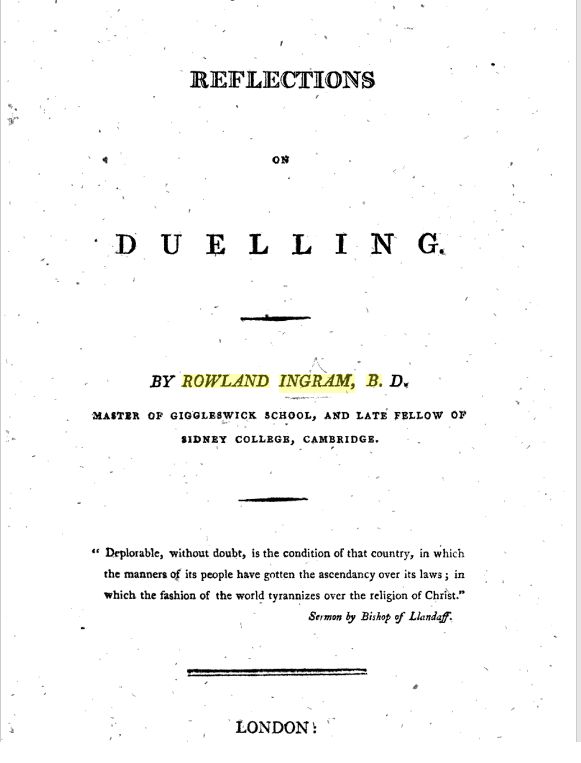
1. Reflections on Dueling: By Rowland Ingram B.D. [8260], 1804.
This book written by Richard Julius's kin in this pedigree, came too late for Richard's edification.
As an Attorney though he must have been aware of "HAWKINS's Pleas of the Crown", p. 80, SECT. II. below and that murder was the charge that faced him should he succeed at this duel. Hence his immediate flight "towards Dover" and escape back to St Kitts into the arms of his immediate family.
REFLECTIONS ON DUELLING
BY ROWLAND INGRAM, B. D.
MASTER OF GIGGLESWICK SCHOOL, AND LATE FELLOW OF SIDNEY COLLEGE, CAMBRIDGE.
"Deplorable, without doubt, is the condition of that country, in which the manners of its people have gotten the ascendancy over its laws; in which the fashion of the world tyrannizes over the religion of Christ."
Sermon by Bishop of Llandaf
LONDON:
PRINTED FOR S. PAFCHARD, BOOKSELLER TO HER MAJESTY,
OPPOSITE ALBANY HOUSE, PICCADILLY.
Dated 1804
REFLECTIONS ON DUELLING.
SECT. I.
INTRODUCTORY,
That in direct opposition to the express laws of the land, to the spirit and rationality of law itself, to the unequivocal precepts of an established and revered religion, and to the conclusions, equally unanimous and decisive, of professed moralists, a practice, having for its immediate aim the destruction of human life, should not only subsist, but should be considered as imposed, by a sort of necessity, upon persons, to whom, in much of the common intercourse of society, the world looks up for its pattern and example, is an instance in the history of manners, I believe, without a parallel. Yet such is duelling and, what renders the matter still more extraordinary, the whole procedure is of that arbitrary, not to say whimsical, contrivance, that among the motives which may be supposed to influence the challenger, in a great variety of cases, the idea of seeking, still more, of accomplishing, any avowable purpose, which bears the slightest natural relation to the primary occurrence, from whence the challenge originated, is altogether superseded. Even when we here except the single supposition of recourse being had to this expedient for the purpose of obviating an imputation of cowardice, this supposition also involves the absurdity of attesting the absence of one species of fear alone, under the circumstances of the duellist a very warrantable fear, at the expense of betraying the predominance of other fears more truly irrational, and therefore more justly entitled to the opprobrious epithets, which are customarily affixed to cowardice. From a practice thus essentially illegal, unchristian, immoral, and absurd, that evils of serious magnitude, and extensive spread, would naturally result, is a fair presumption, and one which the author hopes also to substantiate into proof, upon the ground of existing manners; after having, in the first place, attempted to shew, severally, that the characters, by which he has already ventured to designate the practice itself, are most strictly appropriate. But a question, rather obvious than profound, may here be started, which it might be dismiss at the threshold. Whence comes it, that proper to a practice of the above description should have continued so long, during the brightest ages of science and civilization, to be sanctioned by the imposing example of estimable individuals, and by what would be deemed on other points, a very respectable portion of public sentiment? To this, the following introductory observations will probably convey a satisfactory reply.
The advancement of science and civilization, in whatever degree it may carry the theory of morals towards its highest attainable perfection, cannot, until human nature undergo some very essential and universal change, secure to it's in any proportionable measure, a practical reception and conformity. Contracted is the horizon, within which morality appears displayed in the spotless lustre of truth and reason. Viewed from the closet of the philosopher, or illumining the footsteps of the few, who carry philosophy abroad with them into life, it faintly scatters its broken rays amidst the clouds of prejudice, and the floating impurities of fashion; and is long before it fixes the observation, longer still before it determines the conduct of what is called the world. True it is, that of that, which philosophy and theory alone have never attempted but with scanty and fugitive success; Christianity, by its paramount pretensions, and by the authoritative promulgation of precepts sufficiently consonant with the unbiassed determinations of the human heart, has accomplished much. Founded upon a rock, and framed of materials alike imperishable, as the church of Christ, agreeably to his own predictions, has hitherto stood during the lapse of ages wonderfully discriminated from each other, so it shall for ever stand, and if there be any scope of inference in prophecy, shall for ever cause the truths, which it proclaims, to be heard, at least, with some effect. Yet this effect, in the ordinary course of Providence, is perhaps only to be attained by dint of unwearied inculcation, by the continual and successive exertions of the parent, the tutor, and the preacher. And, according to the variable complexion, and accidental peculiarities of prevailing modes, there will generally be some points of duty, which it will be necessary to set forth with peculiar prominence; some reigning corruptions, which must be dispossessed of their strong holds by strenuous and reiterated assaults ; some obscurations of moral or religious truth, for the detecting of which, the listless, or preoccupied attention must be forcibly arrested, and which , may long require, for their final dispersion, fresh and ceaseless adhibitions of the light of reason and revealed wisdom.
Now it is pretty evident, that the public mind has never yet been fixed to the subject of duelling; with any degree of steadiness proportionable to its importance. Else, why does it so long remain undecided, whether arbitrary custom, which, in no other instance, has ever assumed such a daring and imperious attitude in opposition to the good sense of the nation, expressed in its laws and its religion, shall finally triumph in their abolition and repeal, or submit, with becoming deference, to their acknowledged authority ? Or, whence is it, that our legal proceedings should here alone exhibit an indecisiveness and inconsistence so foreign to their general character? Of the solemn verdicts of my countrymen, pronounced in our courts of justice, I would speak with due respect; but is it too much to ask, whether those who have been found, upon satisfactory evidence, to have achieved the full completion of a duel, in the death of their antagonists, have not been returned into society as acquitted of all crime ; notwithstanding that the same persons would, doubtless, have been prohibited, on their peril, from prosecuting their design, as being, in the very outset, criminal, had any magistrate been apprised, in time, of the intended meeting ? If, in such cases, an acquittal be fitly awarded, why does not some member of the legislature boldly propose, in the national council, such necessary restrictions upon an officiousness thus rudely hostile to prevailing manners, as might preclude all future interference of the magistrate with measures of private option; measures, which even after their worst consequences, are not, it seems, obnoxious.to civil punishment ? And why do not grave and able writers seize upon a field still fresh, if not untrodden, for the display of their talents, and freely expose the worthlessness of God's first gift, and vindicate the just rights of the creature to hurl that gift in the face of Him who gave it, or to snatch it, self-authorized, from the bosom of his fellow?
If, indeed, before the question be determined, the public wait with scrupulous impartiality until the experiment be fairly tried, how far either argument or eloquence can go towards illustrating the innocence or expedience of private combat, they ought, upon the same principle, for ever to remain undecided respecting the most obvious truths; since these, however they may be ridiculed, or exploded, by libertines, are least likely to be gravely disputed. Otherwise, the means of conviction, already before them, might be thought sufficiently ample; and, that the arguments, which they furnish, have never yet been fairly or seriously combated, might be plausibly enough accounted for, on the supposition that they are, in fact, unanswerable. Yet it is but too possible, that the conclusive treatises of Dr. Richard Hey and Mr. Moore, together with a sermon preached before the University of Cambridge, by Mr. Jones of Trinity College, as excellent in itself, as the catastrophe, which gave occasion to it, was awful and melancholy, no more than serve to gratify the scholar, whose convictions are sufficiently established, or to fill the shelves of book-collectors ; for even of those, from whom more correct notions might reasonably be expected, there are many, it is to be feared, who too "readily acquiesce in the self-sufficient conceit, that they think for themselves; that is, that they adopt, as their own, the opinions which chance has first taught them, without at all inquiring into the reasons, upon which opinions directly opposite are most ably maintained,
It would be unpardonable presumption in the author of the following reflections, to expect, upon any ground of their intrinsic merit, that a greater impression will be produced, than such as has already followed from the valuable performances above mentioned. But he wishes also to make his suffrage known; persuaded, that if all: who think with him, yet who may mix more in the world, would boldly and explicitly do the same, according as opportunity might occur, the result could scarcely fail of being favourable. In the depths of obscurity and retirement, his only means are furnished by the pen; and how short soever he may appear to fall of the abilities of those who have preceded him, this is no reason why he should altogether despair of effect ; since various are the contingencies upon which some probability of success may depend, where even the characteristic excellencies of other publications might be, in part, the cause of their failure.
And that he may the better economize both his own and his reader's time, nor misemploy argument upon those, whose hardihood he must consider as, in this respect, invincible, of the various professors of duelling, he begs leave to assure a very numerous party, comprising all heroes trained upon the pavement of Bond Street, or in the lobby of the theatre, all impetuous youths lately broken loose from school, all those likewise, who fashion their conduct upon the more scientific rules of the turf or gaming-house, that he has 'no thought of canvassing the deep considerations, upon which they found their creed. To speak seriously, the author is disposed to argue the case with those alone, who are, in some degree, accustomed to reflect, who have exercised some thought in laying down for themselves a certain line of duty, to which, with as much firmness and constancy as human nature is, for the most part, deemed capable of, they uniformly adhere. Of these, let it be admitted that there are not a few, who are in the habit of displaying numberless very amiable and useful qualities, whose services, whether devoted to their country, to their families, or to the world at large, entitle them to be regarded, in human estimation, persons of high worth, whose accustomed sobriety and discretion will, generally speaking, furnish them with sufficient security against rude and unprovoked aggression, or the still more perplexing turbulence of their own passions ; yet persons, at the same time, who, under particular circumstances, against which it may be impossible to be at all times guarded, would not scruple perhaps to challenge, but certainly, if themselves challenged, to meet their opponent according to the received forms of single combat. Such at least may be conceived to be that higher sort of character, at the reputation or reality of which many may be presumed to aspire, whose convictions, on this subject, are either unsettled, or opposite to those of the author. To such persons the following reflections are principally addressed, accompanied, it is hoped, throughout, with all that respect which is due to those; who mean well, and are desirous of judging rightly; yet not with that fearful avoidance of possible offence, which might prevent the act of duelling itself from receiving its full measure of severe reprobation, according as it may hereafter appear to merit. Persons of this description may not only be regarded with much deference by the private circles, in which they are accustomed to move; they may arrive at deserved eminence in the different lines of public employment; they may be sworn upon juries; they may, in other capacities, assist or preside at the trials of those, who may have sought to provoke of those who, according to existing notions, may be even accused of having declined the combat, or of some unhappy duellist, who stands at the bar of his country, arraigned for murder.
Their sentiments therefore are of infinite consequence to the public ; and, as they will certainly do themselves the justice to acknowledge, that, in maintaining or abandoning them, reason and argument ought to have sole sway, so they will assuredly grant, that duelling presents itself, at the first blush, in too horrible a form to be regarded as of trivial magnitude, fit to be either defended or tolerated but upon mature deliberation, and the most attentive scrutiny into all its bearings and consequences. In humbly offering my assistance towards this end, I shall begin with appealing to an authority, which those whom I am ad, dressing are, generally speaking, not wont to treat irreverently ; an authority, which, instead of exacting the servile acquiescence of fettered minds, rather encourages such manly freedom of rational discussion, as, by supplying what is defective, by correcting what is erroneous, and by vindicating what is just and wise, may best serve to confirm its salutary influence in the highest perfection, at which human nature is permitted to aspire, of justice and wisdom : I mean the authority of our laws. And from an attachment so reasonable in itself, and at the present day so nobly evinced to the main fabric of our constitution, there is room to hope that my readers will receive with indulgence, at least with candour, an attempt to render such attachment still more cordially complete, by shewing that, whereas one particular part of the fabric, when viewed from the midst of incidental accompaniments, may less agree with their first conceived opinions of suitable accommodation, it is not, on that account, undeserving of its place, but partakes essentially of the general character of the whole, and has equal claims to their entire respect.
SECT. II.
DUELLING REPUGNANT TO THE LAWS OF THE LAND, AND TO THE FUNDAMENTAL PRINCIPLES UPON WHICH LAWS ARE ENACTED.
HAWKINS's Pleas of the Crown, p. 80. " As to duelling it seems agreed, that wherever two persons in cold blood meet and fight on a precedent quarrel, and one of them is killed, the other is guilty of murder, and cannot help himself by alleging that he was first struck by the deceased ; or that it was his only intent to vindicate his reputation ; or that he meant not to kill, but only to dissarm his adversary; for since he deliberately engaged in an act highly unlawful, in defiance of the laws, he must at his peril abide the consequence thereof.
Sect. 22.--" And from hence it clearly follows, that if two persons quarrel over night, and appoint to fight the next day; or quarrel in the morning, and agree to fight in the afternoon; or such a considerable time after, by which, in common intendment, it must be presumed that the blood was cooled, and then they meet and fight, and one kill the other, he is guilty of murder:"
Sect. 31.-" But the law so far abhors all duelling in cold blood, that not only the principal who actually kills the other, but also his seconds are guilty of murder, whether they fought or not; and some have gone so far as to hold, that the seconds of the person killed are also equally guilty, in respect of that countenance which they give to their principals in the execution of their purpose, by accompanying them therein, and being ready to bear a part with them: but some have thought this too severe a construction, to make a man by such reasoning the murderer of his friend, to whom he was so far from intending any mischief, that he was ready to hazard his own life in his quarrel."
Also, p. 135, tit. Affrays. " It is certain that it is a very high offence to challenge another, either by word or letter, to fight a duel, or to be the messenger of such a challenge, or even barely to endeavour to provoke another to send a challenge, or to fight; as by dispersing letters to that purpose, 'full of reflections, &c."
Burn's Justice, Homicide, iv. 2." There is no difference between murder and manslaughter, but that murder is upon malice forethought, and manslaughter upon a sudden occasion. As if two meet together, and striving for the wall, the one kill the other, this is manslaughter and felony. And so it is, if upon that sudden occasion they had gone into the field and fought, and the one had killed the other." 3 Inst. 55.
Blackstone's Commentaries, b. iv. c. 11." The punishment of common affrays is by fine and imprisonment: the measure of which must be regulated by the circumstances of the case : for where there is any material aggravation, the punishment proportionably increases. As where two persons coolly and deliberately engage in a duel; this being attended with an apparent intention and danger of murder, and being a high contempt of the justice of the nation, is a strong aggravation of the affray, though no mischief has actually ensued."
1 Hawk. P. C. 138.
This naked statement of the law, as it stands, might alone justify a direct appeal to the consciences to the shame to all the honourable feelings of those, who are not content, like dealers in contraband, to estimate the risks and penalties, whilst equally callous to the public discredit, or intrinsic turpitude of civil disobedience. And nothing, it is presumed, will be wanting to render this appeal final and decisive, if the leading principles, and overruling considerations, upon which these decisions are founded, be justly appreciated. Let us therefore first inquire, what it is which the spirit and rationality of law itself, in this case, demands.
The main purpose of civil government, as far as regards the intercourse of subjects, one with another, is the prevention of mutual wrong; and this it can only accomplish by forbidding the commission of such wrong, upon peril of certain pains. and penalties, which it is exclusively authorized to inflict. It were a contradiction in terms to say, that this authority might be conferred on the state, and, at the same time, retained or assumed at pleasure by the subject. The arm of the individual is not less competent to defend himself against aggression, than his impatience and resentments, under grievances, either real or imaginary, are qualified to exact compensation, which shall be no more than equitable, or to inflict punishment which shall be no more than adequate and the grant, if at pleasure resumable, would never be conceded ; for who so prone to judge the pending cause as those, who are least fit for the office; that is to say, those, who owe the debt of satisfaction, and those, to whom it is due ?
If indeed punishment be the object, this the state is not only, in its constituted ministers, the fittest judge to determine, but also the party most concerned to exact. For punishment, be it observed, is a totally distinct thing from reparation; and after the offence is committed, the person offended is not more intimately concerned in providing against a repetition of it, than any other member of the community. The security of all is alike menaced, and that can only be consulted for, with safety and effect, under the direction of the power, which guarantees its preservation. This primitive authority the savage, indeed, antecedently to notions of civil confederacy, might frequently enough exercise precisely to such extent, and upon just such rightful claims, as the hottest rage of passion might suggest ; and to concede the exercise of the same to the individual members of a social community would be to perpetuate, in civil life, those very passions, which, in a savage state, are most of all to be deprecated, by an inexhaustible supply of their favourite alimerit.
And as to repuration, redress, or satisfaction, though the language (which is no inconsiderable part of the mischief) is by no means obliterated, yet that any thing, to which that language will, with any strictness, apply, can possibly accrue from disabling or destroying the offender, is, I believe, among the more humanized advocates of duelling, so generally exploded, as not now to need refutation. But satisfaction, even under that most absurd, and now exploded, notion of it, could never, upon the reception of an inferior, or subordinate grievance, convey a warrant to commit in return that, which is the greatest practicable * ; for, even on the barbarous balancing of the account of grievance and retaliation, there would here be necessarily produced a preponderating weight of gratuitous wrong--the very evil which government was, in its primary and most explicit intention, instituted to preclude ; whilst the only' office, now consigned to it, would be that of shutting the door against the tumultuous tush of violence, without possessing the key, or commanding the bolts.
But of the various duties of forbearance, which on the part of the individual, government is not*
* "In expostulating with the duellist I all along suppose his adversary to fall. Which supposition I am at liberty to make, because, if he have no right to kill his adversary, he has none to attempt it."-Paley's Moral Philosophy, Chapter on Duelling.
only authorized, but pledged to maintain and enforce, the first, it will be granted, both in order and importance, must consist in respecting the lives of fellow-subjects. In vain are political institutions formed for the preservation of the united whole, for the secure possession of their individual rights, and for the secure enjoyment of the various blessings conferred upon them by their Creator, if that, which includes every right and every blessing, may be violated with impunity.' Society itself could have had no other existence than the Chimæra, or the Minotaur, if the laws by which it was to be regulated, did not provide against such violation. Here, if any where, their control must be absolute, and their voice peremptory.
Now since the act of being instrumental to the death of a fellow-subject may be attended with very different degrees of guilt, may, on the one hand, reach the utmost acme of civil offence, or, on the other, may be committed without any that is imputable, it is the peculiar, and that too a sacred, province of the legislature, to distinguish with the most scrupulous' accuracy, that is consistent with general rules, these different degrees, and to lay down, with all possible precision, the only admissible grounds of extenuation, or acquittal. These, in general terms, it is not difficult to state. As far as regards persons amenable to the law, and those who are entitled to its protection, they amount simply to misadventure, palpable and instant necessity, and transport of passion. To mark the far extent of these grounds, their intermediate boundaries, and their subdivisions, and to determine to which of these, in particular, individual cases, as they occur, are or are not referrible, may be a nice and perplexing task. But it is sufficiently clear, that beyond their confines, the law can neither tolerate, nor admit of palliation, without expressly abjuring its avowed purpose of protecting the subject, and without relinquishing that fundamental claim to his forbearance and acquiescence, upon which its authority rests, and by virtue of which alone that purpose is to be accomplished. If in this most serious concern of all it waves its pretensions, or neglects its duties, there is an end of general or elementary principles : its forms, the semblance of steadiness and precision, are idle mockery; it is no longer the supreme arbiter ; an appeal to its mandates is alike optional, and of fortuitous expectation ; for they are in fact no other than a loose aggregate of heterogeneous materials, which, with all the improvidence of the Sibyl, it abandons, as soon as issued, to the sport of winds.
On the supposition, however, that duelling must at any rate be tolerated, it would at least be requisite that, amidst these bits and scraps of legislation, a declaratory statute should be introduced, which might expressly pronounce it justifiable, and more particularly, be the issue what it may, at no time to be confounded with the crime of murder ; for certainly the essentiality of the distinction is by no means self-evident, or of easy comprehension to ordinary and untutored intellects. Truly the preamble of such a statute would exhibit, for the present day, a curious specimen of senatorial exposition. If it did not contain a formal acknowledgment of the right of any private club, or of any one description of subjects, to pass their wildest extravagances into laws *, and impose
* I cannot here refrain from subjoining the following extract from No. VI. of Edin. Rev. art. Dr. Winterbottom's Account of Sierra Leone. " The most singular circumstance in the history of barbarians is, that tendency to form interior societies, comprehending a vast number of members, and rivalling the government in their influence upon public opinion, · Such is the Areoy Society at Otaheite, and such the Society of the Purra in Africa. Every person, on entering into this society, lays aside his former name, and takes a new one. They have a superior, whose commands are received with the most profound veneration. When the Purra comes into a town, which is always at night, it is accompanied with the most horrid screams, howlings, and every kind of awful noise. The inhabitants who are not members, are obliged to secure themselves within doors. Should any one be discovered without, or peeping to see what was going forwards, he would infallibly be put to death. Mere seclusion of females is not considered by the society as a sufficient guarantee against their curiosity; but all the time the Purra remains in town, the women are obliged to clap their hands, to shew they are not attempting any private indulgence of espionage. Like the secret tribunal which formerly existed in Germany, it punishes : the guilty and disobedient in so secret a manner, that the perpetrators are never known, and from the dread of the tribunal not often inquired for. The natives about Sierra Leone speak of the Purra with horror, and firmly believe that they have all strict and incessant intercourse with the devil."
them upon the community at large, doubtless it would detail whatever sage motives and shrewd pretexts might apply with equal force to the justifiableness of murder, if perpetrated in a certain place, on a certain day of the month, with a weapon of a certain construction, or in such specified cases as treading upon a neighbour's toe, or brushing a few particles of powder from his curl. What the law thus suffered, if afterwards it were not futile to talk of what it did and what it did not do, it would virtually command : for by the very act of declaration, which should place duelling and its consequences beyond its jurisdiction, 'it would affix the seal, alas ! of its expiring authority to the vulgar sentence of infamy, pronounced with a
If gentlemen duellists be not desirous to see their country revert to a state of barbarity thus characterized, they might do well to consider of what nature their claims are to the connivance or tolerance of the legislature, to which a new society, formed upon the model of the Purra, might not with similar reason pretend. It might also be a fit consideration, whether (the laws remaining as they are) by arrogating to themselves the privilege of establishing, to the utmost extent of their countenance and example, imperium in imperio, they do not approach with serious strides to the confines of systematized insubordination and revolt. Promptitude still more decided than heretofore, upon every refusal of a challenge, or forbearance to issue one, be the incident ever so slight or frivolous which might happen to be deemed obnoxious. So that whilst the lives entrusted to its guardianship are seen to ride upon the light gossamer, which fancy scatters in their course, their precipitation would only be still more speedily accelerated by the puerile flapping of the shield, which was framed for their security. The list of capital offences, it seems, must be reduced. By what means ? By enacting in effect, that every grievance must be resented by the sword, or cumulated with indelible shame : in other words, by converting every grievance into a capital offence; yet with this remarkable refinement on the rigours of the old Athenian lawgiver, that it be held a matter of perfect indifference, whether the penalty be inflicted on the author, or on the receiver, of the injury !
But " the interference of the law," it may be said, " is impertinent, when the subject voluntarily foregoes his claim to legal protection." In the eye of law he cannot do this: he may forfeit protection by crime ; but a voluntary resignation of it cannot be accepted in a well-constituted state of any one to whom free residence is allowed ; for the laws cannot, without inconsistence, admit the supposition. The advantages of society are so palpably evident (a postulate upon which alone the act of legislating is at all defensible), that no one can be imagined desirous of resigning them unless in idiocy or madness, or under such influence of inordinate passion, as may be considered a state equal to it. How barbarous, how revolting to humanity must those laws be, which should specifically exclude from their tutelary care persons thus affected! If there be any description of men, against whom the vigilance of government ought to be particularly directed, it is surely against those who, actuated by whatever motives, have hearts prone to avail themselves of any idle grant, or rash permission given by a child, an idiot, or a madman, to his own prejudice. The knavery and fraud which may exist in such hearts, and by which the most prudent may sometimes be circumvented, do not always appear in characters sufficiently palpable to admit of merited animadversion. But it is not so with the deeds, which ordinarily result from fool-hardy impetuosity from pride inflamed by provocation, or, what is equally, if not more highly censurable, from the servile mimicry of prescribed resentment. More particularly the act of taking life is of a nature far too horribly definite to escape cognizance.
With those who think life not worth preserving upon certain conditions expressed, or understood to be implied in the duellist's code, in an affair depending so much upon private thought and private imagination, the law can feel no sympathy. In discriminating between right and wrong, it has no concern with other counsel, or with other sentiments, than the dictates of sober reason. If therefore the alleged acquiescence of the sufferer in the usual conditions of a duel be, as will here after be more fully shewn, irrational, immoral, the work of idle fears, or groundless prejudices, it can be no more admitted in plea, than the acquiescence of a traveller in the demands of an armed robber, or the sufferance, perhaps the entreaties, of a poltroon, who might wish to elude the bounden service of his king and country, by voluntarily submitting his limb to the hatchet.
What might be expected to follow from the optional resumption of authority once vested in the state has been already shewn ; and the allowed privilege of withdrawing from its protection would be no less formidable to mutual security, nor less impregnated with the leaven of civil dissolution, For can there be conceived a juster object of terror and apprehension, than the assertor of this senseless privilege, than one, who, spurning from himself with contemptuous indifference the benefits, which social institutions proffer, must be presumed to entertain but little respect and veneration for them as belonging to other persons ? Of this the duellist is a positive and striking instance. Depreciating his own life, which nothing but perversion and abuse can render altogether worthless, he pauses not to inquire, whether the life at which he takes his aim may not be transcendently valuable. Contented with the single acquiescence of his antagonist, he asks no other suffrage-to the dearest rights and interests, to the most sacred and imperious claims of numbers besides, he is inexorably deaf.
But so far from consulting the capricious humours, from listening to the chimerical demands, or inconsiderate concessions of individuals, even of their just rights and reasonable liberties, government can entertain no other practical notion than as they stand related, and are strictly subservient, to that necessarily supreme object, the good of the community at large. Now in this view, the destruction of any member not convicted of crime must be accounted a public loss ; for who when it is not so? or what authorities shall allow, either to themselves, or to others, the right of determining upon that question ? Let us only imagine a grave assemblage of legislators arguing the possibility of circumstances, under which one citizen may be justified in taking away coolly and deliberately the life of another, as an act not at all militating against the good of the community. From such legislators might be expected nothing short of the death-blow to filial shall say duty, or, if nature would admit of it, the extinction of parental affection; for they would probably authorize the son, vaunting the vigour of youth as the sole criterion of good citizenship, to grasp the hoary locks of his crippled parent, whilst he lays open the vital springs, from which his own veins were filled ; or they might instruct the profligate and indolent father, in penury of bread, to stop the craving mouths of his famished children with the dust and ashes of the grave. Nothing, it is granted, can exceed in horror such execrable modifications of the law which prohibits murder. Yet history furnishes the examples ! and indeed, the good of the public being the assumed standard, even these fall short in that palpable absurdity, which is immediately detected upon the slightest reference to first principles, of allowing any one to deprive the community of a citizen, whose fresh and unimpaired faculties hold forth high expectancy, upon no other plea than that such citizen had basely consented to the annihilation of promised usefulness. Far indeed is it from being to him alone that the slayer is responsible. Waving, at present, the mention of private claims, which however, in a public sense, are all of high consideration, to the community he is accountable for an equal deprivation, an equal injury, as if he had been the perpetrator of the most unprovoked and unforeseen assassination.
But the modern duellist seeks also to exculpate himself on the plea of no malice prepense; a plea which has been often set up, yet one which involves either such ignorance of language, or such an insult upon common sense, that it is astonishing it should ever be listened to, either in courts of justice or out of them. Every deliberate intention, which threatens harm to the community, is malicious; every such intention, which threatens an individual with the greatest and most irreparable injury, that one man can receive at the hands of another, is surely malicious. The duellist may, we will suppose with truth, disavow resentment, revenge, with various other hateful passions; but malice does not solely depend upon this or that particular passion, however copious a source it may be, in fact, of malicious actions. The essence of malice consists in meditating wrong, and numberless are the corruptions and obdurations of the human heart, from which wrong may proceed, on the catalogue of which must not be omitted that slavish subserviency to custom which precludes reflection ; which refuses to contemplate the most solemn and indubitable truths; which shuts the eye of the understanding to the glaring characters of atrocious crime. Having thus considered the prohibitory declarations of our laws on duelling, with reference to the primary views and principles of law itself, I proceed in my subject to the recognition of another circumstance of radical and indefeasible authority; which, as expressly incorporated with the grounds of our judicial proceedings, I shall state from Judge Blackstone in words, that deserve to be engraven in capitals over every tribunal of justice throughout the kingdom: CHRISTIANITY IS PART OF THE LAWS OF ENGLAND *.
* Blackstone's Comment. book iv. ch. 4. iv. where the following authorities are referred to: 1 Vent. 293, 2 Strange, 834.
SECT. III.
DUELLING REPUGNANT TO CHRISTIANITY,
In advancing towards the precincts of the temple, most earnestly do I entreat of all, who may be disposed to accompany me, to possess themselves of that modest, sober, collected, considerate frame of mind, that pure simplicity of an upright heart, exclusively studious of truth, with which alone the views, now opening upon us, require to be contemplated, and the oracular voice of the sanctuary demands to be heard; which alone can qualify them to weigh probabilities (a term the doubter will scarce refuse me) equally grave and affecting, and worthily to estimate the magnitude of those final and conclusive objects, without some reference to which the life of man is altogether inexplicable, his pursuits pitifully vain, his apprehensions childishly absurd, his warmest hopes no better than the fleeting aspirations of petulant desire, or the mechanical impulses of instantaneous appetite. As preparatory then to a fuller sense and comprehension of the argument, when regarded in connexion with circumstances now remaining to be brought forward, I beg leave to submit to my readers severally, for their private resolution, the following serious inquiries, supposing them, in any case whatever, advocates of the act of duelling.
Have you gravely reflected upon the probable durability of the sentiments, which incline you to justify that act? Are the principles, upon which those sentiments are founded, such as you may think fit and expedient to maintain for about six, or eight, or perhaps a few more years from the present time, and then for ever to relinquish? You will not allow, that they are raised upon such perishable materials. Have you then well considered, with what force of reasoning you will defend, with what inward consciousness you will cherish, with what countenance you will dare to avow them, when, after six, eight, or a few more years, you may possibly be called hence, perhaps in consequence of acting upon those very principles, to give an account of them in another world? Are they indeed principles which will abide the test of that awful expectation, which are compatible with the momentous lessons it inculcates, and which do not rather indicate either a total absence of every thought connected with it, or a preposterous denial of its application to the concerns of all preceding time?
In a country, where Christianity has long been professed and taught, highly purified from the gross superstitions, misconceptions, and abuses, which once hung so thickly round it, a great deal of very sound morality is, amongst certain ranks of life, caught up almost inadvertently through the course of a common education, imbibed, it might be said, with their mothers' milk, inhaled with the air they breathe. And hence it is, that many persons, pronounced highly respectable, content themselves altogether with a system of morals, thus easily and loosely acquired ; without considering, in how many points it might be found, upon comparison, to fall short of the perfection of that standard, which God Almighty has been pleased to set before us, without sufficiently weighing the sanctions, whether of reason, or of higher authority, by which the system, if admissible, must in every part be proved and warranted, and without that scrupulous adherence to it in practice, which must not be expected from creatures, who have prejudices to encounter and passions to control, unless habitually upheld by a just and awful sense of presumable consequences.
The religion, in which you have been educated, and which claims the authority of a divine revelation, lays before you the unbounded regions of eternity, the complexion of which will borrow its hue, but inconceivably heightened, from that of your present life. Have you then, with any degree of attention proportionable to the magnitude of the objects it places before you, weighed and considered its credentials? If you entertain doubts of their validity, do not, through want of a short examination, suffer your doubts to assume the force of conviction ; do not be too hasty in imagining yourself more competent to form your own opinion, than the many of highest estimation who differ from you. Indeed the evidences of our religion have been brought within such narrow compass, by the performances of men equally distinguished for soundness of judgment, clearness of conception, and perspicuity of style, that it is difficult to imagine how any person of common education can allow himself to pass through life, in a Christian country, without an earnest, and, until gratified, a restless desire of doing justice to the subject.
Are you a sincere professor of the faith in which you have been instructed ? you will instantly acknowledge, that to pay to the precepts of its divine Founder something more than ordinary attention, is not only politic and decorous, but even obligatory. However highly you may think of your own judgment, and of your own common-place morality, you cannot but be in reason impressed with much curiosity, not to say awful anxiety, to see how far your present tenets accord with those, in whích, notwithstanding men's natural capabilities, Christ judged it necessary explicitly to instruct them upon his own high authority. Or, should you have perused Lardner, or Doddridge, or Paley, or Pretyman, or Porteus, or &c. &c. on the evidences of Christianity, and still entertain doubts, I would not yet despair of you, I would still entreat you to examine more particularly the morality of the Gospel itself; above all, to consider those precepts which seem most to militate against preconceived opinions, against notions hastily adopted, or rudely formed, and such as are, for the most part, prevalent among those, who, whatever may be their avowed faith, do not study the Scriptures; and then to reflect, whether in these particular points it is not, beyond everything, that you before conceived, most fit to have been imparted from Heaven, and to be embraced with grateful submission by God's rational creatures. Possessed with the hope of this result, and upon many of my readers for more than this I rely with confidence, suffer me to lead your attention to such portions of the New Testament as may serve to shew what decision Christ himself, if he were now visible on earth, might be expected to pronounce upon the subject in discussion. Matt. v. 5 : 22. . . . . . then follows numerous texts to support his argument.
These can be found on: https://books.google.co.nz/books?id=EbdYAAAAcAAJ&pg=PA34&lpg=PR2&focus=viewport&dq=Rowland+Ingram+BD&output=text#c_top
. . . . . It is not necessary further to multiply texts, or to refer to parallel passages of almost verbal repetition. We see here the general prohibition against murder, as it stands in the law of Moses, expressly recognised by our blessed Saviour, and for what purpose cited ? Is it for the purpose of restricting its authority, of specifying exceptions, or of vesting in his disciples a discretionary power to the same effect, as if it rested with them, like the arbitrators of some vulgar contest, to determine at will, by the mere virtue of a previous declaration, how much shall be allowed to be fairly admissible in the rude encounters of human life? Quite the contrary. "Think not," says he," that I am come to destroy the law: I am not come to destroy, but to fulfil" it, as the whole tenor of his discourse demonstrates, by the fullest enlargement of its purport, and by prohibiting, as far as is in human nature possible, the very imagination of offence. Nor could he more clearly illustrate his general meaning, than by the comment which he himself furnishes on the particular statute against murder, pointing, as he does, to the remotest sources of the evil, requiring in his followers the strictest vigilance and control over every turbulent, insolent, or harmful passion ; inculcating, in language the most impressive and emphatical, the counterworking graces of meekness, gentleness, forbearance, and long-suffering; and enforcing the positive duties, when practicable, of speedy reconciliation, and reiterated forgiveness.
The first circumstance of trespass against these precepts, which I shall mention, as exhibited in the proceedings of a duel, is the voluntary and deliberate exposure of life, which, if self-murder be criminal, must necessarily participate in the criminality of that act; precluded moreover from all title to that palliative indulgence with which the transports of a perturbed imagination, or the stupor of despair, may plead to be regarded. No passage of Scripture can, I believe, be adduced, where self-murder is prohibited in terms: it is more than probable, that the recurrence of that act, in the earlier ages of the world, and during the whole continuance of the Jewish dispensation, had never been sufficiently frequent to render the precaution necessary; and why, at any rate, necessary ? In the general prohibition of the supreme Disposer, self-murder is as substantially included as the murder of any conceivable individual, whom it would only have been equally nugatory to specify. Had it indeed been a part of our Saviour's mission to mend and qualify the original law, by a special dispensation in the case of suicide, the remainder of the Gospel might have been contracted within much narrower limits. On Christian fortitude, on patience under affliction, on acquiescence in the will of God, on perseverance in the work of duty, it would have been needless to expatiate. The significant parable of the talents would never have been uttered; for with what consistency could that Lord have demanded an account of entrusted talents, who had authorized his servants, at their own discretion, to abandon them, not singly, but altogether, to the grave ? The sum and substance of our Saviour's doctrine might then have been thus simply stated: My followers, the joys of heaven are before you ; it is in your own power to command them at will: the inevitable troubles and the supposed duties of this life are of no avail: the moment, therefore, that difficulties threaten, or vexations disturb your peace, discharge yourselves from the inefficient vanities of this sublunary stage, and seize upon your rightful inheritance.
But, secondly, if compassing of the death of an adversary can, under any circumstances, be accounted guiltless, it must at least proceed from some irreprehensible motive. Does the indulgence of resentment, or the prosecution of revenge, furnish such a motive? If the Gospel be deserving of attention, nothing can be more widely distant, The Jews too had their fashionable tenets ; among others, not to retaliate upon the offender, in case of a received injury, was accounted, it seems, derogatory to their dignity, and inconsistent with manly character. Thus, what the law permitted, with a view to the intimidation of the violent and unjust, and for the purpose of public security, was claimed with rancorous pertinacity for the private gratification of a malignant triumph. How pointed is our Saviour's reproof of this retaliating spirit! Nothing, it must be observed, could be more foreign from his intention than to screen the offender from public justice *.
* The right or propriety of appealing to the laws of the land, when injuries are sustained, the Scriptures upon certain principles, not precisely those which actuate many when they so appeal, both explicitly and implicitly recognise ; explicitly, in the whole detail of the Jewish law, where the modes of appeal are prescribed, and the persons to whom those appeals are to be made are appointed; implicitly, wherever , both in the Old and New Testament, the powers and functions of civil governors are declared to be ordained, under the permission of Heaven, for wise and good purposes. Appeals of this kind, according to existing laws, may lead to the death of the offender. And there are those who doubt whether, in the present circumstances of society, capital punishments are, in any case, defensible. It is certain however, that under the scriptural notion of murder such punishments are not comprehended; since the same original code, which forbids it"
Dost thou then delight in the infliction of evil, because the law has placed thine adversary in thy power? If says the one, authorizes the other ; the latter being moreover the identical punishment appointed for the former. St. Paul, Rom. xii. 4, &c. "thou do that which is evil, be afraid; for he," that is, the civil ruler," beareth not the sword in vain." Is the exercising of the sword, in the discharge of his penal functions, offensive in the eye of Heaven? No; for he is immediately after declared to be " the minister of God," and in that character requiring, not obedience only, but support. In Numbers, XXXV. 22, and following verses, particular provision is made for those cases, in which the private individual, who has caused the death of a fellow-citizen, is able to plead the absence of previous design; a circumstance, which shews, that, where discrimination is requisite, it is not in Scripture overlooked.
Before the subject of exceptions is dismissed, it may be expedient to say a few words on the conditional lawfulness of -War, as maintainable on scriptural grounds. Premising therefore that the Jews, to whom the original law was immediately delivered, never appear to have had any reason given to think otherwise; but that, on the contrary, the historical parts of the Old Testament furnish a continued series of the amplest evidence of its consistence with the divine counsels ; I cannot better consult the gratification of my reader, than by laying before him, if he be not already familiarized with them, the following very pertinent and seasonable observations: " It is extremely remarkable, and well worthy our attention, that among all the various characters we meet with in the New Testament, there are few represented in a more amiable light, or spoken of in stronger terms of approbation, than those of certain military men." Therefore, " when we observe men bred up in arms repeatedly spoken of in Scripture in such strong terms of commendation as those we have mentioned, we are authorized to conclude, that the profession they are engaged spleen and vengeance thy sole movers, and does thy heart swell with the near prospect of his humiliation? Then art thou not leagued with demons -their voluntary instrument now-their devoted associate to endless ages ? For when thou supplicatest for mercy at the gates of heaven, thine adversary shall be there also to withstand thy plea: thine own example shall judge thee; thine own precedent shall be ratified against thee. Oh! then, if thou hast other hopes, by every thing that is different in conduct must those hopes be realized in is not, as a mistaken sect of Christians amongst us professes to think, an unlawful one. On the contrary, it seems to be studiously placed by the sacred writers in a favourable and an honourable light; and in this light it always has beer, and always ought to be, considered. He who undertakes an occupation of great toil and great danger, for the purpose of serving, defending, and protecting his country, is a most valuable and respectable member of society; and if he conducts himself with valour, fidelity, and humanity, and, amidst the horrors of war, cultivates the gentle manners of peace, and the virtues of a devout and holy life, he most amply deserves, and will assuredly receive, the esteem, the admiration, and the applauses of his grateful country, and, what is of still greater importance, the approbation of his God." Bishop of London's Eighth Lecture on St. Matthew. References are here made to Matt. viii. 5, &c. xxvii. 54. Acts, xxvii. 43. X. 2. To which I beg leave to subjoin mention of the inference deducible from St. John Baptist's monitory reply to the soldiers, "who demanded of him, saying, And what shall we do? as conveying not the most distant reproof or disapprobation of their professional engagements." Luke, iii. 14.
Sufferest thou wrong? there is one " to whom vengeance belongeth," who seeth that thou sufferest. Does the public safety require that the transgressor should not pass with impunity ? to the public perform thy duties. Or, does the prosecution of thine own important concerns render it necessary that his violence should be restrained ? to those who are " the ministers of God, attending continually upon this very thing," make thy just appeal. But remember that he is still thy brother ; remember that you have cause to bow 'the knee together as suppliants in the presence of Almighty God: remember, at thine everlasting peril, that " the wrath of man worketh not the righteousness of God;" or, if thou really aspirest after victory, be thine the victory of patience and long-suffering : by thy meekness, if possible, and it is more possible than by stiff opposition, appease and subdue him; by thy gentleness disarm him; by every testimony of that " faith, which worketh by love," convince him, that to the aspersions of calumny, the scoff of petulance, and the rude taunts of vulgar insolence, the stedfastness of thy heart, and the probity of thy character, are alike superior ; nay, rather than copy the example of which thou seest the injustice, if thy forbearance should even invite a repetition of the same, be content to remember that the evil, which thou sustainest, is incalculably less than that, which thou hast cause to commiserate in him and how might it be presumed, that the same Preacher of meekness, if now visible on earth, would address the modern champion, who, soaring far beyond the vulgar limits of Jewish retaliation, in return for an offence, which, if strictly examined, if resolutely borne, can seriously affect none but the aggressor, considers his own life no otherwise valuable, than as a stake to deposit in the vengeful combat ?
But revenge and resentment the modern champion disclaims. Will you then indeed venture, in behalf of others, as well as yourself, to uphold the assertion, that resentment and revenge never accompany the combatants to the field ? or, what does it signify that the sun, at his going down, should have witnessed the subsiding of passion, and the gloom of unrelenting composure, if he rise to behold the cool-hearted execution of the bloody compact, which was covenanted in the hottest paroxysm of wrath?
Let us, however, hear you upon your own plea, Fashion, it seems, has varied her instructions ; retaliation, as among the Jews and Goths of old, is no longer her favourite cry; for that would be too notoriously inconsistent with the boasted, comparatively speaking, the justly boasted humanity of Britons: but, still bent upon securing submission to her behests, adhering with more than wonted uniformity to the requisition of the same realities, she is content to change her language, when she urges you to assert your honour. Upon what particular points of character you chiefly lay the stress is well understood ; but, at all events, your character must be maintained according to the mode prescribed for you by the custom of your equals. At all events, God forbid! Had duelling been adopted in common practice among the Jews, or even their Gentile neighbours, previous to the coming of our Saviour, we might indeed have had much cause to wonder at the forbearance of all scriptural allusion to an expedient of such a singular cast; but it was not for Christ and his apostles to notice every device of man's imaginations, present, past, and future, which should mark the lapse of time from the creation to the day of judgment. All that could in reason be expected of them they have done; they have laid down in terms, which " those may run who read," such general, indefeasible principles of duty, as are sufficiently applicable, for every purpose of probationary discretion, and moral responsibility, to particular cases as they occur.
That God is invariably represented in Scripture as the supreme object of love, honour, obedience, veneration, and fear; that to his pleasure alone every action of his rational creatures is to be referred, whatever allurements and solicitations, whatever menaces or terrors, from other quarters, might intrude upon their counsels, it would be needless to crowd my pages with references to prove.
Let the few following admonitions, of highest authority, suffice: "No man can serve two masters" (Matt vi 24)
Is self then the liege sovereign, to whom exclusive devotions must be paid in defence of whose emoluments, fair fame, or even life itself, everything on earth and in heaven must be risked ? Far otherwise ; " For it is written, Thou shalt worship the Lord thy God, and him only shalt thou serve " Thou shalt love the Lord thy God with all thy heart, and with all thy soul, and with all thy mind, and with all thy strength; this is the first commandment. " And I say unto you, my friends, Be not afraid of them that kill the body, and after that have no more that they can do. But I will forewarn you whom ye shall fear : Fear Him, which, after he hath killed, hath power to cast into hell ; yea you fear him." This latter fear is, in fact, the sole basis upon which rational (the only true) courage can be established or maintained. Fears incompatible with this can only arise from constitutional weakness, from the wavering of an irresolute mind, or from a total absence of collected thought; can only agitate the breast of those, who, in the language of the Psalmist, fear where no fear is. And whoever disregards the one transcendent object, I do not say, of distracted, servile apprehension, but of filial, reverential awe, may indeed, with the misgiving constraint of an affected bravado, in the stupor of fool-hardiness, or under the mechanical influence of contingent habits, arrogantly defy the sword of his opponent. But, however high his fortitude may tower on the approach of dangers, which he has thus been trained to face with practised looks, some time or other it will scarcely fail to betray the inherent instability of its crumbling fabric.
And there is neither inconsistence nor improbability in the supposition, that a sneer, a hiss, a pointed finger, may, even in imagination, possess sufficient power to scatter its walls of sand, to dislodge reason from its commanding throne, and freeze the immortal soul, if not more securely garrisoned, with terror and dismay. He, then, who pays his exclusive venerations at the shrine of honour, in place of that God who can at all times defend and protect his votaries, has chosen for himself an idol, which his own weak arm must guard from assault; whilst he is compelled to view, with feverish jealousy and mortified zeal, the gathering dust of the temple that settles on its head.
It remains however to be observed, that the very pretext of honour, or character, is not only by inference from fundamental principles of scriptural doctrine, but in terms, scarcely less than prophetically explicit, denied the duellist. Or, was it for the purpose of exculpation, that St. John has told us of certain chief rulers, that." they loved the praise of men more than the praise of, God (John xii 43)" Was it in derision of their foolish extravagance, that St. Paul speaks of those, " whose praise is not of men, but of God" Was it to set forth an example of hopeless simplicity, or pusillanimous debasement in the conduct of himself and his colleagues, when he tells us, that " being reviled, we bless ; being persecuted, we suffer it; being defamed, we entreat it " Had there not been some solid foundation for the support of such sentiments and their corresponding demeanour, with how ill a grace would the subsequent text, though after the intervention of other matter, have dropped so shortly from his pen! " Wherefore, I beseech you, be ye followers of me."" If ye be reproached for the name of Christ," says St. Peter, " happy are ye" and whether it be reproach or violence, the scope and limits of our circumspection, both as regards the reach of human possibility, and the just intent of human endeavours, are accurately defined by the same authority. " If any man suffer as a Christian, let him not be ashamed (Pet iv 16) But let none of you suffer as an evil doer . . . . . .
In fine, together with these remarks, let the following declaration of our blessed Saviour be borne in mind : " By this shall all men know that ye are my disciples, if ye have love one to another 1." Preferring, then, the " honour," which you may receive ~ one of another," to that, which " cometh from God only ," should you, under any circumstances of trial, under any pretext of human infirmity or error, hope to elude the condemnation of your Master and appointed Judge, weigh well your probability of success, when, with equal contempt for the post, on which you are stationed, and for the account, which must be one day given, perhaps before another hour is passed, of the solemn grant of life, you tear from your breast the distinguishing badge of a disciple; when, to whatever Christian-like affections you may pretend, that the simuosities of your heart afford a lurking-place, as efficient motives of conduct, you are ashamed to acknowledge them ; when, on the contrary, you seek to accomplish, in the unsophisticated characters of stubborn fact, a deed the most completely repugnant to every feeling, uponi which the Gospel confers a sanction, infringing moreover an express prohibition of Almighty God; a prohibition, by his blessed Son, enforced to the utmost extent of cautionary forbearance, and still more effectually guarded against even the conception of trespass, by a careful designation of positive and opposite duties.
SECT. IV.
APPLICATION OF THE TWO LAST SECTIONS.
On the authorities which I have adduced, in a country calling itself Christian, and boasting the wisdom of its laws, the question might be reasonably presumed to be for ever settled; but, at any rate, enough has surely been said to awaken, in the breasts of those, who may be called upon dicial capacity to take cognizance of some fatal issue of a duel, a very awful sense of the trust, that may be so reposed in them. And, as many of these may be imagined, from their rank and situation, not the least likely to be, at some time or other, instigated to the commission of similar outrage, I conceive it would be no inefficient check upon the practice; if, in the hour of private reflection, they would allow themselves to anticipate the judgment, which, according to their sober and best-formed convictions, it might become them officially to pronounce upon it.
It has been submitted, that what the law in this instance requires, it could not do otherwise than require, but at the expense of abandoning its own fundamental principles, together with the precepts of a religion which enters into the very essence of our constitution, and is expressly recognised as a part of the law itself. And if this has been satisfactorily proved, it follows, in course, that the expectations of every one amenable to the law should be such only as are warrantable on these principles and these precepts. The laws are all professedly instituted for one and the same purposes-the good of the community ; and if their severest prohibitions be directed to this end, and strictly necessary to the securing of it, it is fit that the community should reap the full benefit which may be expected to accrue from these, as well as from any other less offensive enactments. When therefore, through the remissness, the carelessly adopted prejudices, or self-formed notions of the administrators of justice, the subject is taught to expect verdicts according neither with the letter nor with the spirit of the regulating code, the administrators themselves are so far reprehensible, and may be said to administer any thing else rather than legal justice. At the hands of such arbiters is it not to be feared, that, before the tribunal of conscience and of God, the blood of many may be required, the shedding of which they may not even live to behold ? for nothing can be more obvious, than that. an unjustifiable acquittal virtually operates as the sentence of death many who may hereafter fall premature victims at the shrine of triumphant folly--victims, not simply urged to destruction by their own rashness, or that of their antagonists, by the intemperate counsels of ardent friends, or the dreaded scorn of opinionative companions ; but gravely exhorted thereto by the deliberate decisions of courts of judicature. Still, should it appear that, in any case, the laws have thus been lost sight of by persons sworn to enforce them, and the only rules by which they were bound to direct themselves, forsaken instead of putting the harshest construction upon the proceeding, which would neither be just nor necessary, let it be admitted that the instantaneous motions of a tender conscience were obeyed, and that the overruling bias was no other than the kindly impulse of humanity itself; a conscience, it must however be asserted, but little informed by serious reflection : an humanity of feeble policy and contracted views. For, in real estimation, what is that humanity, which, engrossed in the patronage of an individual culprit, is inadvertently busied in perpetuating a practice, unhappily too frequently recurring to be viewed otherwise than as a familiar object, but in its true merits, fit to be regarded by the arch enemy of humanity alone without regret and horror
Neither is it necessary, for the purpose of developing the essential criminality of an established practice, to disallow the possible palliatives, which, in particular cases, may concur with sufficient force, though very far from justifying, to awaken the liveliest interest on the side of the offender. A youth of high promise, of manners generally amiable, scorning to 'foster sentiments which he would blush to declare, educated in the strictest notions of whatever is commonly deemed most sacred amidst the duties of social life, yet instructed withal to regard the reputation of these duties as no less indispensable than the actual observance of them, not inconsiderate of danger, though fearless of encountering it in the path of conceived rectitude, on some more than usually plausible ground of provocation, is instigated to send a challenge, or, by some one more prompt to take offence than studious of sifting the real intention of the offender, is peremptorily summoned to the field-they meet : his antagonist falls. Is this misguided votary of domineering prejudice, who, it is probable, now reviews with keenest anguish the irreparable work of his hands, to be placed upon the same level with the hardened villain, who, impelled from one deed of atrocity to another, at length with stedfast and cool-hearted malice seeks, amidst the shades of night, the destruction of a sleeping brother? God forbid that any thing so stoically monstrous should ever drop from my pen ; or that the utmost abhorrence, with which abstract guilt may justly be surveyed, should ever mislead the human soul to such a blood-freezing conclusion! It must however be observed, that many of the more favourable personalities in the assumed case, can in strictness be only known to the omniscient Searches of hearts ; and that, when the law has accurately defined the crime itself, and has apportioned the penalty to the well-weighed necessity of a deterring example all that can be expected from the letter of its prescriptions is then performed.
But the provisions of our excellent constitution do not stop here. It does not ratify absurdities; it does not, by an act of self-abrogation, confer upon judge or jury-those whom it solely commissions to execute its behests, the exclusive privilege of holding them at nought. Neither does it, on the other hand, regard the ends of humanity, and those of justice, in nature one and the same, as in practice irreconcilably hostile. There is attached to the British crown" a gem of purest ray serene," admirably fitted, when in its place, to soften with its steady lustre the features of peremptory rule ; but when, wrested by rude hands from its socket, it flings abroad its ill-directed effulgence, it dazzles only to mislead. Such a gem is the prerogative of mercy, vested in the father of his people, unbounded in its application to every conceivable purpose of free pardon, or of the milder discipline of such parental correction as may be variously inflicted without either countenancing crime, or utterly confounding the marked discriminations of its shades ; softening the severity of the law, without relaxing its-force : a prerogative this, which, enviable as it may be thought, , will impose upon the mind of the sovereign, though aided by the best counsels of his constitutional advisers, a degree of circumspect and fearful discretion beyond any other, however ample or exalted, which he may possess, But far from an obscure subject be the hateful task of even insinuating limitations, beyond which the mercies of a monarch, equally benignant and upright, ought Not to pass. Suffice it to say, that in his hands alone is the exercise of this gracious privilege either salutary, or safe ; but, when usurped, or encroached upon by subordinate functionaries, the law expires. How far this has actually happened with regard to its specific enunciations on the case of duelling, I leave for my readers to judge from their own recent recollections, and for the authorized guardians of our constitution to inquire.
SECT. V.
DUELLING REPUGNANT TO COMMON PRINCIPLES OF MORALITY.
Conceding then to the sovereign, for every purpose of public concern, the supereminent office of weighing comparative demerit, where the law indiscriminately announces guilt, let us not forget that much is also due to private candour, and to such equitable appreciation of character as the motley nature of man, even where there is much to condemn, full frequently calls upon us to exercise with tenderness and careful discernment. For how often do we behold virtues of the most inviting, of the most commanding aspect, blended in closest union with infirmity, folly, and vice !
But to the work of self-regulation, maxims of sterner import more suitably apply. Destructive must it be of the vital principle of virtue to hold it as a set-off against concomitant folly; to be occupied in seeking or inventing palliatives, with the sole design of reconciling to our minds some possible trespass, into which we are but too sensible that we may hereafter be betrayed, is itself wilful and deliberate guilt; and pertinaciously to espouse opinions, however suspicious, merely because they are prevalent in a certain class, obviously betrays, if not a perfect indifference for what is right, a decided predilection for something of inferior worth. These are certainly not the methods of consulting either conscience or reason. The remark may savour of common place; but it seems peculiarly applicable to the examination of a proceeding, at the first mention of which, supposing it hitherto strange and unheard of, the conscience of any well-ordered mind would instantly recoil ; nor would any one be hardy enough to risk his character, as a man of reason, by offering arguments for the adoption of it. By the ingenuous dictates then of conscience, and by the well-weighed counsels of sober reason, let the duellist patiently assay his favourite tenets. From the tribunal of his own breast, from the searching inquisition of the judge within, deliberately conducted in some unruffled hour of secluded leisure, never let him incur the degrading necessity of appealing to the uncertain decisions of those, whose judgments numberless circumstances incidental to particular facts may elude or pervert ; yet whose utmost lenity, though applauded' by countless multitudes, cannot transform guilt into innocence, cannot repeal the ever-biding sentence of immortal truth, or frustrate its execution. If in the proceedings of this inward tribunal, the revealed " wisdom which is from above" be suffered to interpose its precepts, the result, it is presumed, will be speedy, and conclusive, and my purpose will have been accomplished to its fullest extent beyond the reach of controversy.
Should there however be any who would still contend, by I know not what dexterity of logic, that duelling is not necessarily irreconcilable with those precepts, or should this essay chance to fall under the notice of any who doubt their supreme authority, let it not be hastily supposed, that these persons are all so totally devoid of candour and upright intention, as to be altogether callous to the impressions of other argument, and deaf to the voice of reason, from whatever quarter it may sound. It may not therefore be entirely fruitless briefly to pursue the inquiry upon such other grounds as may still remain to be admitted between us, involving considerations, which, even in the eyes of the firmest and most ingenuous believer, may be regarded as tending not merely to corroborate what has been already, advanced, but to establish in one very striking instance, amongst many others which might be adduced, this material conclusion, that Christian morality, though such in various particulars as the human mind may antecedently be much indisposed to adopt such also, when viewed entire in all its parts, as the unassisted powers of man would probably have ever remained incapable of conceiving, or of establishing with effect, is however precisely such as when once set forth and offered for consideration, reason, upon a sober and attentive scrutiny, must of necessity embrace.
In extending however the field of argument, there are certain boundaries within which it will be still necessary to confine the discussion. It is no part of my present design to reason with the atheist. No sensible and well-informed man can presume to assert, that Christianity is false; I do not yet venture to assert positively that it is true; but I confess the probabilities are in its favour." Had the conduct of the unfortunate person who made this declaration, the result, as it appears, of much previous thought, been framed in rational consistence with even this qualified concession, I cannot but think it highly probable that he might have long survived his doubts. I wish not in the smallest degree to derogate from the virtues, which, we are creditably informed, concurred to embellish his character : but that with those dispositions towards the reception of Christianity, and the reflections which must be supposed to have accompanied them, and upon which they were probably founded, he should not have been impressed with a more effective reverence for the commands, whether revealed or presumed, of an eternal God, than he appears to have been for the opinion of a few associates, the possible insinuations I might rather say of a few frivolous praters, himself at the same time conscious of their falsehood ; that with all his characteristic inflexibility, he should shrink, as it were, with horror from the bugbear of suspicion, a suspicion affecting only this life, and to say all, most partially affecting it, seemingly regardless of an approaching sentence, which, according to his own persuasions of probability, might seriously affect an immeasurable hereafter I would only urge as an awful example of the tyrannizing influence of a custom so preposterously endured in an age which boasts its extended information, enlarged conceptions, and unshackled reason.
Where scepticism approaches still nearer to determined infidelity to expect that argument, in a case of conscience, or on a point of morality, will much avail against fond prepossession, is to imagine the existence of certain eminent qualities, combined in a greater number and in higher perfection than human nature, when exclusively relying upon its own strength, is often found to exhibit. Let us however, at any rate, assume the following postulates : That He who created the world and its inhabitants is not unconcerned about their welfare: that whatever objects he can well be conceived to have proposed to himself, appear to be promoted in very different degrees, according as his rational creatures exercise their high and distinguishing faculties, more, or less, judiciously that over these, as well as all his other creatures, his power is uncontrolled: that even in this life the happiness of the individual is wont to be considerably affected according as he pursues or thwarts the evident designs of his creation, in promoting or impairing the welfare of those with whom he has intercourse: that after the expiration of this short existence an eternity must inevitably follow, which, even when regarded as altogether remote from human penetration, and wrapped in the most profound obscurity, cannot but be, in reason, considered as an object of awful apprehension ; that, however, it has been regarded by many able and sincere inquirers, upon other grounds besides those of revelation, as involving a continuation of endless existence to the race of men, wherein the justice of divine retribution, even now manifested, though manifested with apparent variableness and imperfection, shall hereafter attain its full consummation in the most accurate apportionment of good and evil.
Upon these leading positions of what is called natural religion, which scarcely will my readers undertake to confute, I, in the first place, argue, that whatever has been already advanced on the requisitions of our laws, and on the primary objects of legislation, instantly applies with the full force of indispensable obligation to the consciences of subjects. For, if the Deity be concerned in the welfare of the human race, he is concerned in the upholding of those social institutions, which are so manifestly essential to its furtherance, and withal so congenial to the fondest affections which he has planted in the soul of man. The ordinances then of just and well-devised polity (for the argument by no means turns upon any extreme case, or any dubious points of subtle resolution), ordinances such as have been shewn to be not discretionary, indifferent, or arbitrary, but of fundamental importance, it is alike incumbent upon governors to enforce, and subjects to obey, from the same common principle of indefeasible submission to the will of Him who first contrived order, who perpetually maintains it, and by the whole tenor of his providence declares his love of it. Nor is there any impiety in saying, that, within our present limitations, the laws of man assume the authority of the laws of God, resting, as they obviously do, upon the same basis with every thing else that can justly be denominated duty.
The same abstract of natural religion will easily be understood to comprise every conceivable particular, whether of social, domestic, or private duty, and to enforce upon the individual the obligation of performing each, and all, with the utmost, correctness and efficacy, which his understanding can devise, or his abilities attain ; the one, gene. rally impelling motive, being no other than that supreme veneration for his Maker, and exclusive deference to his will and authority, which is so strongly inculcated in the Christian system. To this must every imagination of immediate or subordinate good be strictly subservient; for assuredly there can be no such thing as obligation, if that which, by the very grant and nature of his existence, is imposed upon the creature to fulfil the will of his Creator, be not transcendent over all, universally; and at every instant binding. Now, under this view, the innumerable duties of life, pursued through their manifold branches and relations, form themselves into such a solemn, heaven-imposed task of extensive and never-ceasing service, that for any one needlessly or precipitately to hazard the utter extinction of all power, whether in himself or in another, to discharge the same, betrays an extravagance of presumption, which ignorance and folly alone can reflect upon without dismay. Arguments without end (for every possible duty is an argument) crowd upon the mind to evince the incalculable value of the deposit of life. Should any one say, that his continuance in this world is of no use or consequence, he speaks the language of the most contemptible baseness : nor is it less audacious than contemptible ; for it is to arrogate to himself the power of defeating the counsels of Omniscience, to affirm that, as far as himself is concerned, the all-wise Creator has produced a vain and fruitless work, with infinitely more truth and justice it is to acknowledge, that the deficiencies and vacuities of his past life remain to be compensated, as far as compensation is possible, by an entire new course of thought and action, for the timely effectuating of which a farther sufferance of his existence may well become the burden of his most fervent prayers. Estimating the lives of others upon similar considerations, with what mind, is it conceivable, that two mortals can slowly and deliberately step forwards to contend, at their common peril, which of them shall succeed in forcing his opponent to appear, unbidden, before the dread tribunal of a defied Creator
No two things can be more distinct from each other than exemption from duty, and the nonperformance of it. Exemption therefore from duties, both numerous and important, let no man venture to plead, who possesses strength of arm and strength of nerve sufficient to point the sword or level the pistol, lest by so doing he be found to aggravate instead of extenuating their urgent pressure, and virtually to acknowledge that his character, the pitiful idol of his heart, is not worth an effort to vindicate, that no effort whatever, short of a thorough reform, much less the very clumsy and irrelevant expedient of a duel, can possibly retrieve it. To every man there is allotted by the sovereign Disposer his proper range of activity, within which it is by no means his part to employ his imagination in limiting or defining the productiveness of his powers; but to render those powers, according to their nature, extent; and number, as productive as he can; and, for any thing that he can foresee, the task required of him may rise infinitely in importance beyond his present conceptions, as he advances on his journey through life. The following supposition therefore, whilst it adduces examples of unusual prominence for the purpose of a deeper impression, leads to no other inference than what may apply with sufficient force to the conduct of every rational accountable creature.
One of the two engaged combatants let us suppose distinguished, upon ample proof of his talents and characteristic virtues, by the unbounded, we will say the exclusive, confidence of his king and country, in some unparalleled crisis of alarm and peril : the other, the sole support and stay of a numerous group of relatives, encouraged by his rising fortunes to form to themselves the cheering prospect of future respectability, comfortable independence, and extensive service; yet who must inevitably sink within the contracted sphere of obscurity and indigence on the event of his premature extinction. Here is no room for the idle pretence of conscious insignificance. With what profane ceremony then, of idolatrous desecration, shall the allegiance, I say, not of the subject to his earthly prince, but of the creature to his God, be withdrawn? With what unholy chant shall every public and every private hope be suspended upon the flimsiest thread in obedience to the whim of man a being, with whom, at the next instant, every connecting tie may be for ever dissolved, in contempt of the Lord of nature, from the reach of whose, extended arm there lies no escape? The mediators of the Sabine peace in the early days of Rome, will occur to the recollection of my readers. Barbarians listened and sheathed their swords. But civilization, as it certainly multiplies, might also be expected, from its grateful refinements and improved intelligence, more forcibly to endear and ratify the intertwining connexions of social life. No! the effusion of blood between our civilized combatants is indeed superfluous. Mark the firmness of their tread the steadiness of their deportment-the fixed composure of their looks. Already, before they enter the appointed field, they have achieved the completest triumph of their prowess, in stifling every sense at least every operative sense of the claims, expectations, and affections, which respectively centre in their persons claims expectations affections, to which no man of real honour can be deliberately false ; for the sake of which the man of honour will never submit to regard life as a worthless thing ; in the fulfilment of which alone, supported by just reflection, by the convictions of conscience, and the humble hope of heavenly approbation, he is prepared to lay it down.
SECT. VI.
THE ABSURDITY OF THE PURPOSES, FOR WHICH DUELS ARE FOUGHT, CONSIDERED.
The leading principles of conduct being once settled, whatever is shewn to be of a nature directly contrary and repugnant to them, must, in just consequence, be abandoned, and without the necessity of further proof, as radically untenable, erroneous, and absurd : though prejudice should still be found so blind, and sophistry so imposing, that the fallacy of pretended arguments may elude immediate detection. Whilst however there are such things in the world as prejudice and sophistry, it may be occasionally useful to manifest, by a more direct exposure, the absurdity of their tenets.
In opposition to the conclusions, at which it is presumed we are most legitimately arrived from principles, than which none can be said to be more generally acknowledged, or more firmly established among the thinking part of mankind, the duellist takes his strong hold in the maintenance and vindication of character. Let us examine into his means of defence. It is not improbable, if there be any common acknowledgment of moral obligation between us, that he himself may be disposed to give some such representation of them as the following: " The importance of the duties of life I freely admit; but to the efficacious discharge of these duties, character is an indispensable requisite. My character therefore in the world must be maintained : it cannot be maintained among those with whose opinions I am exclusively concerned, but upon terms, which they hold sacred, and alone compatible with the claims of honour : whenever therefore I either receive a challenge, or such an offence as, according to their well-known sentiments, demands the sending of one, the necessity, which presses upon me, is obvious, and it is not my business to inquire into the abstract question, whether it be the best expedient, that could be devised for the satisfying of those claims, since it is the only one, that has been devised at all: and if the same companies, who impose and sanction duels, should deem it a fit and necessary test of character for every gentleman to abide by, that, on the event of certain casualties, he should be conveyed blindfold to some spot half surrounded with precipices, and then, with the bandage over his eyes, walk steadily forward, for a definite space of time, in the first assumed direction, assisted by some contrivance for preserving it, I should think it incumbent upon me to submit to that test." The true value of character is correctly adverted to, when it is made to consist in rendering the discharge of incumbent duty more prompt, more efficacious, and more widely beneficial, which it is well calculated to accomplish, by securing the cooperation of many, the deference and favour of all. As one amongst the numerous stimulants to virtuous conduct, let it then be urged with becoming energy, particularly on the minds of those whose thoughts are most disposed to turn upon immediate, or early advantages. And let the satisfaction arising from the marked esteem, and love, and grateful homage of numbers won by our attentions, or benefited by our services, be painted in the full colouring of impassioned eloquence, as the highest reward which this world has the power of conferring on virtue. But, assuredly, there is nothing here which can be regarded as the sole, or the supreme motive of conduct; nothing, which has any pretension to be assumed as the regulating principle. So little is a regard to character qualified for that high office, that, when exclusively pursued for its own sake, und as a final end; to which conduct only furnishes the means, it can never be secured in perfection, or established in purity and splendour. The very solicitude to secure it will betray itself in ill-supported pretensions and ostentatious enterprise, will draw upon actions, the most plausible, the eternal suspicion of something dissembled, something constrained. The opinions of men are various and fluctuating to a proverb ; to follow, therefore, where they lead, is to follow no standard; from the nature of the pursuit, it is to incur the perpetual risk of disappointment, not the less bitter when attended with the just consciousness of its being deserved. Such will ever be the lot of those who consult opinion, and bow implicitly before it; but should any particular set of men be selected, as those with whom alone it were necessary to keep up a fair report, this very act of selection argues egregious defectiveness of character, and negligence of its real worth and importance; for where is the man who can justify consider himself as connected in duty and mutual service with any one set of men only? Still more infallibly will this contracted maxim lead to debasement and unworthiness, when the conduct is modelled after the opinions of any particular class of persons, who, on the supposition, which is not improbable, that false and unfounded sentiments should ever gain a reception among them, are, from a faulty or half-finished education, or from certain distinguishing habits and pursuits, but little likely to reform them, or to become sensible of their erroneousness. An explicit deference to the opinion of the world, or any part of it, might seem less to require animadversion, as it so ill accords with the prevailing language of modern times, and the customary abjuration of every thing, that wears the form of authoritativeness or prescription ; yet. it is singularly remarkable, that this language is by none more readily adopted on various occasions, when it happens to suit their purpose, than by those who, with unaccountable inconsistence, seek to justify their conduct, in particular instances, by no other more valid reasons than such as imply the most abject prostration of independent sentiment at the foot of that very authority, which they affect to despise.
But character, though not the final object, is certainly desirable ; if, therefore, we wish to secure it, it must be sought, not in that conduct, which men may happen to approve, but in that, which they ought to approve; not in avoiding that, which they may condemn, but what they ought to condemn. Let virtue be uniformly pursued upon the supereminent principles I have stated, and it will as naturally be followed by good character, as the substance is followed by the shadow, which may indeed, for a while, become confused and indistinct, or disappear, but it is only when the light is intercepted, when clouds obscure, or the earth is wrapped in darkness; the substance still remains, its sterling uses are unimpaired, and the returning l of the day will display it in all its lineaments. For the mere sake of character to cultivate even virtue, would be worthy of him alone, who, when undertaking to celebrate the praises of the British oak, should find no other theme for his panegyric than the verdure and shade of its boughs. The verdure and the shade may attest the power of vegetation, may attract the gaze of the enthusiast, or invite the warderer to repose ; shall Parliament then, at a time when our floating bulwarks require additions or repairs, proscribe the hatchet, that the pride of the forest may remain inviolate? Alike in wisdom would be his policy, who should regard virtue as subordinate to character, seeking from its intrinsic worth no other advantage, than the preservation of an exterior, sacrificing the universality of its counsels, and the energy of its most characteristic principles, to the simple consideration of momentary or transient effect.
Reputation, when once lost, it is said, can never be regained: a maxim well entitled to the attention of those, who are merely ambitious of specious fame. Morally speaking, it is an equal impossibility that a really good character should ever be lost. For a good character does not depend upon the performance of a single action, be forgotten ; or upon the existence of a single constitutional or mental quality, or of any single virtue, which may pass unnoticed or unseen ; but upon a bright assemblage of useful qualities, of steady and permanent virtues, and upon a series of actions daily and hourly proceeding from them in a regular and consistent course. But that these actions should abruptly terminate, that these their generating principles should, in an instant, become extinct or unproductive, unless from some providential disability, is no more conceivable than that the stream should forget to flow, or matter cease to gravitate : and the established testimony of their past and continued results, is as little likely to be obliterated from the minds of numbers interested in cherishing and proclaiming it.
The moral value of character has been assumed to consist in the increased efficacy and scope, which it gives to virtuous principles and a just sense of duty. To leave our duties then behind us with the vain hope of gaining a character, is to sacrifice the main object for something which is only valuable as it is conducive to the better attainment of that object; than which nothing in conduct can be more absurd. in point of moral effect, what is it that the duellist hazards ? It is nothing short of a complete and everlasting cessation of every duty, against the bare contingence of a partial obstruction expected of him, who declines a duel, that he does it from a settled persuasion of propriety from the absence, not the influence, of base timidity; and that he is prepared to put his firmness and inflexibility to the most indubitable proof, by adhering, with the utmost pertinacity, not of reputed, but of real, heroism, to the dictates of his best discretion. Pursuing his course with a mind thus disciplined upon maxims, not hastily embraced for the eluding of a pending trial, but attested in the whole tenor of previous conduct, no man can have less occasion for discomposure or uneasiness, when he looks forward to the verdict of public opinion. Censure from those, with whose opinions he will do himself the justice to think, that he is most concerned, he can have no cause to apprehend. What those, who arrogantly style themselves the world, may dare to say, is, at the worst, uncertain ; yet admit the utmost effect ; allow the widest scope to their consequence and power ; even though they force him to relinquish some given line of honourable employment, they cannot prohibit him from performing numberless remaining duties of high importance, both in the eye of God, and man.
Must then every purpose of life be abandoned, because one channel of utility is, or may be, obstructed ? Though one entire profession be barred against him, are there not many other posts, both in public and in private life, at which the man of worth may take his stand with confidence, and command the full tri, bute of due respect from the world at large? a tribute, which may be, for a while, withdrawn, but, when deserved, is seldom ultimately lost? Even were it so, the circumstance can be no otherwise considered by him, than as one amongst the various trials, by which Providence may judge proper to testify the obedience of his creatures : and it is not for them to prescribe upon what terms of probation they will deign to live. If neither the accidents of fortune, nor the tongues of men, are placed under his control, or regulated in truth and equity, let him not seek a retribution, the expectancy of which, uncertain as it is, may lead him far astray from better things ; but whilst rectitude, and the rewards of rectitude, are his objects, let him look for his recompence, where alone it is to be, with confidence, expected ; for it is the voice of nature, as well as the declaration of Scripture, that this is not his " continuing city."
But there are peculiarities in the language of the duellist, which it may be proper to examine with stricter accuracy. As character is his favourite watchword, it may well be asked, what it is he means by the term. Of truth, or falsehood, of honesty, or dishonesty, or, in general, of previous rectitude, or wrong though itself a positive commission of the latter it is evident, that a duel is no criterion. All that it can possibly attest in reference to character, is a disposition, which, with whatever pretence, or to whatever extent, it may claim the denomination of courage, assumes, at least, when considered with the proposed reference, a very singular and questionable aspect. Courage, according to the acceptation of the term in certain vocabularies, may turn out, upon inquiry, to be an object of abhorrence and execration, or one that is fit only to be regarded with the mixed sentiment of commiseration and contempt. Of the former sort is evidently the courage to do wrong: of the latter is that courage to which it is thought essential, that it should be ambitiously displayed ; that courage, to which folly, with a voice it dares not disobey, says, " Hither shalt thou go, and no further ;" that courage, which, with the utmost extravagance of exhibition, is evinced to be defective in trial, fitted : perhaps, when strained to its highest tone, for & precipitate explosion, but confessedly incompetent to the full demands of duty, and to the persevering prosecution of reason's direct march. I take not upon myself to determine, which of these descriptions best applies to that courage, which consists in meditating the destruction of human life, with all its sacred purposes, upon the ground of opinions, which no well-informed, independent, and upright mind can possibly stoop to admit as the basis of conduct.
Nothing can be better attested than that the courage, which consists solely in venturing life, is no rare quality ; for, had it been so, how little comparatively would have remained for the pen of the historian to record ! and that it is a quality by no means peculiar to good fame is equally apparent; for how often does it stand recorded by the same pen, as exemplified in the most detested, and the most depraved of the species ! Whatever there is of meritorious connected with it, must arise purely from the services, in which it is employed, and from the moral motives, to which it is at all times subservient.
Is courage indeed to be displayed ? Let it then be displayed in that uniformly consistent intrepidity, unhappily perhaps as rare, as to some it may appear difficult of attainment, equally abhorrent of wrong, and studious of good alone ; an intrepidity, which, having laid the foundations of future worth in the mastery of the heart and its internal agitators, never assumes a more exalted form, than when, regardless of the din of fashion, it listens with undiverted attention to reason's " still small voice," when, stemming the adverse current of popular opinion, its looks are serenely fixed upon securing the sublimest heights of human excellence.
If then there be any creditable profession, to which, above others, courage may be justly thought essential, shall this noblest and only consistent courage be thence rashly exploded, that an equivocal, a delusive, a mischief-brooding substitute may be received with open embrace? I believe the fact impossible. I cannot attribute such boundless influence to existing prejudices, however powerful and imperious, as that he, who, resolutely, and from the most settled convictions of what is right, declines a duel, could ever, on that ground, feel himself necessitated to retire from an honourable service *.
* There are articles of war which expressly prohibit, on pain of being cashiered, both the sending a challenge, and the upbraiding any person who should refuse one, Yet I find it asserted, that, notwithstanding these articles, "a cat will always break an officer that refuses a challenge ;"-by virtue of another article, or clause of an article, which orders, ** That if any officer does not behave himself like a gentleman, he shall be broke." The language of this assertion is too unqualified to be strictly defensible ; and I could rather wish not to have had occasion to copy, from a volume of sera monst, words but half written : yet it is certainly deserving of notice, because, if it be not grossly calumnious, it goes ta fix a charge, than which few can be conceived more disgraceful to the administration of martial law. Of the facts, upon which it may be supposed to rest, I have not the means of acquiring a competent knowledge. I can readily imagine, that some officer, after declining a challenge, may have been, broken for ungentlemanly conduct. But the facts must be very siubborn indeed to shake my present firm persuasion, that no truly worthy and respectable officer will ever be pronounced by a court martial, guilty of misconduct merely for refusing a challenge. Family Lectures a new volume, London, printed for T. Longman, &c. 1795.
To the existing myriads of my armed countrymen it were impossible to advert without feeling an honest elevation of grateful confidence, and patriotic pride. Collected as they are from every age and station, it were idle to suppose, that there are not to be found amongst them many, of lighter character, the giddy, the unthinking, the self conceited, the servile repeaters of echoed sentiment; but that the British military (under which general term it will doubtless be understood, that I include the navy) is worthy to be so characterised, no one would venture to assert, who is not completely ignorant of the transactions of the whole earth. Let us then spurn the supposition, that a member of that generous and magnanimous body, who, instead of compromising those high qualifications, which constitute the pride and honour of his profession, exhibits them in their veriest and most irreprehensible state, should, by that body, or any respectable part of it, be rejected as an unworthy member, or otherwise treated with the pitiful arrogance of self-debasing contempt Opposed to the heroism of this adamantine temper, it would be a gross perversion of language to apply to the sneer of flippancy, the frown of brute pride, or the gloomy taciturnity of a host of scorners-the name of trials. But when we Behold the grey hairs of cool-headed veterans, when we read the dispatches of our most ardent companders, written in the moments of most elevating success, yet acknowledging with grateful deference the Supreme Giver of all victory, let us beware of acquiescing in the niggard conclusion, that these alone amongst our gallant defenders, possess firmness and principle to pay honour; where honour is most richly due, and to be as just as they are brave. The army, there is no doubt, contains many, who with the ardent spirit of enterprise, can well combine the more seciate temper of sober and intelligent citizens, many a strenuous advocate of law and order, of discipline and subordination, civil as well as martial, many who know how to appreciate genuine worth, and who dare to give it their unreserved countenance; and the suffrages of such characters would be far too weighty to be overruled or counteracted by whatever multitudes of less correct notions, less steady principles, and less dignified conduct.
If the mind once suffer itself stedfastly to survey, in its genuine and undisguised colours, the moral complexion of a duel, either every rational obligation must have been previously disclaimed, or the resolution must spontaneously follow, for ever and unalterably to abjure the ferocious combat: and this resolution, a just conception of the human character, instead of engendering chimerical fears of subsequent censure, will encourage and confirm The life of the individual may be a public blessing of wide extent; nor ever is it, in fact, ignore truly valuable, or more likely to be so appreciated by others, than when in the hands of one, who can best assign to it its true value, neither timidly parsimonious of it, when his country, or any just necessity, points to danger, nor absurdly lavish of it, when a thousand calls of duty forbid the risk, and no palpable good requires it. And he who maintains, or hazards it in strict regard to the purposes, for which it was conferred, must have far too strong a hold upon the hearts and interests of all connected with him, to sustain a diminution of their esteem at the instant when he merits its amplest measure, much less to be long regarded with unreflecting scorn, or otherwise to be impressed by the attacks of calumny, than the file by the viper's broken tooth. Placed in the identical circumstances, in which numbers have imagined that they could only preserve their reputation by death or murder, it might be his triumphant lot to present to the world an example, which should forcibly attract, not blame, but heartfelt applause, an example, which publicity would only serve to exalt, as a signal precedent, worthy of the most emulous imitation. Let me not, however, be thought too sanguine. The establishment of such a precedent is, in the probability of events, perhaps to be only expected from characters of superlative weight and settled worth ; from characters, to speak more within compass, which are least likely to be involved in the trial.
For whoever should decline a duel from principle, would, it consistence with the same principle, cherish with attentive care a strong host of habits, alike formidable in abashing the insolent, and powerful to conciliate all besides. In the pages of the Gospel, if no where else, there is a certain temper delineated, which, however it may be derided in words by the petulant and the frivolous, is never viewed in real life, without either willing, or reluctant; reverence, without love, or without awe.
This temper whoever, having once fixed his eyes upon the right path, is resolutely bent upon pursuing the same through life, will see from daily observation upon men and manners, more and more reason to prize and cultivate. From the twofold experience of his own imperfections, and those of other men, he will readily estimate the value of that circumspect forbearance, which will best preclude him both from giving, and from receiving offence : yet by a rigid adherence to his prescribed course, he will scarcely fail of shewing; upon numberless proofs, that his forbearance is hot the forbearance of a coward : and that his circumspection is no other, than the watchfulness of the brave sentinel, whose eye is ever directed towards the quarters of the enemy, not for the purpose of eluding, on the approach of danger, but-of fulfilling, in whatever mode the chance of unforeseen events may require it, the duties of his trustful station.
At the same time, should any one imagine that his own character is not sufficiently well established to bear him out in a similar conflict with the conceits, and prejudices, and misconstructions of the world ; let him remember, that whatever there may have been defective in past conduct, whatever may have been the amount of antecedent faults or weaknesses, though the probability of future misdemeanour may be increased, yet not even the shadow of an apology can hence be urged for the commission of it. For, though it be granted, that he, who has taken one false step, is more likely to take another and another, than one, who has never deviated from his path, yet monstrous indeed would be the doctrine, which should assert, that he, who has unhappily entered on a wrong course, must, as if impelled by an irresistible destiny, necessarily proceed in that course; his follies and indiscretions, instead of opening his eyes, by their consequences, to the error of his ways, being thus converted into an argument for the perpetration of more enormous guilt.
SECT. VII.
THE EFFECTS OF THE PRACTICE ON GENERAL MANNERS,
DUELLING, we are told, is an expedient of tried efficacy in guarding the peace of society--operating as a salutary restraint upon the impetuous and turbulent passions-maintaining habits of mutual respect and discreet reserve, and thus keeping aloof the customary excitements of animosity. Strange, that in the present advanced state of society, amidst so wide a range of influencial considerations, both of divine and human enforcement, the world should hold itself indebted to guilt and folly for an effect, partially as it is yet attained, which every just principle combines to promote! It was a memorable answer of a French merchant; who, upon being consulted by the minister as to what might be done in favour of commerce, replied, 66 Laissez nous faire." So let the experience and reflections of an enlightened age, and the spontaneous operations of the social principle, by them corrected and informed, be left to the performance of their own office. They are not aided, but obstructed, counteracted, and perverted, by the imposition of arbitrary modes, or by the studied perpetuation of customs, engendered in the spawn of obsolete barbarity, and ill assorting with the boasted character of the times. When Nature is wrested from her course, nothing is more remarkable than the disposition, which she still evinces to effectuate her original and destined purposes. Of these, however, in her new situation, she must sometimes fail : they will often be produced imperfectly, and never but at the expense of much extraordinary, perhaps ruinous, effort. In the same manner, when juster principles are lost sight of by the world, others of a different kind may, within a certain compass, be convertible towards some particular end of generally acknowledged expediency; but always with such a lame effect as to afford constant cause to regret the moral distortion; working even the desired good in the midst of mischief and disorder. I do not then deny that the most pusillanimous and meanest of mankind may have been deterred from acts of rude insolence, or may have been cowed into unworthy obsequiousness, by the fear of provoking a challenge. But these are surely not the persons, with whose motives, be they what they will, the world is most materially concerned, or whose conduct can give cause to serious alarm. And where will the duellist be found, who would not scorn to acknowledge, that he was ever actuated from similar impressions ?
Should we however ascribe to these impending terrors the utmost conceivable benefit, which might hence be said to accrue to society, it would still remain for us to calculate the price at which it is purchased. Were the precepts of religion and true morality generally adopted as the fashionable and only reputable rules of life, mankind would live in peace. It is only by violating these precepts that that peace can be disturbed. The recurrence of such violation we have daily occasion to deprecate and deplore. That some effectual remedy might be devised, were indeed most devoutly to be wished. But what shall be said of that remedy, which is itself the grossest violation of those precepts, fundamentally subversive of their authority, sacrificing the very being of obligation to the preclusion of one single species of trespass, and that too, by pushing the trespass, when it occurs (not now to mention how often it is hence excited), to its most desperate extreme? Never yet, it may be affirmed, was trespass so precluded. Poison may be administered medicinally ; but who would call it medicine, when fastening with unallayed corrosion on the vital parts?
Those who, in the manner prescribed, and at the price, which has been stated, are desirous of seeing the path of life smoothed by the rude instrumentality of the king of terrors, will do well to reflect, that they adopt, to a most egregious extension, a maxim, which few will envy them the credit and reputation of maintaining ; for it is a maxim which has had its day, and in that day has so manifestly developed its hellish consequences, that to mention and to explode it are the same. Such is the maxim, to the historian but too well known, of "doing evil that good may come." If admitted, it has indeed the advantage of most others in opening an unbounded field to invention. Why then should it be restricted, from an exclusive partiality to duelling, to the prohibition of a thousand other expedients ; some of which might be found, at least, more simple, prompt, and obvious, equally efficacious, and not more desperate ? Thus, upon the same principle, it might be enacted, that whereas every one knows best what is offensive to his own feelings, it becomes him, whenever they sustain a shock, both on considerations of his own dignity, and of the public harmony, to fell the offender instantly to the ground. The speedy consequence of such a law would probably be, that no one would go where he might chance to meet the "human face divine," unless armed with a club; and, after a while, it would be found infinitely best, never to meet it at all. And, I believe, the same result would readily follow from the received custom of duelling, were not the principles, which lead to it, happily tempered and mitigated by numerous others of a much more auspicious cast.
Good breeding, and a strict attention to the established rules of companionable intercourse, are objects, perhaps, least of all, neglected in education amidst the higher classes of society. They are taught in the first moments of opening intellect, they are copied in the spontaneous imitation of hourly example: they early assume the strength of habits, and are confirmed by every precept, moral or immoral, just or exceptionable, which parents, teachers, and friends in general, may, according to their particular judgments or prejudices, consider most forcible and pertinent. The pupil, thus formed, is soon prone to feel disgust at manners of a contrary description, and, as the world opens upon him, he cannot fail to observe that others are affected, under similar circumstances, with the same sentiments as himself. To recommend himself to society is, for the most part, his first study, and, that he may do this the more effectually, he has only to pursue that line of conduct, which, from his predisposed habits, and acquired taste, is also most pleasing and natural to him. This is the result most anxiously sought from what is usually called a liberal education, and might be expected much more invariably to follow, were it uniformly pursued upon sound and consistent principles.
But within the precincts of polished life, who are they, who oftenest offend against the laws of real good breeding, and that just sense of decorum, which equally prohibits rude aggression, and restrains those intemperate sallies, which, in less tutored minds, are ever ready to break out upon the slightest conceived provocation? I believe, if the question be truly answered, they are those, who earliest imbibe, and most tenaciously espouse, the more peculiar tenets of the duelling system, who are most occupied in imagining such cases as they conceive to render a duel indispensable, and who hold themselves no further accountable for their conduct, than as they are, at all times, ready to summon to the field any one who should venture to impeach it,
It has been already seen how egregiously at variance are the manifest tenets of the duellist with a just regard for human life, for every tender interest and every solemn duty, which it involves for every thing, which religion represents as sacred, or morality imposes as expedient and just, We cannot therefore wonder, if there should be found, in practice, to be engrafted upon the same stock a more than ordinary indifference, instead of a more respectful attention, to the peace and tranquillity of society, and to those nicer feelings, upon which, if not the serious business, the happiness of life very much depends. This effect might seem most naturally to follow from maxims, which inculcate a high sense of self-importance, and, more particularly, that promptitude to fight, when called upon, is itself a sufficient apology for any offence.
Let those, who have the best opportunities of seeing what is going on in the fashionable world, judge for themselves, whether it were a strained inference to attribute a very large measure of the immoralities, which disgrace the age, to the same cardinal tenet. Is the peace of a family for ever murdered ? Is the wife perhaps of a friend-seduced from his bosom the mother from her unformed offspring ? Is unsuspecting simplicity betrayed by specious vows of constancy, and promises of the nuptial sanction ? Unless his incompetence to meet the penalties which the law may, or may not, award, compel the monster to fly his country, in the societies where he is most solicitous to be received, he needs never hesitate to shew his face : his character is unblemished : the gay companion is courted : the seducer is caressed: none, but the pedantic priest, or the censorious misanthrope, would withhold the courteous smile as he passes by. And why? He has obeyed the summons of the avenger; or he has himself summoned the upbraider to the field, perhaps has crowned his exploits in the effusion of the blood of those, whom he had before most sensibly injured!
Odious, beyond comparison, as are his capabilities of vice and villainy, the imputation of cowardice. is all that he is anxious to avoid. This imputation obviated, as if every social right and privilege depended upon it, with the rest, say his associates, "we give ourselves no concern; veniam petimusque, damusque vicissim."
Though the above representation were somewhat overcharged, yet it must be acknowledged, that the colours are from life. I have no desire to choose for delineation scenes, which might be remembered to have been exhibited in the drama of living licentiousness; much less to stigmatize individuals. It were indeed more consistent with Christian charity, as well as with experience and observation, to presume that many, who have fallen victims, or who have survived the combat, have descended to the adoption of a vicious custom, unworthy of their general characters; and that, however they may have been actuated through life by an incongruous mixture of very opposite sentiments, they were not capable of exemplifying the quelling principle in all its genuine consequences ; consequences amidst the moral features of the times, by no means obscure consequences, which, more or less unrestrained, will, of themselves, be ever prone to follow from the gratuitous assumption, that intrepidity in the combat is an answer to every charge.
But it is pretended, that the laws of honour serve well to supply the deficiencies of the law of the land, by taking cognizance of offences, which the latter cannot reach *.
* Should any one entertain a doubt whether the laws of his country be not much more competent to the essential vindication of character, than the pretended laws of honour, I might refer him to the proceedings of the Court of King's Bench on the 23d and 24th of May last. Cases : Ainsley, Esq. v. Sir William Gibbon ; and King, at the suit of William Wickham, Esq. v. Daniel Seaton, Esq. The decisions of a court of justice, in such cases, might perhaps be treated with a sneer ; but what would that sneer imply? that there existed one, who would prefer the sensations with which it might be þis fortune to return from an arena stained with blood, to those with which a prosecutor might reasonably be supposed to quit the court, after having, upon the broad basis of public testimony, afforded every pledge to his friends and to his country, that he is not unworthy of their esteem, and that he is more anxious to possess their just confidence in his established probity, than to raise their suspicions, or excite their terror, by an act of wild desperation. Another circumstance is here worth remarking. In the latter case the defendant was found guilty of what ? of sending a challenge; and, upon being brought up (June 16th) to, receive judgment, it was observed to him from the bench (according to the report before me), that his offence was of great enormity :" whereas, had Mr. Wickham accepted the challenge, and fallen in the contest, though the fact should be most clearly proved, have we any ground to conjecture upon precedents, that the said defendant would not have been acquitted?
The remote fear of the contingence of a duel is, however, when opposed to the immediate incitements of passion or pleasure, as a moral restraint of little worth: to the violent and unruly, those who are most likely to commit the supposed offences, it may be said to be unknown. By the intervention of the proposed atonement, they are not suppressed, they are countenanced and provoked, in proportion as the combatant is conceived, both in his own eyes and those of his companions, to have gained more consequence by the combat, than shame by the aggression. These offences, which, in fact, are, for the most part, imaginary, every man of true fortitude will know. how to meet, to reprobate, or to despise, as the case requires ; and if custom and nature were, in this respect, the same, the world would do so likewise. The disturber of general harmony, the unprovoked assassin of another's peace, the insolent, the arrogant, the captious, would then soon be left to discover that they had none but themselves to annoy, or to contend with. As it is, decorum may be forgotten, humanity trampled upon, all sense of deference to others overpowered by extravagant conceits of self-consequence, and the transgressor has only to bring with him, from the Aceldama of honour, his admission ticket to be re-invested with the entire freedom of all his accustomed rea sorts. How does the spirit of modern society descend to the most degrading servility, when these, its honourable assailants, are suffered to take the lead with every advantage on their side, to the very impolitic, and unwise, as well as illiberal, discountenancing of the meek, the modest, the delicate, and the amiable! Self-constituted judges of every thing, which concerns themselves, or which they choose so to consider, from their opinions, not the most likely to be right, from their claims, however disputable, from their encroachments, however undisguised, there lies but one appeal, which, in point of equity, might equally as well be made to the all-impartial chance of the die, and, in point of humanity, to the tender mercies of the exasperated Indian, or the other inhabitants of his forests,
There is one species of immorality, of which, in particular, it is understood, that the duellist must never permit himself to be pronounced guilty with impunity, namely, that of uttering a falsehood. But is it probable that he, who considers the work of self-vindication as, in all cases, achievable by a duel, should be more deeply impressed with a sincere and heartfelt love of truth, than other men? Or does it appear, in fact, that the duellist is indeed gifted with any extraordinary measure of that cautious diffidence, which hesitates to affirm, where it cannot affirm with certainty that he is, beyond others, divested of that self-partiality, which urges to blazon and embellish, where silence might have been more graceful and more just ? of that contemptuousness, that wantonness, those aversions, which might urge to disparage and depreciate, where candour would have dictated unqualified praise ? or of that warmth and impetuosity which, passing hasty constructions upon the words and actions of other men, scruples not to fling them instantly in their teeth, however misconceived, in the fulness of round assertion? These doubts will scarcely be answered in the affirmative, until mankind be brought once more to believe, that a challenge is the appeal of conscious rectitude to Heaven ; or, that between two antagonists, whose language has been flatly contradictory, and who are alike prepared to maintain their words in combat, a duel is itself undeniable testimony of veracity.
The defence of duelling, as a punishment, as a satisfaction, or the gratification of an importunate passion, is generally understood to be abandoned by its more plausible and cautious advocates. But it would be taking a very contracted view of the evils attendant upon a reprehensible custom, were we to consider it merely in the modified character, which it may assume amongst those, who possess minds endowed with no ordinary powers of refinement and abstraction, whose general habits may indicate a very opposite bias, who, in passing the shrine of Folly, may be content, under the charm of some mental salvo, to degrade themselves by indifferently bending the knee, amidst the undissembled humiliations of the prostrate throng. The notions, above stated to be disclaimed, were, however, precisely those, in which the duel first originated ; and with minds less subtle, or less informed, such as are not much indisposed to acquiesce in the transmitted manners and sentiments of their ancestors, the continuance of any institution, founded in those manners and sentiments, is certainly the measure which one would most readily adopt, were it the object to perpetuate them. And the practical effect, in the instance before us, must remain to be lamented, until the following phraseology shall become obsolete and forgotten. " I will have satisfaction: I will seek an honourable revenge I will chastise-I will punish-or I will perish in the attempt." My pages shall not be blackened with other language, now before my eyes, in which the challenge is not unfrequently provoked; the genuine language, whatever may be said to pass in the heart, of rancorous resentment, and for nothing fit, but to raise a reciprocal flame: language, which could never be suffered in the circles of polished society-could never be permitted to sully the lips of one, who claims to be styled a gentleman, were not the ceremonial of a duel immediately in contemplation, as of all-sufficient virtue to cleanse away the pollution.
Neither let it be urged that those, who seek in duelling, as the only means which modern manners lay open to them, the prosecution of some inhuman and malignant passion, are simply guilty of perverting and abusing a system of rules sanctioned for better purposes ; since they only exemplify the natural consequences of a system, which is itself perversion. Besides, what is the difference between him, who has recourse to a duel, under the operation of sentiments avowedly hostile, or when inflamed with passion, and him who does the same thing in cool compliance with a prescribed rule? The difference is this, that the former does an act congenial with a disordered state of mind ; the latter, by performing the same act, copies with dispassionate imitation the identical passions, which he pretends to disavow. The cry of revenge has been the same, wherever its voice has been heard, from the days of its earliest influence. " Kill your opponent, or lay down your life in the attempt :" but revenge your scorn: custom then steps in, and says, " What revenge would dictate, that I require of you to do." To custom you are all obedient. After the deed is perpetrated, who is the better for being told that though you are capable of the actions, you were never conscious of the influence of revenge? or, to what purpose shall the discipline of the passions be inculcated, when it is left optional, rather, when it is represented as an incumbent duty, to act in the same manner as if they raged?
In the devious excursions, too frequent in man's worldly pilgrimage, no offences must come :" but when they do occur, the duties, most intimately blended with his condition here, and his hopes of an hereafter, are the reciprocal duties of reparation and forgiveness. These duties the laws of duelling proscribe, unless it be the undefinable reparation of life forfeited, it matters not by which party; or the tardy forgiveness of the expiring spirit, anxious, in the last moments of its earthly residence, to procure a passport to heaven. Analyse then this boasted remedy for the broils and tumults of life, and you find it impregnated with the sharpest virulence of the disease it is supposed to heal. Who will be the daring empiric of some future age, who, vainly seeking to subvert the fame of a Jenner, shall undertake to exterminate the vaccine malady, by waking into slaughterous activity the last infectious remains of its pestilential sister
CONCLUSION.
The preceding reflections have no claim to be considered as forming a complete treatise, or as a disquisition calculated to instruct the professional moralist. Such an undertaking, at the present day, would have been superfluous. My object was of a different nature ; not to inform the retired student, but to catch and rouse the attention of a variously occupied, but enlightened public. And this has been attempted by a direct appeal to whatever is held most sacred amongst Britons, amongst Christians, and amongst men :-to the wise and equitable 'decisions of our laws, to the distinct precepts of our religion, to the most generally acknowledged, and only stable principles of moral conduct. My voice may be rude and feeble : but let the authorities, to which I make my appeal, speak for me: their language is unequivocal, and, in the present attitude of the British empire, they cannot be supposed to speak in vain, unless it be also supposed (which gracious Heaven avert !) that there is something hollow,- something fatally deceptious, beneath the semblance of the most august spectacle, which the whole world can exhibit : an entire nation, single amidst the subjected, or intimidated kingdoms of the earth, spontaneously risen in arms for what purpose ? most expressly for the defence and maintenance of those laws of their country-of the free possession of that faith-of those universal laws of human nature, to which I have earnestly bespoken their perfect, and consistent regard. When a ferocious despot, habituated to trample under foot all that is established or revered, seeks the darkness of the midnight hour to cover the foul stain of murder, it is the exclusive glory of Britons, that they dare express their abhorrence with unreserved freedom. Never then let it be said, that they can suffer, with unblushing publicity, the very lightest stain of similar pollution to defile their illustrious cause.
Call them not Britons, who would recede from before the menaces of their detested and defied enemy, to depicture a shrivelled likeness of his outrageous transports, in the inglorious extravagance of self-destruction. Call him not a Briton, who, in this time of unparalleled emergence, would relinquish his post-the post of efficient duty and real fortitude-to exhibit such a pitiful display of brute hardihood. The lives of my brave countrymen, without exception of us all, are pledged to nobler purposes ; they are pledged, if in the face of real, inevitable necessity, to be laid down without a murmur; if otherwise, to be cautiously preserved, and anxiously cherished, for the preservation, and protection, and support of every thing for which man can wish to live, or can justly dare to die. In strictness, however, the present crisis, although it certainly lends great enforcement to our arguments, can scarcely be said to add to the number of them ; for, even in the bosom of the most tranquil peace, we still should have a country, still should have friends and fellow-creatures to serve, and a Creator to obey ; and the question of acceptance will not turn so much upon the nature or extent of our services, as upon the devotion of the heart and affections, with which they are performed
Yet in these very days of awful and perilous expectation, duels have been exhibited with more than wonted repetition I had almost said with daily increased encouragement. For where the issue of those which have terminated fatally, appears, upon a long string of precedents, to be no other than impunity to the survivors, though, in the circumstances of the particular cases, there should have constantly occurred something of so peculiar a nature as to justify the same issue according to the spirit, or marked restrictions of the law, yet the effect, as it applies to the future, must remain to be deeply regretted ; and a consequent impression, not the less mischievous, though it were unjust, can scarcely fail of fixing on the public mind, to the belief that judges, and grand juries, and common juries do scarcely acknowledge a duel to be illegal, or the laws upon that subject, to be binding Humble as the pretensions must be of an unpractised author, the topics which I have started, cannot be pushed from the mind with scornful indifference. The task of reflection I have thus imposed upon others, and I leave it with them : let it then be performed in truth and steadiness, and their resulting convictions would little need to be indebted to the aid of accumulated arguments, or the most persuasive charms of eloquence. But why do I speak of argument, or of eloquence ? A readier and a plainer guide is at hand, and one which cannot mislead. Though, amidst an imagined variety of readers, I may be addressing the unsettled and unthinking, I am not addressing a herd of hypocrites ; but chiefly, those, who are prepared to acknowledge with undoubting assurance and heartfelt gratitude, that their benign Creator has not left them to the fallible, decisions of their own reasonings, clouded, as they often are, by prejudice, perverted by passion, or suspended in indolence; but. that, - through the blessed mediation of One, who came from heaven a light into the world," he has made known to them his perfect will. Let them be obedient to that will in heart and in voice ; let them not be, content with the simple offering of self-conformity; invested, as they may be, with divers powers, whether of authoritative station, of domestic, or familiar influence, of conversation, or of the pen, to enforce, or conciliate the obedience of others.
Should there remain cause to fear, lest the unsocial unpatriotic spirit of self extermination may still be more than usually fostered-I had almost said, in the bosom of patriotism itself, þut in the military ardour of the times, it must be impossible for those of real sensibility and just reflection, who bear the military name, to view with unconcern so miserable a misconception of the professional character, or to be otherwise than feeling solicitous, if they were but able, to remove the obnoxious charge. Only let them not underrate the ability, which they actually do possess. In no line perhaps do age and superior command carry with them a greater weight of influence and authority, than in the army. At any rate, the vote of reprobation from respected individuals, delivered amongst their equals with firmness, yet with temper and discretion, will seldom fall to the ground.
Let the voice of suitable instruction sound in our military academies. Deeply let it be impressed upon the minds of our rising defenders, what claims their king and country, have on their future services, and, that none of any profession whatever have less pretext to call their lives their own, or to dispose of them at pleasure.
In no instance let the aid of the pulpit be denied. Of zeal, or of talents, at the present day, our church betrays no dearth. Yet I should be happy to stand corrected, if I erroneously conceive that, amidst the multifarious and very estimable labours of her ministers, the subject of duelling is very far from gaining its proper share of their notice, in joint proportion to its prevalence, its sinfulness, and (as to human laws) its impunity.
Associations of the wise, the worthy, and the pious, for the promotion of religion and truth, and the suppression of vice, are existing among us, whose means are not inefficient, nor their reputation small. The subject is not beneath them it were an insult to suppose they imagined so nor foreign from the nature and main objects of their institutions. Through the instrumentality of the press, their unremitted efforts to awaken the public mind, would be worth the experiment, and ought not to be hastily pronounced hopeless. Neither should they despair (such are the numbers of which they consist--such is the high respectability and rank of their patrons and other leading members--and such ought to be their zeal) of communicating an efficacious impulse to the administrators or guardians of our laws, or of reconciling the minds of subjects, if not fully reconciled already, to their discreet interference.
Prevention is at all times preferable to punishment. No method can promise better for effacing false ideas of honour, than that of attaching to the overt act the stigma of deserved shame. That no expedient of this nature should be thought practicable amongst the near advisers of his Majesty, I should only be disposed to suspect from their long forbearance. Of the according inclinations of a most religious, conscientious, and humane sovereign, no man could entertain a doubt. That the public are actually reaping considerable benefit from the services of those, who have heretofore been engaged in duels, I am fully prepared to admit, and long be the benefit continued. But with deference be it submitted, should the act of fighting a duel, of sending a challenge, or of accepting the part of a second, be henceforth declared to be, ipso facto, a disqualification for ever holding any office, or commission, immediately at his Majesty's disposal, I cannot apprehend that, in consequence, the public would ever sustain a serious injury. On the contrary, in any of their truly estimable servants, though young, and inconsiderate and not those alone might thus be eventually secured to the path of real honour, consistently pursued through a long life of usefulness to the esteem of their friends, and to their country's gratitude. Good and pious men, now that God's severest " judgments are in the earth," might have the consolation of witnessing one crying reproach of the nation wiped away, or exclusively attached, with crimes of baser repute, to the worthless and ignoble. The flame of resentment might seldomer be roused, or more harmlessly diverted : and many would be relieved from a powerful (for fashion has so rendered it), but most unwelcome solicitation, to commit a heinous sin against conviction, at the desperate hazard of being at once dispatch'd:
Cut off even in the blossoms of their sin
No reckoning made, but sent to their account
With all their imperfections on their heads !"
Printed by S. Gosnel, Little Queen Street, Holbola.
Ref: https://books.google.co.nz/books?id=EbdYAAAAcAAJ&pg=PP7&lpg=PR2&focus=viewport&dq=Rowland+Ingram+BD&output=text#c_top
Richard had a relationship with Mary DANIEL [33439] [MRIN: 227], daughter of Dr John Maddox TITLEY MD [33440] and Christiana PHIPPS Spinster [33441]. (Mary DANIEL [33439] died after 1818.)
Richard next married Sarah Ann CROOKE [756] [MRIN: 244], daughter of Milward CROOKE [4925] and Nancy CLARKE [13669], on 23 Jul 1797 in St Mary Cayon By Licence. (Sarah Ann CROOKE [756] died on 9 Jun 1807.)
|