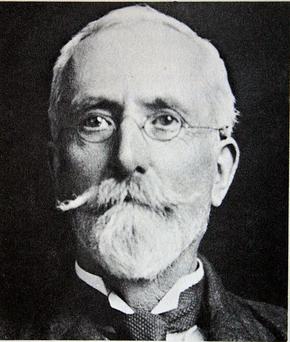
Sir David Ernest HUTCHINS [27516]
- Born: 22 Sep 1850, Shoreditch LND
- Baptised: 26 Oct 1850, Christ Church Streatham Hill LND
- Marriage (1): Violet Beatrice WALKER [27517] on 15 Jan 1891 in St Mary Bathwick SOM
- Died: 11 Nov 1920, Karori Wellington NZ aged 70
- Buried: Karori Cemetery Wellington

 General Notes: General Notes:
David Ernest Hutchins
Registration Year: 1850
Registration Quarter: Jul-Aug-Sep
Registration district: Shoreditch
London
Volume: 2
Page: 4035
David Ernest Hutchins
Record Type: Baptism
Baptism Date: 26 Oct 1850
Baptism Place: Streatham Hill Christ Church, Lambeth, England
Father: David Hutchins
Mother: Sarah Hutchins
Register Type: Parish Registers
HUTCHINS-WALKER-On January 15, at St. Mary, Bathwick, Bath, by the Rev.Arthur Hutchins, assisted by the Rev. G. Tugwell, Violet Beatrice, youngest daughter of F. J. Walker, of The Priory, Bathwick, Bath, to David Ernest Hutchins, of Knysna, Cape Colony.
David Ernest Hutchins
Age: 40
Birth Year: abt 1851
Marriage or Bann Date: 15 Jan 1891
Marriage Place: Bathwick St Mary, Somerset, England
Parish as it Appears: Bathwick
Father: David Hutchins gentleman.
Spouse: Violet Beatrice Walker
Marriage
David Ernest Hutchins
Registration Year: 1891
Registration Quarter: Jan-Feb-Mar
Registration district: Bathwick Somerset
Volume: 5c
Page: 939
Records on Page:
Name
David Ernest Hutchins
Violet Beatrice Walker
Sir David Ernest Hutchins FRGS 22 September 1850 - 11 November 1920
Hutchins was a British forestry expert who worked around the British Empire .
Educated at Blundell's School and the École nationale des eaux et forêts (National School of Water Resources and Forestry) at Nancy , France . He then joined the Imperial Forestry Service in India , in which he served for ten years, then served for another 23 years in the South African Forest Service , where he recommended that a Forest Service be started in the Transvaal and that certain Mexican pine species, such as Pinus patula , be cultivated. He finally served three years in the British East Africa Forest Service , from which he retired as Chief Conservator of Forests . In 1908 and 1909, he explored the forests around Mount Kenya .
After his retirement, he reported on the forests of Cyprus in 1909 for the Colonial Office , toured the forests of Australia in 1914-1915 for the government of Western Australia , and in 1916 toured the forests of New Zealand to compile a report for the Dominion government. He was knighted in the 1920 New Year Honours.[1]
Brachylaena hutchinsii , a species of African tree in the Asteraceae family, was named after him.
Wikipedia
See further:
<http://www.environmentandsociety.org/sites/default/files/key_docs/eh164_roch e.pdf
SIR D. E. HUTCHINS.
The death is announced by Reuter's Agency as having occurred in New Zealand of Sir David Ernest Hutchins, of Cobham, Kent, an authority on forestry, whose experience was gained in almost every quarter of the Empire. Born in 1850. Sir David Hutchins was educated at Blundell's and the School of Forests at Nancy. For 10 years he served in the Indian Forest Service, and afterwards for 23 years in that of South Africa, and for three in that of British East Africa, where he was Chief Conservator of Forests at the time of his retirement. He had made a special study of the extra-tropical forests of South Africa, and in 1908 and 1909 explored the forests round Mount Kenya. In the latter year he also visited Cyprus, and reported to the Colonial Office on its forestry. In 1914-15. he made a tour through the New Zealand forests for the Government of the Dominion. He was the author of many official reports and other works on forestry, a Fellow of the Royal Geographical Society, and a member of the British Association and the Authors Club. His knighthood was included in the last New Year Honours list. He married a daughter of Mr. Frederic J. Walker, of The Priory, Bathwick, Bath.
Sir David E. Hutchins
Birth Date: abt 1850
Death Age: 70
Death Date: 11 Nov 1920
Death Place: Karori, Wellington
Burial Place: Wellington, New Zealand
Cemetery: Karori.
Obituary
Sir David Ernest Hutchins, 1850 -1920.
The late Sir David E. Hutchins, born on the 22nd September, 1850, was educated at the well-known Blundell's School, Tiverton, England, and after leaving went, when twenty years old, to the famous École Nationale des Eaux et Forêts at Nancy, France, where he gained his diploma in forestry. From Nancy he went to India as Deputy Conservator in Mysore, and spent some ten years in the Indian Forest Service. Here he showed his wide views of forestry in two papers which he wrote on Australian trees in the Nilgiris and on the coastal planting of Casuarina. These papers are still standard works on their subjects. From India he was transferred in 1882 to Cape Colony, where, after some years passed in charge of the Knysna forests, he succeeded Count Vasselot de Regné as Chief Conservator of Forests, and remained until 1905. Sir David's work as a forester in South Africa has received the highest praise from such well-known authorities as Sir W. Schlich, the late Professor Fisher, M. Pardé, H. R. McMillan, and others. Under his regime in South Africa not only was scientific management applied to the remaining indigenous forests, but extensive plantations were made of eucalypts and other exotics, which are now yielding an annual revenue of about £20,000. On his retiring from the South African Forestry Department Sir David was later employed by the British Government to report on the forests of British East Africa, where he succeeded in demarcating reserves, and, among other things, in establishing economic plantations of the Chinese coffin-wood tree (Persea nanmu). He was appointed Chief Conservator of Forests for this territory, and after three years service there he retired from regular Government employment. At various times in his career he was called upon to visit different countries and report on forestry problems. In 1907 he was employed by the Colonial Office to report on the value of the Kenia forests, and in 1909 to inspect the forests of Cyprus. In addition to his experience in India, South and East Africa, Sir David during several visits had gained an intimate knowledge of the forests of Algeria, Italy, Spain, Portugal, Belgium, France, and Germany. Sir David came out to Australia in 1914 with the British Association for the Advancement of Science, and remained there to study forestry in that land. Whilst in Australia he wrote a valuable book on Australian forestry, A Discussion of Australian Forestry, with Special Reference to the Forests of Western Australia (1914-15), and by his persistent advocacy stirred up such an interest in the matter that in all the various States of the Commonwealth Forestry Departments are now firmly established. In 1916, on the invitation of the Government, Sir David Hutchins came to New Zealand to report on forestry in this Dominion, and it was mainly on his advice that it was decided to establish forestry as a separate and independent State Department here. He was also the original promoter of the New Zealand Forestry League, as he recognized that some such body is essential to sustain the interest of the public in a matter which, unfortunately, is liable to be thought to concern our successors more than ourselves. Whilst in New Zealand Sir David devoted the whole of his time to the study of forestry in this country, and when not in the field inspecting native forests and plantations he was writing on those matters. Before his death the Government had published his Report on the Waipoua Kauri Forest (1918), and Part I of Forestry in New Zealand (1919), and up till the time that he passed away he was engaged in writing Part II of this latter work. For forestry in the British Empire probably no one has done such service as Sir David Hutchins, and it was for this that he in 1920 received the honour of knighthood, which, in connection with forestry, had previously been conferred only on three official heads of the great Indian Forest Service. His published works were numerous, including, besides those mentioned above, Report on Transvaal Forestry, 1903; Report on Rhodesia Forestry, 1904; Extra-tropical Forestry, 1906; Forests of Mount Keria, 1907; Report on Forests of British East Africa, 1909; Cyprus Forestry 1909; and others. He died at his residence, Khandallah, on the 11th November, 1920.
E. Phillips Turner.
Transactions and Proceedings of the Royal Society of New Zealand
1 Jan 1921 Page 15.
Research Notes:
A Footnote to this man's life is his effect on the small nation of NZ where he died, sadly too young aet. 70.
Sir David Ernest Hutchins work, with the support of a senior NZ politician Francis Bell led to the formation of the NZ State Forest Service and the Forests Act of 1921.
In the 1920's and during the 1930's depression, the NZ Govt put 1000's of the unemployed and prisoners to work planting trees. Particularly in the central Nth Island where a cobalt deficiency in the volcanic soils precluded rearing livestock.
The biggest forest was Kaingaroa which at its peak was the largest planted exotic forest in the world, over 3000 sq km
It is almost certain David Hutchins can be thanked for that inspiration and for the predominant variety chosen, pinus radiata, which he recommended. His legacy almost 100yrs later, a $5b industry (2018) on near useless land.
E L Fenn
Other Records
1. Census: England, 30 Mar 1851, Lambeth Brixton SRY. David is recorded as a son aged 6 mths born MDX LND
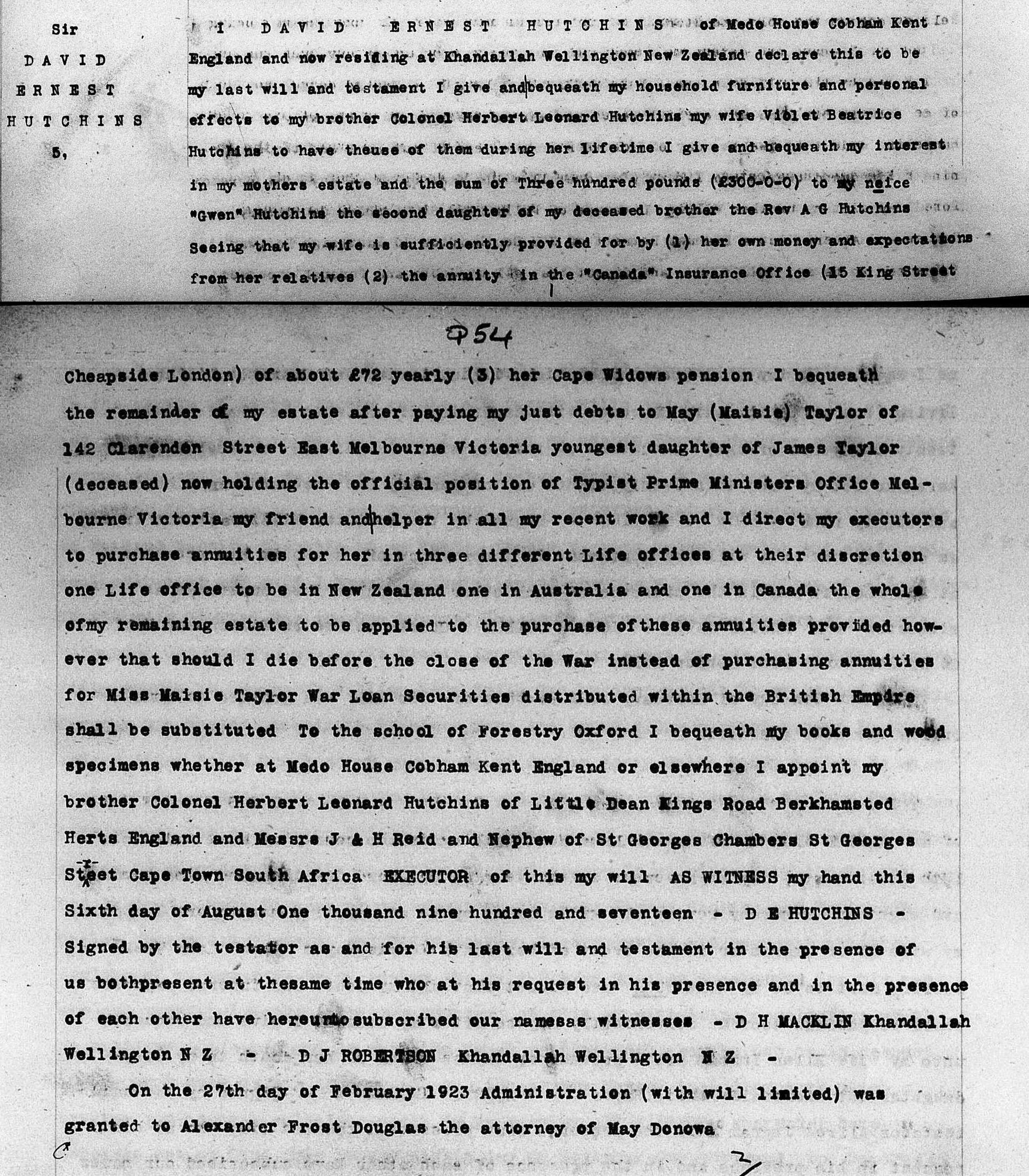
2. Davis Ernest Hutchins: Wll, 6 Aug 1917.
3. David Ernest Hutchins: Courtesy of Shelia Wilson, 2018.
THE HUTCHINS FAMILY
DAVID ERNEST - The Forestry Man
The 'Register of Sarah and David Hutchins' children' begins: "David Ernest Hutchins
born on Sunday 22 September 1850 at 7.22 a.m. at 7, King St, Finsbury Square and
christened 26 October at Christchurch, Tulse Hill." This entry is written by his proud
father who, having married comparatively late, was then aged 39 and a successful
wine merchant in the City. David and Sarah (nee Page) had married the previous year
on 19 July 1849 at Mortlake, Surrey but had obviously known each other for at least
six years as, in 1843, Sarah's elder sister, Annie, had married one of David's elder
brothers, John. Both girls were the daughters of George Page who had been butler to
the Marquis of Tweeddale at Yester House, Gifford, East Lothian from about 1821-
1841 so the girls were brought up in Scotland. It is not known how the families met
but John, a surgeon, may have studied in Edinburgh for a period and met Annie there.
David and Sarah lived at his previous address, Craven Cottage, Tulse Hill, after their
marriage so it is not known why their first son was born in London rather than at their
home which is given as their address when he was christened the following month -
although named David Ernest he was always known as Ernest in the family. When he
was 18 months old his sister, Frances, arrived followed by a brother, Arthur, in
December 1853. Shortly after this birth the family moved to a much larger house at 33
Albert Square, Stockwell where the three younger children were born and the family
lived happily until his father's early death in 1859. Ernest was only 8 years old when
he suddenly became 'the man of the family' and was probably the only one of the six
children who could really remember their father. The following year they moved to
Bath and a new chapter in their lives began.
In the 1861 Census the family were living at 4 Seymour St in the Walcot area of Bath
with two servants, both named Mary, who had probably come with them from
London. The children went to local schools but in October1864 Ernest started as a
boarder at Blundell's School in Tiverton, Devon, where he remained for the next three
years. After leaving in June 1867 he then prepared to sit the entrance exam for the
Indian Forest Service. This he passed (at the second attempt) in November 1869 \endash
finishing fifth out of 85 candidates \endash but it is not known what attracted him to the
forest service in the first place. He then attended the highly regarded School of
Forests in Nancy, France, and also a course of forestry instruction in Scotland and,
after completing his studies satisfactorily in Sept 1872, he signed his Covenant of
Appointment to the Indian Woods and Forests Department \endash so starting what was to
be a lifelong career in Forestry which culminated in a Knighthood in 1920!
After ten years in India, where, from 1875, his brother Bertie was also stationed, his
promising career as special assistant to the Inspector-General of Forests was cut short
by a recurrence of severe malaria, contracted during his early years in the lowland
forest of Mysore, and in 1883 he was seconded to the Forest Department of Cape
Colony, South Africa on a temporary three-year transfer which he regarded as a
chance to recover his health in a non-malarial climate. In the event he ended up
spending the next 23 years in South Africa - followed by four in East Africa before
officially retiring on 11 April 1911.
1
An excellent booklet entitled "David Ernest Hutchins: A pioneer in South African
forestry" by Wm Kevin Darrow was published in October1977 as Bulletin 55 of The
Department of Forestry in Pretoria. This gives a full account of his career and a
selected Bibliography of his numerous publications. I have been in touch with Kevin
who told me that his office in King William's Town was in the same Forestry Office
building that DEH had used and he had also surveyed the same forests first cruised by
DEH in the 1880s so felt an affinity with him!! The booklet also relates several
apocryphal stories about him some of which my father had also told me - so there
must be some truth in them! One I even heard from my father-in law, Alan Wilson,
whose version was as follows:
"Hutchins was for a time senior forestry officer to Tom Sims who later became
Conservator of Forests for Natal and was married to my aunt Maggie Wilson. On one
occasion he spent the night in their house \endash I think in Pietermaritzburg, a hot stuffy
town in a hollow \endash where Aunt Maggie was very proud of her feather beds! Hutchins,
who was a 'fresh air fiend', woke up during the night feeling suffocated and felt
round in the dark for a window to open but, failing to find how to open it, he picked
up his boot and smashed it before going back to sleep in the 'fresh air'. In the morning
the wardrobe mirror was found in fragments \endash Hutchins was not asked back as a
visitor!!"
Ernest was, by all accounts, a likeable if somewhat eccentric character. Those who
knew him in South Africa admired his quick mind, boundless energy and his deep
interest in forestry and living things. He liked people and was liked in return despite
his quick temper and sometimes biting comments. In the Department of Forestry's
official record of his career it says "Hutchins showed himself to be a man of
outstanding ability who had the quality of inspiring colleagues and subordinates with
his enthusiasm and drive." Praise indeed!
The story of him and my grandfather (the lark and the owl) meeting on the stairs
during the small hours ( Ernest getting up and my grandfather going to bed!) has been
told in the Chapter about HLH but, from that same visit to Berkhamsted, Dad
remembers being most impressed by his Uncle Ernest's method of packing \endash at the
end of his stay he simply put his sheet on the floor and emptied the contents of his
drawers on to it before tying the ends up and putting it in his trunk!!
After Ernest had been working in South Africa for about six years, mainly in King
William's Town, he was selected to visit and report on the forests of West Virginia in
1889 and on the forests of south Germany in 1890. During this long sabbatical leave
he also found time to get married before returning to S. Africa! His bride was Violet
Walker, youngest d/o Frederick J. Walker of Bath, who he may have met on previous
'home leaves' when his mother lived near Bath. At the time of his marriage he was
41 and she was 26. Shortly after his return he was transferred to Cape Town as
Conservator of Forests for the Western Conservancy and a consulting officer to the
Department of Agriculture. Here he and his wife had a splendid home (designed for
them by the architect Herbert Baker who became their neighbour) in Muizenberg
overlooking the Indian Ocean, an area where Rudyard Kipling spent several winters
around the turn of the century. In 1899 he returned to England and spent nine months
at Kew where a tree, Brachylaena hutchinsii, is named after him. His time in the Cape
was the most rewarding in his career during which he wrote some of his best articles
2
and reports but also, latterly, managed to rub a few people up the wrong way which
led to him being passed over when the first appointment of a Chief Conservator of
Forests for the Cape Colony came up in 1904. This was a disappointment but he
remained in the Cape in various positions for a few more years. During this time his
eldest nephew, Arthur's son Ernest Elwyn Hutchins, came out to join him intending to
follow in his uncle's footsteps and when, in 1906, he was appointed by the Colonial
Office to report on the forests and forest department of British East Africa, as Kenya
was then called, he took Elwyn along as his assistant. His reports must have been
favourably received because, in June 1907, he was appointed Chief Conservator of
Forests for British East Africa and Uganda \endash a position that he delighted in and where
he remained until his retirement in 1911. During his time in East Africa he was asked
to visit Cyprus on his way to England (on leave) in 1909. He spent about two months
on the island and wrote another 'interesting and well-illustrated report' reviewed in
the Quarterly Journal of Forestry. Elwyn was working under him during his time in
Kenya and said that his uncle, known locally as 'Timber toes', was among the first
Europeans to have climbed Mt Kenya despite being almost 60 years old!
Ernest officially retired on 11 April 1911 but did not leave Africa until later in the
year when he returned to England and, for the next couple of years, lived with his
wife in semi-retirement at Medo House in Cobham, Kent. Before they found Medo
House they had rented Rectory Cottage at Ridley, a small village not far from
Cobham and it was here, while on a visit to them, that his youngest sister, Blanche,
died of a heart attack in November 1912 aged just 52. Ernest registered her death and
wrongly recorded her age as 50 so he was obviously upset at the time. This sad event
was followed nine months later by the death of his brother, Arthur, and it was
obviously around this period that Dad remembers his visits to Berkhamsted. During
this time he also had a trip to the Canary Islands and several forestry-related trips to
Europe \endash probably without his wife who must have been busy with the move to Medo
House where he doesn't seem to have spent much time!
His 'retirement' was short-lived as he was invited to join a tour to Australia with the
British Association for the Advancement of Science. He left England on 7 May 1914
on the SS Ceramic bound for Melbourne for what should only have been a few
months but shortly after his arrival he was asked, by the State government of Western
Australia, to do a survey of the forests there. He accepted this invitation and spent six
months travelling all over Australia before writing his report which was published in
1916. By this time war had broken out in Europe so he was in no hurry to return
home and, in October 1916, he went instead to New Zealand, at the request of the
Government, to inspect their forests. This invitation was in the expectation that it
would be a quick inspection (4-6 weeks) and a short report for which he was offered a
railway pass and a per diem amounting to about £100. He had said that he was on his
way to Japan to look at forests there but this never happened, presumably because of
wartime travel restrictions. On his arrival at Auckland he surprised officials by
delaying his journey south in favour of a tour of the Waipoua Forest \endash one of the last
large blocks of indigenous Kauri forest. He spent from 23 October to 27 November
there mainly engaged in forest demarcation work (resulting in a report published in
1918) He then moved south and, using Wellington as his base, started travelling all
over the country, visiting forests, assisting local conservation groups and lecturing on
the value of forestry to the nation. When not travelling he was writing and his book
New Zealand Forestry. Part I was published by the Government in 1919. Most of this
3
information came from Professor Mike Roche of Massey University, NZ who has sent
me much information from various reports he has written about DEH's contributions
to New Zealand Forestry and his latter years During his career of almost fifty years
he had written and spoken in both official and public circles and finally, on 1 Jan
1920, his dedication was recognised when he was appointed Knight Bachelor for
services to Forestry in the British Empire \endash the first British-born forester to be so
honoured. He was also a Fellow of The Royal Geographic Society.
Sadly he did not enjoy his new status for long and was never to rejoin his wife \endash now
a 'forest widow' for many years. During 1920 his health broke down and he was
unable to travel or do much writing but remained at his home in Khandalla,
Wellington, where he died on 11 November. His death was caused by a recurrence of
malaria followed by influenza leading to toxaemia according to his death certificate.
He was buried at Karori Cemetery nearby on 13 November where a splendid
gravestone, featuring a Kauri tree, was later set up in his memory. Mike kindly sent
me a photograph of this.
When his will was proved in 1923 his estate was worth £1346-16s-10d. He left his
household furniture and personal effects to his remaining brother, with the proviso
that his wife was to have their use of during her lifetime. He left a legacy of £300 to
his unmarried niece, Gwen Hutchins, and bequeathed all his books and wood
specimens to the School of Forestry at Oxford University. The rest of his estate he
bequeathed not to his wife, who he explained was already sufficiently provided for in
various ways, but to May (Maisie) Taylor of 142 Clarendon St, East Melbourne
youngest daughter of James Taylor (deceased) now holding the official position of
Typist, Prime Minister's Office, Melbourne 'my friend and helper in all my recent
work'. This will was signed on 6 August 1917 in Khandalla, Wellington naming his
brother in England and his solicitors in Capetown as executors. Administration of the
will was granted on 27 Feb 1923 to Alex F. Douglas the attorney of May Donowa. I
recently contacted some of Maisie's descendants who told me that she had married in
1922 and later built a fine stone cottage in Bankstown, NSW called "Khandalla" but
they never knew where her wealth came from! After she was widowed in 1948 she
visited England on her own in 1949. This was just one month before Ernest's wife,
Lady Violet Hutchins, died and I wonder whether she had hoped to meet her? Lady
Violet had remained in the Cobham area but moved to the nearby village of Shorne
where she lived at 'Bleak House'. I remember Dad taking us to visit her there in
1946, when we were living in Gillingham for a few months (when I was 11) so the
family were obviously keeping in touch with her. It was a lovely old house and we
were served cucumber sandwiches and cake by her maid \endash I feel she wore mauve but
that may be just a name association? As our grandfather died only five years after
Ernest he of course never inherited anything from this will! Ernest and Violet had no
children so his legacy was his lasting work in forestry publications throughout the
British Empire and beyond. Although he spent little time in England he was
remembered affectionately by his nieces and nephews and by all accounts was an
unforgettable 'character' \endash I'd like to have met him!
Sheila Wilson,
Moseley, Birmingham.
Copyright© 2018 Sheila Wilson
David married Violet Beatrice WALKER [27517] [MRIN: 5028] on 15 Jan 1891 in St Mary Bathwick SOM. (Violet Beatrice WALKER [27517] was born circa 1868 and died after Nov 1920.)
|